
‘ARCTIC summers ice-free by 2013’ (BBC, December 2007)
‘Arctic Is Screaming: Global Warming May Have Passed Tipping Point’ (Fox, December 2007)
‘Arctic expert predicts final collapse of sea ice within four years’ (Guardian, September 2012)
‘Arctic ice cap in death spiral’ (Times, September 2014)
‘Arctic could become ice-free for first time in more than 100,000 years’ (Independent, June 2016)
According to the so-called scientists, all the summer sea ice in the Arctic should have melted away years ago, as the above sample of headlines assured us.
Yet the sea ice extent hit its minimum for the year early this time, on September 10, about a week earlier than normal, with an area of 4.6million sq km, which is higher than the 2011-2020 average and higher than 2007.
There was a lot of ice loss in 2007, mainly due to ocean currents pushing ice southwards into the Fram Strait, which connects the Arctic Ocean to the Atlantic between Greenland and Svalbard. That ice quickly melted when it hit warmer seas.
Since 2007, however, ice extent has remained remarkably stable, making a nonsense of the alarmist claims made at the time.
One of the biggest proponents of these scare stories was Professor Peter Wadhams of Cambridge University, gushingly described by the Guardian as one of the world’s leading ice experts. It was his predictions that were behind those last three headlines.
Far from apologising for getting it so badly wrong, Wadhams has simply doubled down, insisting he was just a bit premature and promising that the ice will still disappear in the near future.
Wadhams and his co-alarmists committed the cardinal error of taking a small sample of data, in this case a couple of years, and extrapolating trends from that.

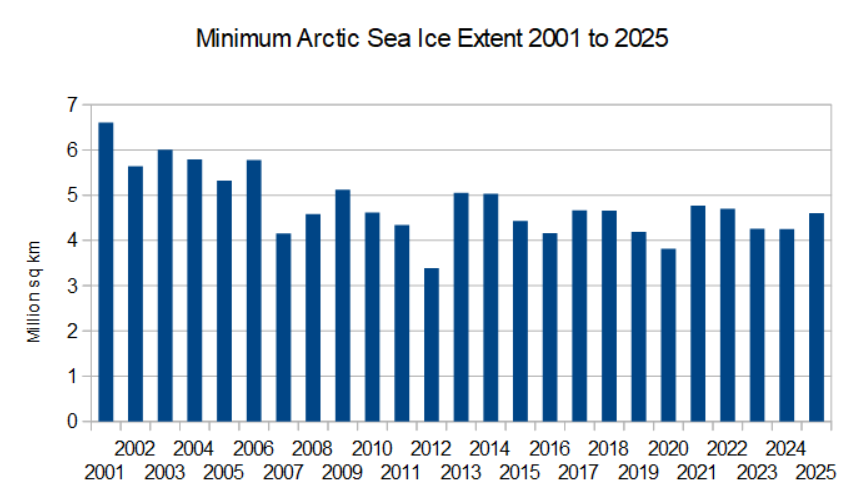
The satellite data we have only goes back to 1979, which marked the end of the coldest era in the Arctic since the 19th century, making Wadhams’s claims even more absurd. Although there was no satellite data at the time, there is a wealth of evidence that it was as warm around the Arctic between the 1920s and 1950s as now. We also know that sea ice expanded substantially in that cold period between 1960 and 1990.
Proper Arctic scientists have long known about these longer-term cycles. So why did the Arctic alarmists ignore them and instead peddle their fake scare stories?
Going further back, of course, there is considerable evidence, both historical and scientific, that the Arctic was at least as warm as now in the Middle Ages and earlier, before temperatures plunged and ice expanded during the Little Ice Age.
The Arctic regularly goes through warming and cooling cycles. It has nothing to do with fossil fuels.
China to cut emissions? Don’t hold your breath
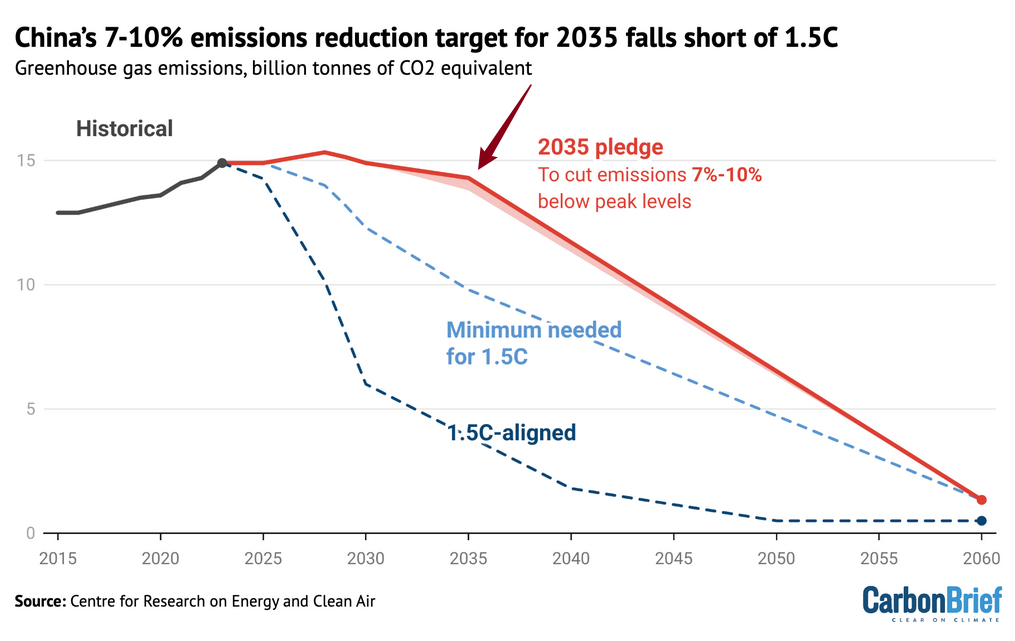
PRESIDENT Xi pledged at the UN last week that China would soon start cutting emissions of greenhouse gases. Under the new plan, emissions would be 7-10 per cent lower by 2035 relative to the year of the country’s peak emissions, believed to be 2025.
Even if they achieve these cuts, it will only bring emissions back to 2022 levels. Hardly surprising then that the green blob have dismissed Xi sop as ‘too weak’.
https://www.carbonbrief.org/qa-what-does-chinas-new-paris-agreement-pledge-mean-for-climate-action/
The Chinese have also said that they will count land use and forestation towards emission cuts. For instance, the plan specifically targets a near doubling of forest stock. Growing new forests may take CO2 out of the atmosphere, but as soon as they are grown that saving disappears and we are back to square one. That is why green lobbyists insist that the only answer is to stop burning fossil fuels completely.
In any event, it is easy to fudge the numbers around land use. China can easily fiddle the numbers to ‘show’ emission savings, while still burning coal and gas. Meanwhile, Xi will not be in power much longer, and whoever replaces him will probably tear his plan up. This is the way Chinese politics works.
The only other concrete target in China’s plan is to increase wind and solar power capacity from 1500 to 3600 GW by 2035. This might sound impressive, but it will only increase the share of wind and solar in the total energy mix to maybe 8 per cent, which is much less than the UK already achieves.
None of what Xi has said is ‘planet saving’ or anything that was not already on the cards. It is no more than political theatre, designed to impress the West and encourage them to further damage their economies.