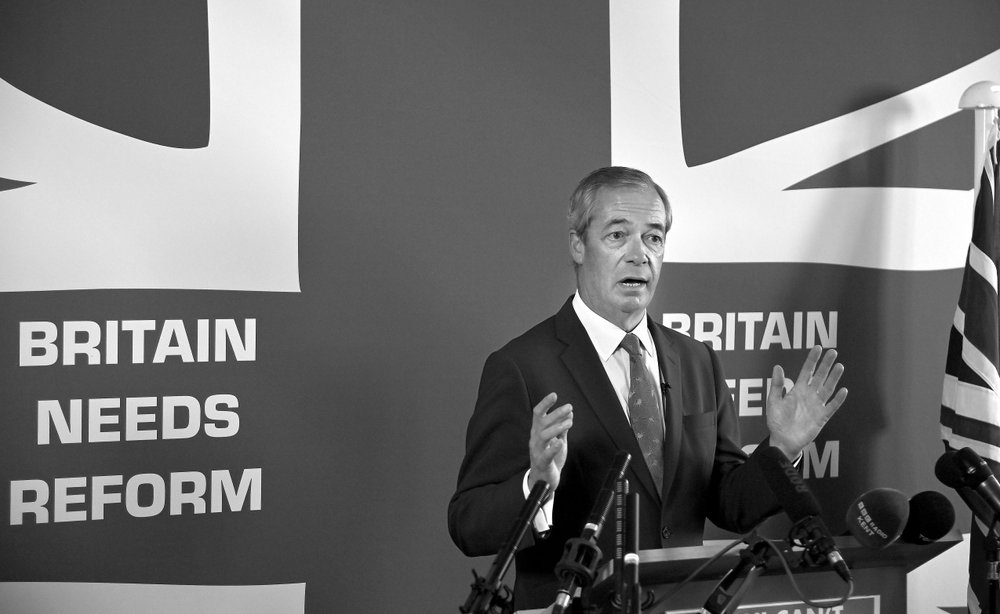
IN WHAT might prove a harbinger of a nightmare scenario for Reform UK, the Times is reporting that eight Reform UK councils are likely to raise tax next year, telling us that ‘despite Nigel Farage’s promises to cut waste and “save a lot of money”, senior officials have now admitted they will likely have to resort to tax rises’.
The inability to deliver is hardly surprising as local government has long since lost any semblance of independence and is largely an implementation agency for central government with most of its spending mandated by statute; chronic underfunding gives even the most frugal of councils very little scope for reducing council tax.
This puts Reform in a bind. To suck votes from the ‘uniparty’ system it has to show that it is different. But if once elected its politicians turn out to be the ‘same old, same old’, indistinguishable from those they have displaced, the party’s electoral appeal may be seriously damaged.
For local government, this might not be too problematic. Expectations tend to be low, as do turnouts. The wave of antipathy toward the established parties will probably provide enough momentum to enable Reform to survive the disappointment, certainly through the next round of local elections.
General elections are a different kettle of fish. Expectations will be higher, the audiences more critical and memories longer. Reform will have to get its offer just right for, while extravagant or unrealistic policies might pull in the votes first time round, if the party fails to deliver, it could be savaged in the following election and disappear into obscurity as rapidly as it initially rose to prominence.
Insofar as history provides any guide, some note may be taken of the early performance of the Labour Party. Founded in February 1900, it was not until January 1924 that it formed its first government – with the support of the Liberal Party.
Riven by policy disagreements, especially over foreign affairs and economic issues, and wholly out of its depth when it came to dealing with the major issues of the day – unemployment and industrial unrest – it was further weakened by a number of scandals, collapsing in the October after a vote of no confidence, having lasted less than a year.
Any parallels will never be absolute, but the history provides enough of a warning to suggest that if Reform is successful in the 2029 election, it will need a carefully crafted and credible plan of action if it is to survive its first term.
Its planners also need to realise that their ambitions must be realistic. I recall some time back listening to an interview with the veteran Labour cabinet minister Margaret Beckett, reflecting on her 45 years in politics and her time in government.
What stood out was her confirmation that making major changes to policies and the way we are governed is an extremely arduous process with endless barriers. Therefore, she cautioned, any government that seeks to make progress is best advised to concentrate its resources on two or three things, at most, otherwise it risks achieving nothing.
This is advice that Farage should heed, but it also puts into perspective the grandiose plan published by Rupert Lowe’s Reform Britain think-tank on mass deportation. While it is certainly ambitious, there are far too many moving parts for it to succeed within one or even two parliamentary sessions, even if the proposals were realistic – which many of them are not.
To achieve anything of note, a newly elected Reform government would have to focus on elements most assured of success, carefully managing the expectations of its electorate.
In dealing with the high-profile issue of illegal immigration, Reform is largely at one with the Restore Britain report, pledging to denounce the ECHR and to disapply the UN Refugee Convention and any other relevant treaties.
Pete [North] has already written at length on the perils of denouncing the ECHR, warning that the potential consequences could absorb the entire political bandwidth of the first term in office, leaving the party facing re-election with very little in the way of achievements
If it intends to add to this not inconsiderable burden by also disapplying the Refugee Convention and related measures, the consequences, as I warned in an earlier post, could be so severe that the repercussions could be uncontrollable.
With that in mind, I suggested that any government embarking on this path would need to take extensive measures to mitigate adverse effects, undertaking a round of diplomacy before any unilateral action is taken.
No sooner said (or written) than we see in the Times an article headed: ‘UN Refugee Convention “is next target” in fight to deport migrants’, with the sub-head telling us that: ‘The attorney general has said the status quo no longer works for Britain’ and is thought to believe the Refugee Convention must ‘evolve’.
This is the infamous Lord Hermer, who has told his staff that although ministers would continue to ‘support the international rules-based order’, treaties must ‘evolve’ to stop the system being abused. He is said increasingly to believe that Britain should not only reform the ECHR but should also look at the Refugee Convention and its restrictions which prevent the return of asylum seekers to their countries of origin. Unwilling to forgo international alliances – which would be one consequence of unilateral action – Hermer is in favour of leading the charge on the international stage to reform the Convention in Britain’s interest.
This is more or less the line that I would propose to take although, when it comes to leading the charge, Hermer might already be too late. Less than three weeks ago, in an event almost completely ignored by the UK legacy media, the Trump administration unveiled a plan radically to reform the global system for asylum seekers and refugees.
This was deputy secretary of state Christoper Landau speaking on September 25 in New York to a panel with the working title of ‘The Global Refugee and Asylum System: What Went Wrong and How to Fix It’.
His speech is far too long to summarise adequately but is a thoughtful commentary that bears reading in full. The Washington Post, however, tells us that Landau outlined a number of proposed changes, including that nations should have no obligation to open their borders to asylum seekers or consider for refugee status those who enter a country illegally; that there should be ‘no right’ for an individual to receive refuge or asylum in a country of their choice; that refugee status must be temporary, not permanent, and that sovereign states should be allowed to make decisions on when and where they can deport people.
Needless to say, the proposals have not been universally well received, with the usual suspects, including Amnesty International, leaping to the defence of the status quo. More recently, the UNHCR head Filippo Grandi has entered the fray, declaring that bowing to pressure to reform the refugee convention and asylum system would be a ‘catastrophic error’. This is only to be expected, although the Trump administration is inviting other nations to join in its quest for reform, with representatives of Bangladesh, Kosovo, Liberia and Panama joining Landau’s panel, and several indicating their support.
What all this tells us is that there is already a vibrant debate in progress on the reform agenda, and rather than banging out what amount to ‘little England’ tracts of dubious worth, UK advocates and campaigners might find it more profitable to join that debate and help build an international caucus to work on the problem.
Spencer Chretien, a senior state department political appointee, has already said that the United States intends to convene interested nations over the coming months to ‘develop and formalise new principles that reflect today’s realities’, and if Starmer’s government is not represented in that group, Reform – as a government-in-waiting – should certainly attend.
We are far from being alone on this issue, with Richard Gowan, United Nations director for the International Crisis Group, saying that ‘Trump has found a very powerful wedge issue, and a lot of populist leaders will rally to this cause’. He thinks the US ‘could inspire a lot of states to treat their international legal obligations around asylum as dispensable’.
We need to be one of those states.
This article appeared in Turbulent Times on October 11, 2025, and is republished by kind permission.