MOST of us know, even if we wish we did not, what an Islamic terrorist attack looks like.
We know that a long list of Islamic terrorist killers have used stabbing attacks to target civilians, and we know the difference between those and gang battles over drug turf or assaults related to mugging and theft. The most recent terrorist attack in the UK was exactly this – a Muslim immigrant attacking a Jewish synagogue and randomly hacking and slashing at innocent civilians (the Manchester synagogue attack by Jihad al-Shamie and accomplices on October 2).
A previous attack followed the exact same pattern. On July 29, 2024, Axel Rudakubana murdered Alice da Silva Aguiar, six, Elsie Dot Stancombe, seven, and Bebe King, nine, as well as attempting to murder ten other people, including eight children and two adults. Around 2015, a wave of such stabbing terrorist attacks surged, particularly in France. In Britain, Wednesday was the fourth anniversary of the Islamic terrorist stabbing murder of Sir David Amess, an MP in a constituency near where I live.
Most of us think of these things when we think of terrorism: stabbings, bombings or shootings targeting unarmed and defenceless civilians. To distinguish such attacks from those motivated solely by insanity or by some personal grudge or conflict, we also look for a political, religious or ideological motive, especially one that can be confirmed by evidence such as materials from terrorist organisations, terrorist literature, or training and contact with known terror organisations. Both the nature of the attack and its targets, and the accompanying evidence, is supposed to rationally tell us whether this was terrorism.
And there is the Prevent strategy. This was introduced by the Blair government of 2003 as a response to 9/11. It’s supposed to identify radicalisation, spot and monitor dangerous individuals who may be terrorists, and train and instruct various agencies and police and security services on the signs of terrorist activity. Prevent documents define what the authorities think terrorism is, how they try to spot it, and how they try to monitor and prevent it. It’s supposed to allow people to refer dangerous individuals to the police and security services.
It defines the entire counter-terrorism strategy of the British state at its most vital juncture by claiming to spot terrorists before they strike. Seven thousand people a year are referred to Prevent investigators, and more than 31,000 cases have been assessed since 2019.
More than 90 per cent of referrals elicit ‘no further action’. But there are also more than 40,000 people on terror watch-lists, often people first identified by Prevent. So it’s pretty important that Prevent guidelines are accurate and sensible, which they aren’t.
The Southport killer targeted the most innocent civilians imaginable. He wanted to provoke as much terror as possible. He stabbed each of his victims multiple times. He stabbed children. He tried to behead his victims. He had an Al Qaeda terrorist training manual and stores to develop ricin poison gas in his flat.
Police at the time concealed the details of the contents of his home. They also provided few details about the attacker. The BBC said: ‘One thing was made public early on – it was not being treated as terror-related by the authorities.’
The police later said they would have been happy to declare the murders as a terrorist attack but were unable to find any supporting ideology.
The Southport inquiry has since revealed that the killer’s parents are Christians and that the police also wanted to reveal this to combat ‘disinformation’ but were advised against it by the Crown Prosecution Service.
There is a certain logic to assuming that because Rudakubana’s parents are Christians then he is too. Because nobody ever has different views or joins a different faith from their parents, do they? Nor does anyone ever change their religion. Nor do people ever pick up ideas from somewhere else when they are radicalised . . . such as from Islamic terrorist training manuals they own.
Presumably most devout Christians copy Islamic beheadings and have Al Qaeda training manuals, according to this logic. Perhaps that’s more common in Rwanda; Rudakubana’s father’s life was touched by the genocide of 1994 (the whole basis for his being offered asylum in the UK).
Axel was a second-generation immigrant.
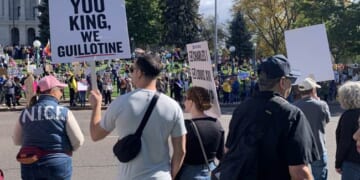
Remember, people were persecuted for speculation about his immigrant status and his faith if combined with rhetorical responses taken as ‘hateful’. Mainstream media went on a hunt for such posts and accounts.
When public anger led to Sir Keir Starmer being heckled at a brief appearance he made at a memorial service, Politico wrote an article about ‘far right thugs hijacking’ the event.
The Independent ran the headline: ‘Former security minister raises concerns Putin behind far right Southport disinformation’.
Sky News went with: ‘How the far right hijacked Southport protests and Southport attack disinformation fuels far right discourse on social media’.
CNN gave us ‘UK rocked by far right riots fuelled by online disinformation about Southport stabbings’.
Throughout the second half of 2024 mainstream media produced hundreds of articles and opinion pieces about the ‘far right’ and about ‘disinformation’.
The articles on the reaction to the attack outnumbered the articles on the attack itself. Some mentioned the flat evidence when it emerged, primarily in passing or in relation to the inquiry.
There were, of course, no major articles questioning whether the killer considered the Islamic terror training manual he owned significant, or whether it was significant that he owned it. There were, so far as I am aware, no mainstream media articles heavily criticising Prevent and its failures to identity Rudakubana as a potential terrorist.
Conduct an AI search now on Southport ‘disinformation’ and you get this: ‘A co-ordinated disinformation campaign falsely portrayed the 17-year-old suspect as a Muslim, undocumented immigrant, or refugee, despite no evidence supporting these claims. This narrative was rapidly amplified by far-right influencers and networks across social media platforms, including X (formerly Twitter), Facebook, TikTok, and YouTube, where over 27 million posts related to the incident were analysed. Prominent figures such as Tommy Robinson, Andrew Tate, and Laurence Fox played a significant role in spreading these false claims, with Robinson and Fox sharing content that falsely linked the attack to immigration and calling for border closures. The disinformation was not isolated; it was part of a long-running strategy by far-right groups and hyper-partisan media, including GB News, to exploit pre-existing anti-immigrant sentiments.
‘The false narrative was strategically planted and nurtured before the incident, creating a receptive environment for rapid amplification during the crisis. This disinformation was further amplified by international right-wing influencers, notably Elon Musk, whose ownership of X allowed previously banned accounts like Robinson’s and Tate’s to be reinstated, facilitating the spread of harmful content. A post by Eddie Murray on LinkedIn, which falsely claimed the attacker was from Africa and on MI6 watch, was reposted by Laurence Fox and viewed over 500,000 times, significantly contributing to the spread of the false narrative. The consequences were tangible, leading to nationwide riots, attacks on mosques, asylum centres, and refugee hotels, with 53 police officers injured and significant property damage. The UK’s regulatory framework, including the Online Safety Act, has been criticised for failing to address the systematic manipulation of online discourse that enables such narratives to gain power. The co-ordinated effort by far-right actors, combined with algorithmic incentives on social media platforms that reward outrage and engagement, created an ecosystem where disinformation could rapidly escalate into real-world violence.’
Yet nobody has ever supplied any evidence that the right-wing figures mentioned above co-ordinated their responses, or that right-wing responses generally were ‘strategically planted and nurtured’. This is all mainstream conspiracy theory.
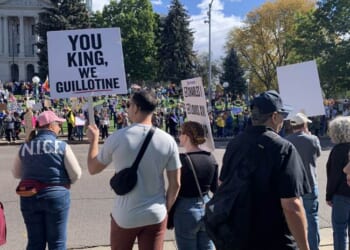
Of course far more people have criticised the Online Safety Act and the draconian crackdowns and censorship of right-wing content in the UK than have praised it. But by the circular logic of their own enormous bias the larger number of people worried about censorship of commonly held opinions automatically become far right terrorists too. This is especially the case if they are at either end of the social spectrum: powerless enough to be demonised or imprisoned for thought crimes (angry white people of working-class backgrounds) or powerful or popular enough to be a threat to progressive political control and authoritarianism.
Before the murders, Rudakubana was dismissed as not being a terrorist threat, despite having been referred three times to Prevent between 2019 and 2021 because of his obsession with violence. Then he murdered three children in a knife attack mirroring multiple Islamic terror attacks.
You would think that the media and the Government, if they wanted to prevent terrorist attacks, would have spent much more time looking at this failure than in responding hysterically to the conspiracy theory that a vast far right network (driven by Laurence Fox and Lucy Connolly) strategically marshalled all those other people who said: ‘This looks like Islamic terrorism to me.’
Now, instead of finally drawing the very obvious conclusion that, Islamic or not, the Southport killer showed terrorist intent and behaviour, the Southport inquiry doubles down again, concluding he wasn’t a terrorist. This is same conclusion that let him commit his attack in the first place.
Why? Well, admitting he was a terrorist would mean admitting that the people the state arrested and imprisoned were right, as would admitting that non-terrorist Christians don’t possess Islamic terror manuals.
Everything Rudakubana did was textbook Islamic terrorism. But it’s not terrorism. And it’s not Islamic. It’s a Christian with mental health issues. Don’t think about the contents of his flat.
According to Prevent, thinking that Western civilisation or the UK is threatened by mass immigration is indicative of a terrorist mindset. So essentially more than half the country are terrorists, according to the anti-terrorism strategy our police and security services work from.
Yet to this lot, the killing of three little girls in a savage knife attack after reading an Al Qaeda training manual isn’t terrorism.
With a watchdog barking so uselessly up the wrong tree, ordinary people can hardly be blamed if they feel so horribly vulnerable and so very angry.
This article appeared in Jupplandia on October 16, 2025, and is republished by kind permission.