Sportswriter Jane Leavy believes that baseball is in trouble, but she also thinks she knows how to fix it. And yet there is a notion that lurks here and there in her new book: Maybe, just maybe, the game is not fixable—at least not fixable in the sense of its ever being restored to its standing as America’s game.
Make Me Commissioner, by Jane Leavy (369 pages, Grand Central Publishing, 2025)
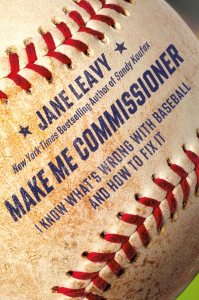 Biographer of the Babe, the Mick, and a non-Yankee pitcher by the name of Sandy Koufax, Jane Leavy has a case to be made that she ought to be appointed to the honorable, if mostly honorific, post of commissioner of what was once America’s game. In the first place, she clearly and deeply loves—and understands—the game, which is more than can be said for virtually every past and present commissioner of baseball, with the singular exception of Bart Giamatti.
Virtually? No one knows precisely what was in the baseball heart of Kenesaw Mountain Landis or Happy Chandler or Ford Frick or General William Eckert or Peter Ueberroth or Bowie Kuhn. Fay Vincent and Bud Selig? Possibly. And hence the “virtually.” Rob Manfred? Strike the “virtually!”
And in the second place…? Is there a need for a second place? Leavy must think so, given her insistence on talking—and therefore writing—like a ballplayer. She doesn’t just quote “f” bombs; she drops them, and not just occasionally, but repeatedly, almost offhandedly.
Leavy’s operating assumption is that baseball is in trouble. Her accompanying assumption is not just that the game can be fixed, but that she knows how to fix it. And yet there is one more assumption that lurks here and there in the book as well. Maybe, just maybe, the game is not fixable–at least not fixable in the sense of its ever being restored to its past standing as America’s game—meaning its unquestioned and unquestionable standing as America’s game.
More than once in these pages she, and others, suggest that baseball is a game that would never have been invented today. It’s a nineteenth-century game trying to survive in our twenty-first century world. It’s too, well, too slow, too pastoral, too timeless, too lacking in action, and too lacking in violent action. In other words, it ain’t football.
Others? Most of the book is Jane Leavy, baseball writer, on the baseball beat. She visits various ballparks, major league and minor league, as well as the Cape Cod summer college player league. She visits with and exchanges ideas with ballplayers forgettable (think pitcher Rich Hill) and unforgettable (think another pitcher, Bill “Spaceman” Lee).
She has extended visits and exchanges with baseball lifers, especially managers Buck Showalter, Ron Washington, and Dusty Baker, as well as the recently deposed Washington Nationals general manager Mike Rizzo.
Curiously, what comes to the surface again and again is something that is not fixable: Baseball is a very hard game to play, and it’s an especially difficult game to play really, really well at the highest levels of competition. Therefore, a would-be ballplayer must be very dedicated to his craft and very driven to succeed, not to mention quite willing, even resigned, to the acceptance of failure. Which may explain why what was once America’s game is losing its hold on American boys.
The two team sports that do have a hold on the youth of America, broadly speaking, are football and basketball. They are not the only sports with such a hold, but they are the only sports that Leavey mentions. What’s missing is another summer outdoor sport, a summer sport that was not part of her youth or my youth, but a summer and fall sport of great interest today: namely, soccer. And soccer, rather than football or basketball, may well be the sport that is attracting those who could be or might be would-be baseball players.
After all, basketball puts a premium on height, and football requires a good deal of heft. Not so with soccer. And not so with baseball. Then there is the not so small matter of parental involvement and interest, both of which might be tied to the difficulty, not to mention the inevitable failures, of playing baseball.
At the end of a soccer game a parent can praise Johnny–or Susie–for the great job on the field, especially since few, if anyone, has a good idea as to what had actually transpired during the game. Besides that, no soccer player had struck out or committed an error. And, therefore, no parent had to console a child for his undisguisable and undeniable failures. But a baseball player who had struck out or committed an error cannot escape having to walk off the field fully aware of such facts of his recent life, and knowing that others knew them as well.
Leavy does devote a good deal of attention to the declining number of black Americans who are playing baseball at the major league level. Here the key factor is less basketball or football than sheer opportunity. And in these pages the key figure, and justifiably so, is one Marquis Grissom.
The fifteenth of sixteen children of a Ford plant employee and his wife, Grissom had an unusual discovery and discoverer. At the age of nine or perhaps ten, he heaved a rock of unknown weight a good, if not exactly known, distance at a car. Whether or not he knew that the car was a police car is also not known. But the policeman who was driving the car knew a potential ballplayer when his car felt one. Hence his offer to the culprit: Join my youth baseball team and I won’t charge you with damaging it. Grissom did, and the rest is history.
That history includes a World Series ring (with his home state Atlanta Braves in 1995), two All-Star games, four Gold Glove awards, 2,251 hits and 227 home runs for six different major league teams. Grissom’s more recent history includes his establishment of the Marquis Grissom Baseball Association shortly after his retirement. The focus of that organization is not just on ballplaying, but on education as well, for the youth of Atlanta.
This feel-good story is the best, but far from the only such story, in this book. Baseball seems to lend itself to such stories. No doubt a sense of nostalgia, or at least a penchant for it, is the culprit here. In fact, nostalgia is on display and at work throughout this book. That would be nostalgia for the game as it was played when a young Jane Leavey, who is now 73, learned to love the game.
Here the culprits are twofold. One is an individual; the other is, for lack of a better word, a phenomenon. The individual brings Leavy back to her reporting roots for the Washington Post. That would be Earl Weaver, manager of the then-nearly-home-town Baltimore Orioles. That would also be the Earl Weaver who believed that managerial success and winning baseball was dependent on three things: good pitching, good defense, and the three-run homer.
And the phenomenon would be… baseball’s succumbing to the inevitable attraction of numbers, as in analytics, as in Sabermatics, as in the Weaver philosophy of winning baseball. It all comes down to power pitching (and blown-out arms awaiting a first or second Tommy John surgery) and power hitting (including lots of taken pitches, lots of walks and little action, and especially little action on the bases).
Moving runners along has gradually become a lost art. And it’s an especially lost art as baseball attempts to become more like football. There was once a time when it might be said that a key difference between baseball and football was simply this: Between snaps in a football game, nothing is happening, while between pitches in a baseball game everything is happening (in the players’ minds and in the fans’ minds). But when everyone is waiting for a bomb, whether that would be a home run or a fifty yard completion… well then, everyone is simply waiting.
The game has always attracted numbers crunchers. But now numbers crunchers are running–and as far as Leavy is concerned–ruining the game. Eyes remain important, but eyes today are being put to use to read numbers, not to observe play and players, and not to look into their eyes.
Bottom-line numbers are important as well, and Leavy does not ignore them. Baseball is currently a major league sport without a salary cap. She has her ideas for what to do, but good luck commish, your sport is run by the big bucks guys. It may well take a strike to change anything, and a strike, perhaps even a long strike, may well be in the offing come 2026 when the current collective bargaining expires.
Speaking of waiting, we’ll all have to wait and see how things turn out. But this much is certain: baseball will not expire. It will continue to evolve, since it has always evolved. Maybe it could benefit from some devolution as well. In fact, none other than Jane Leavey seems to think so. One of her ideas is to extend high plexiglass walls in the outfield, thereby eliminating those high exit velocity, launch-angled, cheap home runs and restore all kinds of doubles and triples. In other words, erect a see-through, non-green, taller than Fenway Park monster from the edge of left field to the edge of right field in every major league ball park.
Hey, it’s an idea. So is this. Maybe the day will come when some team comes up with the notion that it might be a good idea to have one, wizened, clear-eyed, old scout sitting in the stands and later sitting with the analytics crew. Once again devolution, and all in the name of obtaining an edge. Who knows, maybe then baseball will gradually come to its senses, and Jane Leavy will once again be a happy camper without ever experiencing the permanent headache of becoming yet another powerless commish. And to be a powerless commissioner who actually loves the game could produce excruciating headaches.
And if the devolution of the game is ultimately sped along by a very long strike, so be it. More than that, if it also means that baseball never returns to its long-lost standing as America’s game, so be that as well. It was a mistake to try to compete with football in the first place. Jane Leavy realizes that much, even if Rob Manfred probably doesn’t.
__________
The Imaginative Conservative applies the principle of appreciation to the discussion of culture and politics—we approach dialogue with magnanimity rather than with mere civility. Will you help us remain a refreshing oasis in the increasingly contentious arena of modern discourse? Please consider donating now.
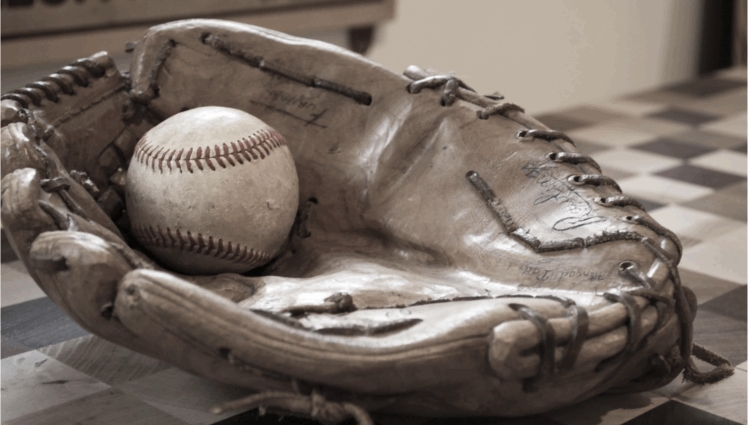
The featured image is courtesy of Pixabay.