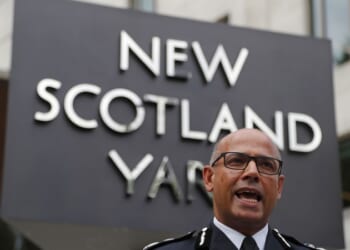
AFTER the Heathrow arrest of writer Graham Linehan over three gender‑critical tweets, the Metropolitan police have announced that they will stop investigating so‑called non‑crime hate incidents and focus on actual offences. That course correction is welcome. It also exposes how far we had drifted toward policing opinion rather than crime. Britain is struggling not to slide into soft totalitarianism. You can see it wherever ‘safety’ becomes the trump card that polices thought and sidelines dissent.
That same safety‑first reflex sits behind two live projects with real free‑speech consequences: the push to define Islamophobia and the plan to criminalise ‘conversion practices’.
In 2019 the All-Party Parliamentary Group on British Muslims proposed a definition that framed Islamophobia as ‘a type of racism’ targeting ‘expressions of Muslimness’. The Government refused to adopt it, warning that conflating race and religion risks confusion under the Equality Act and a chilling effect on legitimate criticism. This year ministers set up an expert group chaired by Dominic Grieve KC to produce wording that targets anti‑Muslim hatred against people without insulating Islamic ideas from critique. Reporting this week points to a pivot away from ‘Islamophobia’ toward a narrower ‘anti‑Muslim hate’ focus with explicit free‑speech guardrails. This is the right direction: Protect people from hostility and violence. Do not create a de facto blasphemy code.
Ministers say they still intend to legislate against ‘conversion practices’, with a draft Bill promised for scrutiny but not yet published. Everyone agrees that coercion and degrading treatment are wrong and already criminal. The fight is over speech and conscience. Professional bodies have built a soft ban by policy. A document signed by more than 25 health, counselling and psychotherapy organisations, the 2017 Memorandum of Understanding, treats efforts to change or suppress orientation or gender identity as unethical and aims to ‘end the practice’. Notably, the UK Council for Psychotherapy withdrew its signature in 2024, citing safeguarding concerns and the need to preserve exploratory therapy, while maintaining its opposition to coercion. The Equality and Human Rights Commission has already urged precision so adults who want help consistent with their beliefs can access it.
Get the drafting wrong and you criminalise a viewpoint. Canada’s C‑4 makes it an offence to cause a person to undergo a practice designed to change orientation to heterosexual or identity to cisgender, and even bans advertising or payment, regardless of adult consent. New Zealand’s 2022 Act includes examples that can capture prayer where the purpose is to change or suppress. This is not neutral safeguarding. It is policing aims and conversations.
Football is the parable everyone recognises. Birmingham’s Safety Advisory Group initially told Aston Villa to host the Europa League tie against Maccabi Tel Aviv with no away fans. The Prime Minister called that ‘wrong’ and ministers said they would provide what was necessary to allow attendance. Villa now say discussions continue. Safety cannot become a warrant to exclude Jews from a European match in Birmingham. Nor can it become the pretext for speech codes around religion or for criminalising adult‑consented conversations in the counselling room.
The same boundary has been tested around abortion clinics. National ‘safe access zones’ came into force last October. Early enforcement collided with freedom of thought, prompting the Home Office to spell it out in draft guidance: ‘Silent prayer . . . should not, on its own, be considered to be an offence under any circumstances.’ That is how a free country draws lines. Punish harassment and obstruction. Do not police interior thought.
Britain already knows how to do this. We abolished blasphemy in England and Wales in 2008. We protect people from threats, violence and harassment, while leaving beliefs and doctrines contestable. Our courts still mark the line between the person and the message. The Supreme Court’s Ashers judgment confirmed you cannot be compelled to promote a message you conscientiously reject. That settlement is the antidote to soft totalitarianism.
How do we get out of this jam? On anti‑Muslim hate, adopt wording that targets hostility toward people and property. Explicitly protect robust criticism, satire and rejection of religious claims. The working group exists to deliver that:
On conversion practices, criminalise coercion, violence and fraud. Write explicit protections for exploratory therapy, pastoral care and prayer when freely requested by competent adults.
On policing, follow the Met’s lead. Drop pre‑crime investigations and train officers to prioritise offences over opinions.
On safe access zones, if we can’t abolish them outright, write the Home Office’s own words into law. Amend section 9 of the Public Order Act 2023 so that silent prayer and mere passive presence are not offences, full stop. Keep the offence tightly on conduct that intentionally or recklessly obstructs or harasses within the 150m zone created by section 9. Pair that with a CPS charging requirement that there must be clear evidence of approach, words or behaviour aimed at influence, not mere visibility.
Yes, anti-Semitism and anti-Muslim hatred are real and must be policed. Coercive or degrading ‘treatments’ deserve criminal law. Survivors deserve justice. None of that requires insulating ideas from criticism or banning adult‑consented conversations.
The price of ‘safety’ must not be a new blasphemy regime policed by HR forms and public‑order notices.