“You are holding in your hands one of the most important dystopian novels ever written,” claims the introduction to the new edition of Jean Raspail’s controversial 1973 novel, “The Camp of the Saints,” an alternately brutal and comedic savaging of guilt-ridden Westerners, who allow their civilization to disappear by welcoming mass migration from the Third World.
The Camp of the Saints, by Jean Raspail, translated by Ethan Rundell (342 pages, Vauban Books, 2025)
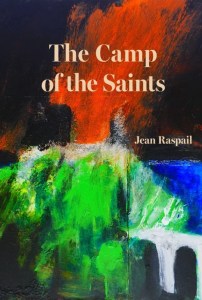 Originally published in 1973, this dystopian novel might once have been dismissed as total fiction. But no more. There was a time when it might have been taken for a dark comedy. Or an impossible tragedy. But no more. Well, maybe a very dark comedy….
With the benefit of a new translation, Jean Raspail’s The Camp of the Saints has now been republished yet again. This time there should be little doubt about how it should be taken. Therefore, the questions of the moment ought to be these: Has the book been published just in time? Or is it too late? Only time, one supposes, will tell.
In the meantime, we might ponder a question about those questions. What might be the response if those two questions were put to the common people of Raspails’s France–or to the common people of England or Germany or Sweden or, for that matter, the United States? One could go on, but the point has been made.
To be sure, their answers would likely produce a volley of yeas and nays. But what would happen if the same questions were then asked of the people who run the European Union or of those in charge in the aforementioned European countries (assuming they still think of themselves as members and/or leaders of individual, independent countries). Their responses would likely be very different. In fact, the response of many might well amount to a quick dismissal of the relevance of both questions.
Of course, all of this presumes that both the common people and those who presume to govern (or rule) them will have either read Raspail’s novel or are aware of its theme and story line. As matters stand, too many of the ordinary folk in too many countries of Western Europe are too busy living, and dealing with, the consequences of mass migration into their countries to have time for a novel written better than half-a-century ago.
And those who presume to govern them? Too many of those in charge are either unworried or uncaring about those same consequences. Or they are too busy celebrating the demographic and political results of their open borders policies, while also congratulating themselves on their open-minded tolerance.
And just what is that story line? Uncountable thousands of the poorest people of an impoverished India have boarded upwards of 100 ships to make their ocean-going journey to the earthly paradise that awaits them somewhere in Western Europe. The scenes then rotate between Franz Fanon’s “wretched of the earth” aboard those ships and Jean Raspail’s Frenchmen as they anticipate what might be coming their way.
This new edition, however, opens with a must-be-read-first introduction written by Nathan Pinkoski. A senior fellow at the Center for Renewing America, Pinkoski pulls no punches about a book that pulls no punches. His opening line almost says it all: “You are holding in your hands one of the most important dystopian novels ever written.”
As Pinkoski goes on to point out, The Camp of the Saints differs significantly from other important dystopian novels, especially George Orwell’s 1984 and Aldous Huxley’s Brave New World. The theme of both of those novels concerns how materialist-minded attempts to create a “progressive paradise” can lead to either a hard (Orwellian) or soft (Huxleyite) version of a “permanent political nightmare.” The Camp of the Saints, on the other hand, “explores the implications of modern spiritual self-hatred.”
What’s at work in the novels of the two Englishmen is, to be generous, idealism and ideology run amok. And the Frenchman? What Raspail finds at work is the “nihilism of guilt” (to borrow again from Pinkoski). In other words, it’s one thing (and far from a good thing) for people to attempt to create a utopia, but it’s quite another thing (and clearly a bad thing) for them to “welcome their own destruction under the guise of creating a perfect world cleansed of their past sins.”
Pinkoski takes pains to note past attempts to suppress and dismiss The Camp of the Saints as little to nothing more than a racist diatribe. To be sure, Raspail’s treatment of the “wretched” of India is harshly negative. But he never indicts them for their behavior or their condition. That verdict he saves for his fellow Frenchmen. And no doubt it’s that verdict that better accounts for past efforts to keep the novel far away from potential readers.
So just who was this Frenchman by the name of Jean Raspail? Pinkoski’s introduction provides a mini-biography of the novelist as well. Born in 1925, he attended the best Catholic schools in Paris. But neither schooling nor Paris were of much, if any, importance to him. The Boy Scouts, however, did have a real impact on him. In fact, the spiritual dimension of the scouting movement had a special attraction to both Raspail, the youth, and Raspail, the adult.
No doubt his scouting experience came in handy in the spring of 1940 when the German army was marching toward Paris. His school having closed, the fourteen-year-old Raspail expropriated a neighbor’s bicycle and managed the 350-mile trip to his family’s home in Bordeaux.
After the war, he was part of a 3,000-canoe excursion from French Canada to New Orleans. As Pinkoski puts it, that adventure “clarified Raspail’s vocation.” Specifically, it was his discovery of an abandoned Algonquin village on an island in Lake Huron that changed his life. It was as though “I had entered a church and rediscovered my faith.” Once he returned to France, Raspail was determined to tell the stories of “disappearing peoples,” and he did.
According to Pinkoski, Raspail’s best novels “veer off into the realm of fantasy.” Historical counterfactuals, his works amount to tales of the “sudden resurfacing of long lost dynasties or peoples.” In fact, had he confined himself to telling such tales, he might have established a respectable reputation as yet another conventional Western anti-imperialist.
But he didn’t. In fact, in one of those early novels he speculated on this proposition: Would the native peoples of Europe someday meet a similar fate. Having retreated from their empires, would they retreat even further? In fact, would they, too, disappear? The result of such speculation was ultimately The Camp of the Saints and the end of any thought that Jean Raspail would retain his never-deserved status as yet another guilt-ridden Westerner. If anything, the novel is alternately a brutal and comedic savaging of guilt-ridden Westerners, specifically his guilt-ridden, weak-kneed—and in some cases malevolent—fellow Frenchmen.
Pinkoski also provides a brief history of the novel, accompanied by a brief history of Western reflections on the decline and fall of the West. Once again Pinkoski refuses to pull his punches beginning with his opening sentence: “The Camp of the Saints is far from the first reflection on the death of the West.” Not decline, not fall, but “death.”
His starting point is Rudyard Kipling’s “Recessional.” The poem was written for Queen Victoria’s Diamond Jubilee, but instead of celebrating the occasion, the age, and the British empire, Kipling chose to speculate on the end of both the age and the empire.
But Pinkoski quickly jumps to Jean-Paul Sartre, who, in his 1961 preface to Franz Fanon’s The Wretched of the Earth, made a very different case regarding the end of the French empire. That end was not to be an occasion for sadness or nostalgia. Nor was decolonization to be a cause for celebration. For Sartre, French withdrawal from Algeria would not be enough to make amends for French imperial rule in Algeria. Instead it would simply be the first step that a chastened France needed to take to “change the order of the world.”
And the next step? Sartre deemed that France deserved what Pinkoski terms “punitive subjugation.” Sartre defines that subjugation this way: “”Our soil must be occupied by a formerly colonized people and we must starve of hunger.”
Did Sartre think that something like that would actually happen? No. Did he want it to happen? Apparently so. More than that, Pinkoski assures the reader that Sartre was far from alone among the cultural and political intelligentsia in thinking such thoughts better than half-a-century ago.
Raspail was certainly aware of such thinking. While never on the left, he was quite aware of the thinking of the left. In fact, he corresponded and exchanged views with more than a few leading figures of the French left. Without doubt, as their ideas percolated and circulated during the 1960s, Raspail began to do his own percolating while composing his historical novels.
The result was The Camp of the Saints. But this percolation was not necessarily meant to be a prediction. Had he been engaging in that sort of thing he might well have made the “wretched” Algerians or Middle Eastern Muslims; instead, they are Indians.
In any case, his real targets are not the Indian boat people. To be sure—and to put it mildly—he doesn’t idealize them. But at the same time it bears repeating that he is not remotely interested in indicting them, which is not to say that the book is indictment-free. Not at all. His real targets are those who have followed the intellectual lead of Jean Paul Sartre to all of its all-too-logical, and deathly self-loathing, conclusions.
No leading French figure escapes Raspail’s sardonic ire. They have all lost the will to resist. And most all welcome their defeat as just retribution for their past sins. But Raspail saves his most scathing ire for officials of the Catholic Church, whether they be French clergy or the pope. In the novel, the papacy is occupied by Pope Benedict XVI. (This most recent addition includes a 2006 Raspail footnote which states that not a word or name had been changed from the 1973 printing. It then concludes with these words: “It goes without saying that the pope mentioned in this fictional account is in no way to be taken for Our Very Holy Father Pope Benedict XVI, to whom I pledge my trust and my respect.”)
Raspail did not live to see the publication of this edition of his novel, but he did live until 2020, at which point he had reached the age of 95. Included in this edition is a 2011 Raspail introduction, titled “The Big Other” (referring to the masses of the Third World). In it, Raspail himself pulls no punches, while confiding to any potential readers that he remains “delighted” to have written this novel in the “prime of life, when my convictions were strongest. I take back none of it. Not a single iota.”
No doubt that would still be true today. In fact, Jean Raspail may well live on in this novel. Readers of novels often wonder if the novelist might have slyly inserted himself into the story. If so, might Raspail have done just that with Professor Calgues. Retired and living near the shores of the Mediterranean, he watches the boat people arrive: “Faced with the vanguard of an anti-world that had finally resolved to come in person and knock at the gates of abundance, he merely felt interest, intense interest.”
Raspail goes on to tell us that Calgues “believed in God. He believed in it all—eternal life, redemption, divine mercy, faith, hope.” As he took in the unfolding scene of mass arrival, he turned on his transistor radio and what should he hear but Mozart. Ah, he thought to himself, the program planner in Paris somehow understood. “Is there anything in the world more Western, more civilized, more perfect than Mozart?” The old professor goes on: “Mozart had never composed to stir the masses, but to touch the heart of each person…”
A bit later Calgues is startled by a “voice from the shadows.” A young man had suddenly appeared on his terrace to exclaim “isn’t it great!” Calgues was neither in agreement nor impressed. Standing before him “in faded jeans and sneakers, with long dirty blonde hair and a generally slovenly appearance, his gaze betrayed the flabbiness of his soul.” Not quite finished, Raspail adds that the professor’s visitor was a “nice example of those parasitic marginals that Europe had secreted by the hundreds of thousands and who already formed, like a cancer, a sort of voluntary Third World within it.”
This youthful cancer tells Calgues that he has not just been exulting, but looting as well. He exults over the “million Christs on those boats.” More than that, he informs Calgues that he expects to escort the “most wretched ones” to his house where they will build a fire with “your lovely oak door,” before destroying the dwelling and its contents because he hates everything that Calgues treasures.
And how does Calgues respond? He informs the youth that he will shoot him. Which is precisely what he does. As Calgues/Raspail observes, it was a “clean death…. No standards, no fanfare, a Western-style victory, as definitive as it was useless and absurd.” At that point the old professor “turned his back on the corpse and went inside.”
Was that line also a commentary on the uselessness and absurdity of what’s left of any Western-style defense of what’s left of France?
Does France disappear because of the invasion of the Big Other? Yes and no. The France of the centuries is gone, but a rump France will remain. At least that is Raspail’s estimate and his hope. Actually, Raspail’s retrospective judgement is that the France of the centuries has long been gone.
The Big Other wasn’t the real culprit; decades of debasement of and by the French themselves was. And yet Raspail was not willing to surrender in 2011: “All the same, let us not despair.” By 2050 there will still be “perhaps twenty or so million French people (and not necessarily of the white race) who will still speak our language and who will remain stubbornly aware of our culture and our history…”
And yet life will not be easy for them. At some point, he predicts, conflict will break out, “and these recalcitrant people will be brought to heel in a democratically legal, coercive, appropriate, and muscular fashion.”
Beyond that, Raspail was content to stay out of the forecasting business, content as he seems to have been to confine himself to the unfolding of a day in the life of France sometime well after 1973. Still, the future appears to be much more foreboding today than it was a half-century ago–or even just a few years ago. In truth, it seems much more foreboding than Raspail was willing to admit in 2011.
Of course, we Americans think of ourselves as the Big Other. The European version of the West might be doomed, but America is always an exception. Or are we? Might Americans who remain “stubbornly aware of our culture and history” one day meet a similar fate?
In fact, this already seems to be the case for France as the novel ends. As it ends, who should reappear but Professor Calgues. In a scene that verges on comic opera, the makings of a rump government for a rump France are hammered out with what’s left of a French army following the invasion of the wretched. And who should emerge as minister of culture but the retired professor of literature. Readers will be perplexed as to whether they ought to laugh or cry.
__________
The Imaginative Conservative applies the principle of appreciation to the discussion of culture and politics—we approach dialogue with magnanimity rather than with mere civility. Will you help us remain a refreshing oasis in the increasingly contentious arena of modern discourse? Please consider donating now.
The featured image, uploaded by Gémes Sándor/SzomSzed is a photograph, “Migrants in Hungary near the Serbian border.” This file is licensed under the Creative Commons Attribution-Share Alike 3.0 Unported license, courtesy of Wikimedia Commons.