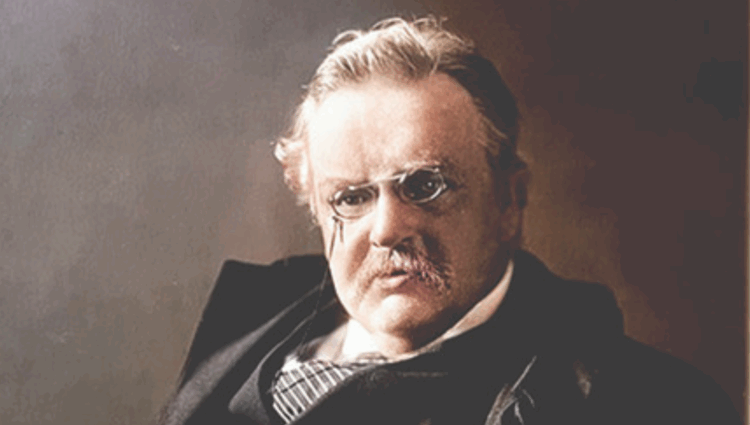
Dale Ahlquist’s “I Also Had My Hour” stands the art of autobiography on it head so that we can see G.K. Chesterton afresh from new angles, much as Chesterton himself stood truth on its head so that we could see it afresh from new angles.
I Also Had My Hour: An Alternative Autobiography of G. K. Chesterton, by Dale Ahlquist (480 pages, Ignatius Press, 2025)
 If one wants to know more about the life of a man, is it better to read his autobiography or would one learn more by reading a biography of him written by someone else? The answer is yes.
What someone says about himself is indispensable but he is hardly going to tell us everything that we might want to know. Even an honest person, telling his own story, is likely to leave out those things that it would be imprudent or intemperate or simply embarrassing to reveal. He might want to protect his own reputation or the reputation of others. On the other hand, a dishonest person might construct an autobiography that is little more than an artful lie. Or, more amusingly, someone might deliberately tell a tall tale for fun, not really intending it to be taken seriously. Take, for example, the poet Roy Campbell who described his own autobiography as “largely a spoof” so “stuffed full of lies” that it should be taken “with a pinch of salt”.
Considering the conceit and the deceit, and the coyness, of those writing about themselves, we might be tempted to trust the biographer over the autobiographer. This can itself be dangerous. Biographers have their own pride and prejudices, and this can distort their perspective. “Every man nowadays has his disciples,” wrote Oscar Wilde, “and it is always Judas who writes the biography.”
These thoughts serve as the backdrop to my own decision, more than thirty years ago, to write a biography of G. K. Chesterton.
Chesterton’s own autobiography, published shortly before his death in 1936, was little more than a rough sketch of his own life combined with musings on the times in which he lived and the people whom he knew. It was bereft of detail and bereft of dates. It reminded me of his popular book, A Short History of England, which is a delightful sketch of English history bereft of any dates. It’s worth reading as Chesterton’s impressions of English history but it lacks the necessary detail. If we cannot connect the dates, we cannot connect the dots. What is true of Chesterton’s Short History of England is equally true of his short history of himself.
In the absence of a satisfactory autobiography, the person desiring to know more about Chesterton needed to look to the various biographies of him. There were a number of these, back in the 1980s, and I began reading them, one after another; none seemed to capture the fullness of the man in his integrity and his entirety. Remaining unsatisfied, I decided to dive and delve deeper, studying the life of the man for myself. The result, after several years of labour, was my own biography, Wisdom and Innocence: A Life of G. K. Chesterton.
Although my book had endeavoured to connect the dots by connecting the dates that were absent in Chesterton’s autobiography, there was still the sense of frustration that the man himself had said so little about himself in the only book he had written about himself. If only he had written more and in more detail. Such were my wistful thoughts which I had assumed could only be wishful thinking. But I had forgotten what Chesterton had written about fairy stories; I’d forgotten “the ethics of elfland”; I’d forgotten that wishful thinking could be good because wishes sometimes come true.
The wish has come true because I have in front of my I Also Had My Hour: An Alternative Autobiography of G. K. Chesterton. It’s as if the ghost of Chesterton has visited us, almost ninety years after his death, to tell us fireside stories about his life; or as if someone rummaging through the attic of an old house had come across a long lost manuscript of Chesterton’s other autobiography, the one in which he provides all the details lacking in the other one. The latter supposal is closer to the truth because this priceless volume has been the labour of love of Dale Ahlquist, that Chestertonian extraordinaire, who has made it his life’s work, not merely to study the works of the man, but to assemble all the works of the man in which the man waxed lyrical about himself and his own life.
First, however, in the Prologue prior to the autobiography proper, Mr. Ahlquist provides a meticulously compiled “Chesterton Timeline”, which connects the dots and the dates, providing the comprehensive data necessary to place Chesterton’s words in their historical context. As for the structure of the autobiography itself, Ahlquist sets it within the framework of Chesterton’s delightful and perhaps best-known poem, “The Donkey”, with each chapter title being taken from a line or a phrase from the poem. Ahlquist’s point is that Chesterton is himself the donkey depicted in the poem, a humble beast of burden who carried the truth of Christ: “He is the Donkey. He does not mind being laughed at, does not mind being starved, scourged, and derided, does not mind being considered an ass. He knows he is carrying Christ.”
As for this new “alternative autobiography”, which Mr. Ahlquist has midwifed into being, he sees it as being superior to any biography:
After more than four decades of reading GKC, I can say that it is more enlightening to read what he writes about himself rather than what others write about him. This is what I have tried to allow him to do in this book, a thing he tried to avoid doing but did not quite succeed – a happy failure for our benefit. His humility prevented him from realizing that he was the most interesting character he ever encountered. Here for all of us is a new encounter with G. K. Chesterton.
I Also Had My Hour stands the art of autobiography on it head so that we can see Chesterton afresh from new angles, much as Chesterton himself stood truth on its head so that we could see it afresh from new angles. It breathes new life into the life of Chesterton, introducing him with a fruitful freshness to a new generation in need of his wit, wisdom and witness. It also breathes new life into old men who thought that they already knew Chesterton well, even those few of us, those happy few, who have had the temerity to write their own biographies
__________
The Imaginative Conservative applies the principle of appreciation to the discussion of culture and politics—we approach dialogue with magnanimity rather than with mere civility. Will you help us remain a refreshing oasis in the increasingly contentious arena of modern discourse? Please consider donating now.
The featured image, uploaded by Gémes Sándor/SzomSzed is a photograph, “Migrants in Hungary near the Serbian border.” This file is licensed under the Creative Commons Attribution-Share Alike 3.0 Unported license, courtesy of Wikimedia Commons.