The priest or religious who takes a vow of Chastity, binding them to Christ as to their spiritual married partner, will be lost without daily access to the contemplation that is for them the indispensable means of uniting them with him.
 From the very beginning, the faithful have been taught that the Church is the bride and Christ is the bridegroom. The Fathers of the Church used the “Song of Solomon” to show how this relationship extends to every single member of the Church as they detailed their journey along the mystic way toward the ultimate mystical marriage in heaven. However, St Bernard was even more specific: it is in and through contemplation itself, that this marriage first finds its completion as we are bonded to Christ. Then, in, with and through him we are led into the ultimate marriage with the Three in One, to all eternity. It is of paramount importance, therefore, to realize precisely what constitutes this contemplation. I began by using the metaphor of the spaceship destined for Mars to show how it is necessary to use canisters of fuel or boosters to lift the spaceship off the ground and through the earth’s atmosphere. This is the role of meditation when we are first filled with the love of Christ on earth that concentrates our heart’s desire and raises it up to be united with Christ as he is now in heaven.
Once this primeval desire for God has been directed towards Christ who will take us into Infinite Love, then contemplation has begun in earnest. However, to begin with and for a long time, we feel nothing. Only the desire for Love keeps drawing us to prayer where nothing apart from distractions and temptations seem to engage us – including the biggest temptation of all, which is to pack up the obscure prayer and do something “meaningful”. Let me insist that there is nothing a person can do who is searching for Love, other than to persevere in the selfless giving that can alone finally open them to this Love. This is the whole point and purpose of what some have called confused or dark contemplation. It is to teach us the selfless giving through daily practice that will eventually make us a sufficiently selfless person who can be united with the perfect selfless One. There is no other way to union with Christ. The demise of mystical theology has meant that this indispensable truth has been forgotten, and therefore never taught to celibates who stop serious daily prayer the moment the feeling and fervour of first enthusiasm leaves them, with disastrous results. First enthusiasm might have left them, but, if they only knew it, it has propelled them forward into the mystic way where they are asked to carry their daily cross and die to self as they embrace the white martyrdom that involves acting selflessly day after day. This is the school of love where gradually our love mixes and merges with the divine love, that enables us to be united with God, even beginning in this life.
I do not like to emphasize high mystical states, as it can instill in a person a desire for pleasurable states of mystical experience. Our sole concern should be to give ourselves to God and God alone, whether we receive something or nothing in return. If we do come to experience mystical touches from God, not just briefly but more regularly, then they are only given to those who seek him for himself alone and not for what we receive from him. This is the whole point of the beginning of contemplation. Until the attitude of mind of the cupboard lover has been changed, our desire to experience the love of God will remain unfulfilled, and the desire to give up the prayer that seems to be going nowhere will become almost irresistible. However, when we have committed ourselves to God come hell or high water, continually giving the same time for prayer when all is dark and dismal as we did when all was sweetness and light, then in God’s good time, not ours, the light of his love will indeed touch us. It will lead us on to experience that love to ever greater degrees of intensity that will be commensurate with our selfless loving. These moments of delight when God makes his presence felt do not last forever, nor are they a reward for perseverance, but rather they are strength for further perseverance as the mystic way continues, sometimes in light but most times in darkness as the purification for union continues.
One very important point is that God is not only present in moments of light, bestowing the fruits of contemplation on the traveller. He is present in the more prolonged periods of darkness too, as long as we are persevering in the selfless giving that enables him to enter into us. The fi rst time that any intimation is given that God is present in what seems to be a pointless occupation, happens when we feel that although we seem to be receiving nothing from contemplation, we also feel we can no longer do without it. We still feel drawn to it despite the darkness and the endless turning away from distractions and temptations in which selfless loving is learned. As we have seen from St Augustine, St Gregory and St Bernard, the further they travelled in contemplation, mostly in darkness, the more they were able to see the truth of God’s plan. They saw what God wished of them while simultaneously receiving the power to do it. The vast majority of people who take their journey in the mystic way seriously can spend their whole lives in the Dark Night where for most of the time they experience darkness. But it is in this darkness as they continually give themselves to selflessly loving God that they are given his truth, his wisdom, and the strength to do the truth simultaneously. Moments of mystical presence are comparatively rare to begin with that encourage the traveller along the way. The selflessness learned in darkness prepares us for the Presence that is experienced in light.
I am purposely not stressing these moments of presence for fear of encouraging “bounty hunters”. But still, something must be said, not only for the sake of the truth but also for the sake of encouragement. When God first makes his presence felt, travellers are astonished and overwhelmed by the power of God which strengthens and fortifies their belief that God exists. They can never again doubt that this power is love and loving them deeply and personally, spurring them on when the darkness returns to enable their love to be purified further for ultimate union.
The priest or religious who takes a vow of Chastity, binding them to Christ as to their spiritual married partner, will be lost without daily access to the contemplation that is for them the indispensable means of uniting them with him. In the aftermath of Quietism, so many of the clergy have been afflicted in one way or another and to a greater or a lesser degree by lovelessness, as what St Bernard calls their “marital act of contemplation” has been taken from them. It is the laity who must now take the lead. In the sacrament of love the laity have for years been learning the selflessness that opens them to receive the love of God that they minister to each other and to their children. Here is the hope for the future for the Holy Spirit who cannot work through those who have no or little access to him but can work through the laity who have learned selfless loving in their marriages.
I do not want to give the impression that prayer is unimportant in marriage, for without it married couples will not receive the grace to persevere in the selfless loving, giving, and forgiving upon which all successful marriages depend. It is this selfless loving that enables the Holy Spirit to do through the laity what the clergy can fail to do if they neglect to practise selflessness in prayer. This is what will enable them to experience the love of the one to whom they made their vow of chastity. The great Jesuit mystic Père Lallemant said that a person can do more in a month with contemplation, than in ten years without it. Now is the time to listen to him and to act on what he said. If priests only take him seriously and begin again, then the renewal that is long overdue will be underway.
I am trying to draw together the ancient mystical tradition of the Catholic Church to show once more the way to loving contemplation, long since forgotten in the aftermath of Quietism that has robbed us of our most cherished birthright. When the faithful, and in particular the clergy begin to do what can alone bring renewal to themselves and through them to others, then I hope that the essential teaching of Catholic Mystical Theology that I have been able to assemble here, will help them go forward without delay.
___________
This essay is chapter thirty-four of The Primacy of Loving and is published here by gracious permission of the author.
The Imaginative Conservative applies the principle of appreciation to the discussion of culture and politics—we approach dialogue with magnanimity rather than with mere civility. Will you help us remain a refreshing oasis in the increasingly contentious arena of modern discourse? Please consider donating now.
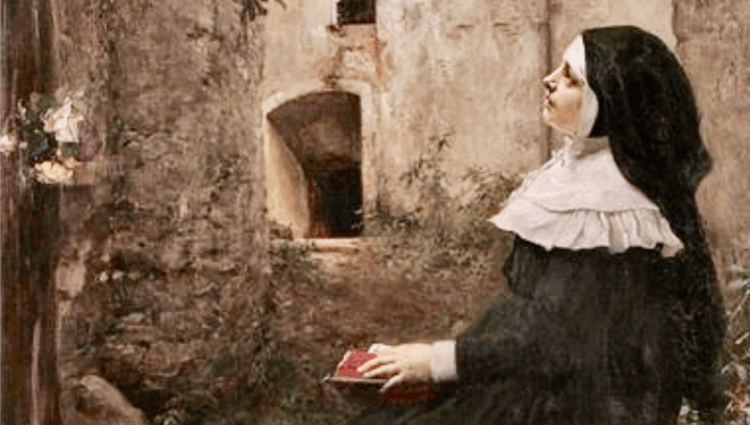
The featured image is “Religieuse” (before 1881), by Ferdinand Wagner, and is in the public domain, courtesy of Wikimedia Commons.