I SEE the Met Office are getting involved in emissions politics again. Their press office issued this warning a few days ago:

It says: ‘Rising seas are irreversible on human time scales and among the most severe consequences of climate change. Emissions released in the coming decades will determine how much coastlines are reshaped for centuries to come. New research shows that near-term mitigation could spare future generations around 0.6 meters of sea-level rise that would be caused by emissions between 2020 and 2090 following current policies, making today’s decisions critical not only for limiting warming but also for coastal impacts.
‘The study has been led by researchers from IIASA (International Institute for Applied Systems Analysis) in collaboration with colleagues from institutions in the UK, Belgium, The Netherlands, and Germany.
‘The paper published in Nature Climate Change goes beyond the usual sea level projections by quantifying how much sea-level rise in 2300 will be “locked in” by emissions this century. By isolating the effect of near- and mid-term emissions, the study provides a direct link between today’s policy choices and sea levels hundreds of years from now – an aspect that has not been quantified in this way before. “It is common for sea-level rise research to deliver projections to 2100 based on a standard set of scenarios, which doesn’t allow to isolate the longer-term sea-level impacts of today’s greenhouse gas emissions,” explains lead author Alexander Nauels, a senior research scholar in the Integrated Climate Impacts Research Group of the IIASA Energy, Climate, and Environment Program. “But we have to explore these impacts on timescales beyond 2100 because oceans and ice sheets keep responding for centuries. Our study shows clearly that mitigation decisions in the next few decades will have multi-century consequences for coastlines worldwide.”
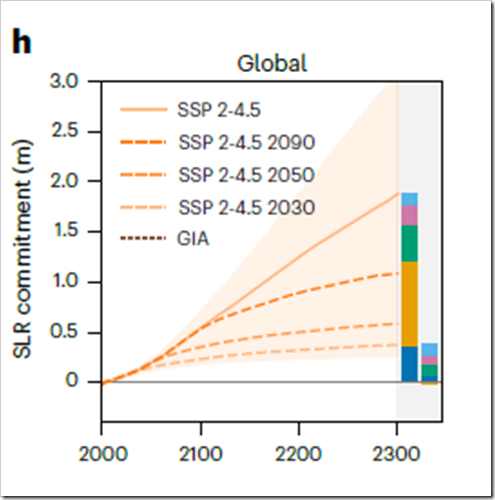
‘The researchers found that under current policies, emissions from 2020 until 2050 would already commit the world to about 0.3 meters of additional sea-level rise by 2300. What may seem like a modest increase would have major implications for long-term adaptation planning. Extending emissions on this trajectory until 2090 would lock in a global rise of about 0.8 meters, of which roughly 0.6 meters could still be avoided if the world started emissions reductions consistent with the Paris Agreement now. These differences can determine whether some low-lying coastal areas and islands remain habitable or not.’
***
It’s the usual ‘we’re all going to drown’ nonsense, based on dodgy computer models. Except this time they are making projections for 2300, probably having realised nobody believes their predictions for this century any more!
If we are good children and do what the nice men at the Met Office want, we might get only half a metre of sea level rise by 2300. But if we carry on as usual, it will be nearly 2 metres:
https://www.nature.com/articles/s41558-025-02452-5
Of course, we have been here before with these scare stories!
Take the projections for New York, for example. They project a rise of about 2.3 metres, which works out at 8mm a year. In reality the rate is less than 3mm a year, and has been since the late 19th century. There has been no discernible acceleration and a third of the rise is due to glacial isostasy – the land mass in the eastern US has been sinking since the Ice Age ended.
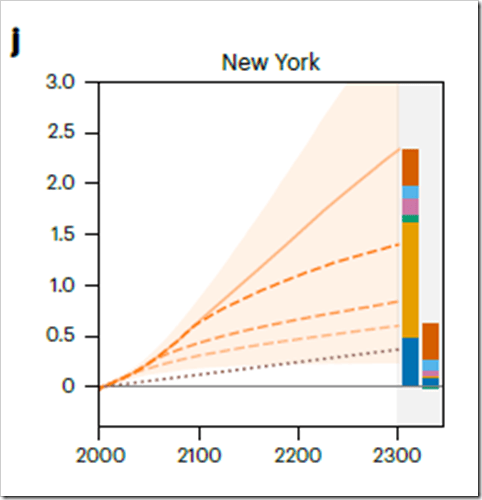

https://www.nature.com/articles/s41558-025-02452-5
Of course, we have been here before with these scare stories!
Take the projections for New York, for example. They project a rise of about 2.3 metres, which works out at 8mm a year. In reality the rate is less than 3mm a year, and has been since the late 19th century. There has been no discernible acceleration and a third of the rise is due to glacial isostasy – the land mass in the eastern US has been sinking since the Ice Age ended.

https://www.tidesandcurrents.noaa.gov/sltrends/sltrends_station.shtml?id=8518750#tabscenario
***
Oddly enough, the Met Office did not issue a press release on another sea-level paper published in August (my highlights):

It says: ‘In 2021, the IPCC published new sea level projections. For the first time, the projections gave insight into expected relative sea level rise locally. A prudent designer of coastal infrastructure will want to know how the local projections compare to local observations. That comparison, to date, has not been made. We compared local projections and observations regarding the rate of rise in 2020. We used two datasets with local sea level information all over the globe. In both datasets, we found approximately 15 per cent of the available sets suitable to establish the rate of rise in 2020. Geographic coverage of the suitable locations is poor, with the majority of suitable locations in the Northern Hemisphere. Latin America and Africa are severely under-represented. Statistical tests were run on all selected datasets, taking acceleration of sea level rise as a hypothesis. In both datasets, approximately 95 per cent of the suitable locations show no statistically significant acceleration of the rate of sea level rise. The investigation suggests that local, non-climatic phenomena are a plausible cause of the accelerated sea level rise observed at the remaining 5 per cent of the suitable locations. On average, the rate of rise projected by the IPCC is biased upward with approximately 2 mm per year in comparison with the observed rate.’
No acceleration found in 95 per cent of the stations, and the other 5 per cent are likely affected by local, non-climatic factors. IPCC projections grossly overstated!
Apparently that is news the Met Office don’t want you to know about. They would rather fill your head with unsubstantiated scare stories about what might happen three centuries from now, when they have difficulty forecasting tomorrow’s weather!
This article was published in Not a Lot of People Know That on October 25, 2025, and is republished by kind permission.