TONY Blair is trying to absolve himself for arguably the most expensive political blunder in modern British history. I am talking about the 2008 Climate Change Act, which has already cost the country more than £100billion.
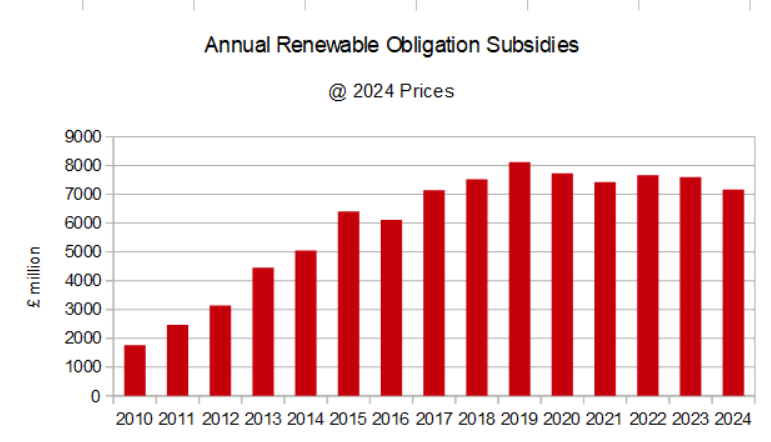
Although Gordon Brown had taken over as Prime Minister by the time the Act was passed, it was Blair who was the driving force in the years leading up to it. Indeed the obscenely expensive Renewable Obligation scheme was introduced on his watch in 2002. Since 2010 alone, it has added an astonishing £90billion to electricity bills (at 2024 prices):
https://www.gov.uk/government/statistics/energy-trends-section-6-renewables
Recently, though, Blair has been trying to back away from Net Zero targets, which were incorporated in the 2008 Act during Theresa May’s premiership in 2019. (The 2008 Act legislated for an emissions cut of 80 per cent from 1990 levels; the 2019 amendment raised this to 100 per cent).
A report from the Tony Blair Institute for Global Change now calls for Labour’s plan to decarbonise the grid fully by 2030 to be dropped, with ‘cheaper power’ being prioritised instead. It was written by Tone Langengen, TBI’s Senior Climate and Energy Policy Adviser, but is undoubtedly endorsed by Blair himself.
Although it retains Net Zero by 2050 as the ultimate goal, this is clearly not consistent with the report’s findings. According to an article co-written by Langengen in the Telegraph headed ‘Greenpeace is wrong – we can’t have net zero at any price’:
‘When Labour was in opposition, and even when they first took office, clean power and cheap power used to mean the same thing. They don’t any more.
‘We are living through two parallel crises: on cost of living and climate. Ed Miliband deserves praise for his strong commitment to net zero, but government policy must also recognise the impact of high prices. We need to confront them together.
‘Clean Power 2030 was the right mission when it was launched in the middle of the gas crisis: its aim was to end our dependence on volatile fossil fuels and make Britain a clean energy leader.
‘But the world has moved on: Interest rates are high, impacting the building costs of wind farms; electricity is four times the price of gas; growth remains stagnant; and families are struggling with their bills. It’s time to shift the focus towards cheaper power.
‘That’s why we’ve set out a new mission: Cheaper Power 2030, Net Zero 2050. It is a plan to cut bills, strengthen energy security, restore growth, and, critically, meet our responsibilities on climate.’
Talk about shutting the stable door after the horse has bolted! Just this week, another Telegraph report by Matthew Lynn claims that ‘British industry is now in terminal decline, killed by expensive energy’.
It is true of course that Ed Miliband’s plans to rid the grid of fossil fuels will add billions more to electricity costs. Electricity from new wind and solar farms remains much more expensive than gas power – the new contracts on offer for offshore wind, for instance, are more than double the price of gas. On top of that come the costs of balancing the grid, provision of standby capacity, payments to wind farms to switch off on windy days and paying for the £80billion upgrade of the grid needed to bring wind power from Scotland and the North Sea to where it is needed.
But it simply is not true that ‘clean power and cheap power used to mean the same thing’, as Langengen claims. As an energy adviser, she must surely know that, apart from a few months during the gas price spike in 2022/23, renewables have always been much more expensive than conventional generators, particularly coal and gas. I can only assume that this falsehood was slipped in to deflect from Tony Blair’s responsibility for the current crisis, presenting the Climate Change Act as somehow virtuous. His successors have of course been equally guilty of pushing ahead with the Act. But it was Blair who started the whole train crash in the first place. Reference to that Ukraine gas crisis is gaslighting. Labour’s project to decarbonise the grid was the plan for years, long before the war started. It was designed for ideological reasons, regardless of cost.
So, what is TBI’s plan to cut electricity bills? Transfer the multi-billion cost of renewable subsidies to general taxation!
That is no solution at all. Shuffling the deckchairs on the Titanic made no difference and neither will this new plan. One way or another, we will all still have to pay for Tony Blair’s Climate Act, no matter how much he tries to rewrite history.
Davey’s dividend
NUMBERS such as £100billion are hard for anybody to comprehend. They are simply too big. Often I get the reaction from people that I must be wrong because the costs seem so outlandish.
A couple of examples might help to bring things back to the realms of reality.
The London Array is the giant wind farm in the Thames Estuary that ruins the view from the Essex and Kent coasts. Starting operation in 2013, it generates less than 1 per cent of the nation’s electricity. At the opening ceremony, David Cameron said it was a ‘great day for Britain’.
This was one of the last major renewable projects built under the Renewable Obligation subsidy mechanism, before it was succeeded by Contracts for Difference (CfDs). London Array is jointly owned by the German energy company RWE, UAE-owned Masdar, a Canadian pension fund and a private company called Greencoat.
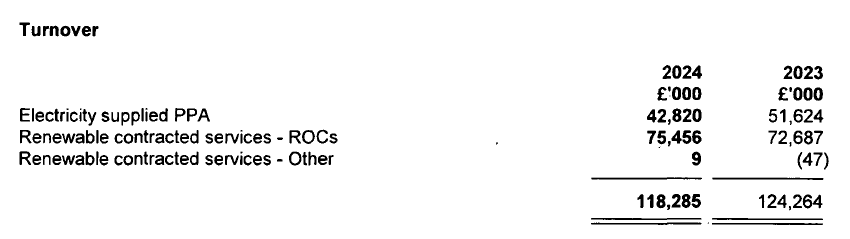
Greencoat, who own 25 per cent, recently published their annual accounts for last year. As is the norm, they included a breakdown of turnover, which revealed that about two thirds of the wind farm’s income came from Renewable Obligation subsidies:
https://find-and-update.company-information.service.gov.uk/company/06638251/filing-history
The figures apply to only a quarter of London Array generation, ie Greencoat’s share of the business. In total, therefore, London Array was handed about £300million in subsidies last year.
ROCs are paid for 20 years, so over the life of the wind farm a total subsidy of £6billion will be handed over, at today’s prices. And all for less than 1 per cent of Britain’s electricity.
From 2016 onwards, new renewable projects became eligible for CfDs, which pay a guaranteed inflation-indexed price. The first tranche of contracts was awarded in 2014 by the then Energy Secretary, Ed Davey.
So desperate was Sir Ed to build offshore wind farms quickly that he abandoned the usual competitive auction process and simply offered contract prices that were four times higher than market prices. This tranche was labelled ‘Investment Contract’, but might just as well have been called ‘Davey’s Dividend’!
Unbelievably, the eight projects signed up have already made more than £10billion out of Davey’s subsidies. As the contracts last for 15 years, that figure will more than double before they eventually expire. All of which will be added to our energy bills.
Ed Davey has to bear special responsibility for this obscene waste of public money. During the Coalition Government, it was always the agreement that the Lib Dems would have total control of energy policy. He cannot shift the blame on to anybody else.
Has any other single minister thrown away so much money at the stroke of a pen?