IN RECENT years, Britain and Canada have become each other’s object lesson in how shoddy lawcraft can lead to dystopian outcomes. As the Leadbeater Bill was being debated in Westminster last November, Canada was the spectre of an out-of-control euthanasia regime that haunted the room. Now, as Canadian legislation is deliberated that allows greater government control, it is the UK that has become the negative example of the slippery slope of criminalising speech.
In Canada, two pieces of legislation, ‘An Act respecting cyber security’ (C-8) and the ‘Combating Hate Act’ (C-9) cleared second reading in early October and are now at the committee stage. The Bills are quite different in intention but are related, in so far as civil liberties proponents argue both would dangerously curtail Canadians’ rights and freedoms if passed as written.
C-8 is a reboot of a 2022 Bill that died in January 2025 after then Prime Minister Justin Trudeau prorogued Parliament. The aim of the proposed law, which enjoys cross-party support, is to ensure the telecommunications sector provides a secure cyber environment to guarantee the protection of national security and critical infrastructure, including energy, transport and finance.
For critics of the bill, the devil is in the details. The amendment to the Telecommunications Act allows cabinet to ‘prohibit a telecom service provider from using all products and services provided to a specified person’. In bald terms, according to MP Matt Strauss, the Bill allows the government the ‘unprecedented, incredible power to kick any private Canadian citizen off the internet’.
Frighteningly, such cabinet instruction ‘may include a provision prohibiting disclosure of its existence’. In other words, when access to email, work accounts, online banking and social media is denied, a citizen would have no idea why he or she had been removed and would have no reasonable means to rectify the situation.
Ironically, Privacy Commissioner Philippe Dufresne told the Standing Committee on Public Safety he had not been consulted on the provisions of C-9 and noted in mild bureaucratese that the government should be ‘legally required to conduct privacy impact assessments and to consult my Office when developing any new programs or initiatives with privacy implications for Canadians’.
To those who say that the Bill is simply intended to target criminal or malign foreign actors, Conservative MP and lawyer Leslyn Lewis warned the Commons that the Bill must be taken at face value. ‘We must rely on what the text explicitly sets out in the law,’ she said.
Strauss noted that ‘the section does not use language about “extreme threats” or “physical damage” or “threats to national security”; it says “any threat”.’
‘What is the standard for this disclosure? Simply ‘the minister’s own judgment of what is necessary is vague, subjective and wide open to abuse’.
It is easy to point to the government reaction to the 2022 Truckers Convoy as an example of how things can go badly wrong: the unjustified accusations of foreign interference and funding, the freezing of 210 bank accounts of Convoy participants, and the invocation of the Emergency Measures Act, which a subsequent federal court judgment found to be unreasonable and illegal.
At the time of the Convoy, Mark Carney, then an informal adviser to the Trudeau government and now Prime Minister, wrote an op-ed for a national newspaper in which he described Convoy donors as ‘foreign funders of an insurrection’ who had ‘interfered in our domestic affairs’.
The piece was published the day after David Vigneault, then director of the Canadian Security Intelligence Service (CSIS), told officials that ‘there [are] no foreign actors identified at this point supporting or financing this convoy . . . The GoFundMe money and other fundraising platforms [are] being tracked by FINTRAC and banks and making sure that it is not used for a non-peaceful purpose.’
Though comprising merely a few pages of text, the Combating Hate Act is a significant advancement of existing hate speech statutes.
Canada inserted laws about hate speech to the criminal code about a quarter-century before the UK but, unlike the UK, Canada has a Charter of Rights and Freedoms, and jurisprudence has developed over the past 50 years to balance those laws with the constitutional right to freedom of expression.
The new law would remove the obligation of the police to gain the consent of the Attorney General to pursue hate speech prosecutions. It would codify the definition of ‘hate’ as ‘the emotion that involves detestation or vilification and that is stronger than disdain or dislike’. It also introduces a new intimidation offence which would criminalise ‘the act of intentionally instilling fear to impede access’ to a wide range of venues, including sports facilities and cemeteries.
A letter drafted by the Canadian Civil Liberties Association, signed by over 37 civil society organisations, notes that the new intimidation offence ‘is so broadly and vaguely defined that it could lead to the suppression of constitutionally protected expression and peaceful assembly’.
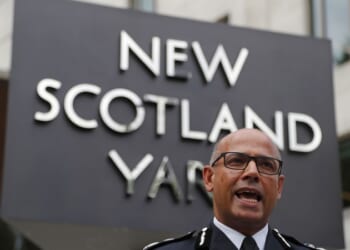
Law professor Bruce Pardy has written and spoken widely about C-9 and, along with law professor Ryan Alford, was a witness at the Standing Committee on Justice and Human Rights (JUST) on October 23. It was in this context that both lawyers raised the concern that C-9 would put Canada on a similar path to Britain where, it was said, 12,000 arrests for broadly ‘offensive’ social media posts were made in 2023.
In a recent podcast, Pardy warned that the law gives the government the ‘discretion to decide that you have stepped over the line without you being able to tell you have stepped over the line’. Canadians will become ‘subject to the discretionary decision-making of officials as opposed to subject to the law’.
The assumption is that the ‘fear’ spoken of in the Bill is of the imminent threat of violence but, according to Pardy, that is not what the law is implying. In a recent interview, he once again referred to the Trucker Convoy: ‘If you have a group of people in your downtown, in a bunch of trucks, that are advocating for an ideology that is contrary to yours . . . then now we are into provoking a different kind of fear. This is a state of fear that until recently has been unknown to the law . . . this was actually a threat to a particular kind of ideology, and to push against those ideas is now considered to provoke a state of fear.’
Against a societal background which includes the recent reintroduction of a private member’s Bill by MP Leah Gazan that would criminalise ‘residential school denialism’ (which itself followed a 2024 private member’s Bill that proposed jailing Canadians for ‘promoting’ a ‘fossil fuel, a fossil fuel-related brand element or the production of a fossil fuel’), the implications of Bills C-8 and C-9 are chilling. Free academic inquiry, journalistic autonomy and integrity, and the freedoms of assembly and expression are in jeopardy in Canada.
Sadly, in this instance, it is Britain which serves as Canada’s cautionary tale.
‘If you want a preview of what our leaders would like to be able to do in Canada,’ wrote former newspaper publisher Peter Menzies, ‘even if the final results would be applied differently, in line with our laws, don’t look south. Look to the UK.’