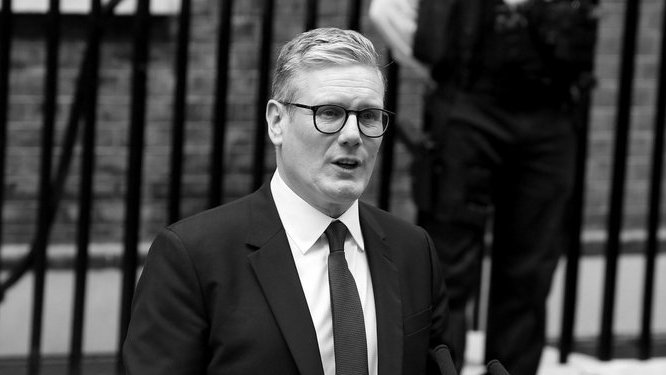
WITHIN Sir Keir Starmer’s delusional speech on foreign policy of Monday were words on Labour’s under-reported China policy. They should be reported, because Starmer is disingenuously claiming to be defending Britain against China while sacrificing our defences in pursuit of economic and environmental co-operation.
Conveniently, the disingenuousness discourages reporting. What on earth was he saying? I can imagine harassed or lazy journalists letting it go.
Starmer’s soporific, robotic delivery also discourages reporting. To compound a disingenuous text, Starmer delivered a lacklustre speech. I was surprised to see him look down at his papers every few words, and speak those words with apparent unfamiliarity, even surprise.
This suggests to me that Starmer was hardly involved in the writing or editing of the speech. The National Security Adviser, Jonathan Powell, probably led its production. Powell is now a year into his unprecedented brief as Britain’s unelected and undeserved chief diplomat, negotiator, and national security adviser.
Powell, the lead negotiator of peace with Northern Irish terrorists, has been travelling to Beijing almost monthly to learn what China wants before Starmer’s planned state visit next year. Starmer hopes to announce some sort of deal that, he would claim, restores British economic security – and the world’s environmental security too, I shouldn’t wonder.
China is the first country the speech mentions, but in the most duplicitous way: ‘No transformation carries greater consequence than the rise of China.’
The speech applies the word ‘consequence’ in two ways. First, to suggest positive opportunities for China’s investment and trade and co-operation on climate change. Second, to suggest that China’s negative side is consequential but not threatening.
Words matter. They enable a downgrade of Britain’s policy towards China.
In the summer, then Foreign Secretary David Lammy promised that the government would ‘never compromise on our national security’. Rather, ‘we will co-operate where we can and we will challenge where we must’.
Now Starmer’s version of this duality is ‘that you can work and trade with a country, while still protecting yourself’. Most reassuringly, the speech goes on to promise that ‘we don’t trade off security in one area, for a bit more economic access somewhere else’.
Over and over again, the speech promises this duality: engagement with protection, or economic access with security.
Some of the promises bend the rules of grammar to the point of self-parody, such as: ‘protect ourselves better because we engage’. Others are decorated with corporate jargon such as: ‘build smart, agile relationships with everyone, where it’s clearly in our interests to do so’.
Clumsy wording is one thing, hypocrisy is another. Indeed, the speechwriters give away the government’s hypocrisy. The speech moves from duality to duplicity. In more words: the speech moves from the promise of protecting ourselves while engaging with China to a practice of surrendering protections in order to engage with China.
Four parts of the speech in particular give away the duplicity.
First, it sets up a false choice between engagement and a supposedly Brexit-driven ‘inward-looking attitude’, of ‘turning inward’ and ‘sever[ing] links with China’. In other words, engage China or cut yourself off from the world.
Second, the speech says: ‘Protecting our security is non-negotiable . . . But given the scale and significance of China, dealing with them on vital issues, like global security, not a choice, but a necessity.’ In other words, engagement is necessary with a big country, even if that country harms you.
Third, the speech offers this incongruity: China is ‘a country that poses real national security threats to the United Kingdom. With all that in mind, the absence of engagement is just staggering’. Incredibly, Starmer is claiming that Chinese threats justify British engagement.
Fourth, Starmer criticises prior administrations for a ‘simplistic binary choice, neither golden age nor ice age’. He complains that ‘for years we have blown hot and cold’. There you have it again! A false choice, between either hot or cold.
Then Starmer promises more engagement in trade, global security, stability in the South China Sea and the Taiwan Strait, nuclear proliferation, the use of AI in weapons systems, climate change and global health.
He admits a long list of Chinese activities against which he promises to protect us: malicious cyber activity, support of Russia in Ukraine, oil and gas operators that support Russia’s military industrial complex, human rights, the prosecution of British national Jimmy Lai, the sanctioning of British MPs, threats to British academic freedom, and the curtailment of freedom in Hong Kong.
Yet Starmer does not specify any Chinese activity that would cause him to disengage. The concept of disengagement isn’t in the speech.
Starmer’s quid pro quos are all British concessions in pursuit of China’s engagement. China gets to continue its espionage, sedition, and defiance of international sanctions without any British punishment. The speech specifies nothing that would cause Britain to disengage.
In Starmer’s foreign policy, Britain should protect itself from, but not punish, China’s malicious activities. Worse, Britain should give up protections in order to get China’s engagement.
Just a day after the speech, the government illustrated its policy of engagement at the expense of security. The government announced that it would decide in January whether to approve China’s plan to build a super-embassy atop London’s fibre optic cables. The delay is procedural. It is not driven by any further investigation or deliberation. The Home Office and Foreign Office – after waiting on MI5 and MI6 respectively – submitted their formal approvals last week. The Housing Secretary, Steve Reed, still needs to consult local authorities. His approval is consequently delayed from December 10 until January 20.
Keir Starmer hopes to make his first visit to Beijing around that week. How fitting!
China will expect its Embassy to be approved before it agrees further trade and investment. Starmer is trading Britain’s security for China’s economic and environmental cooperation. While promising both security and engagement, he is pretending a false choice between insularity and co-operation.