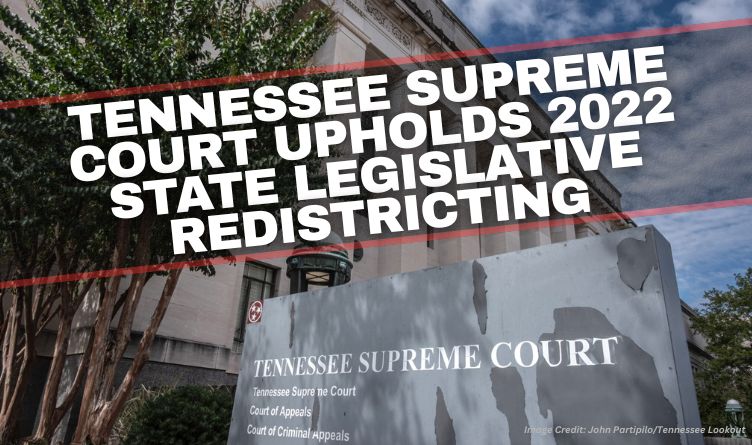
In majority opinion, court rules plaintiffs lacked standing and could prove no harm from House, Senate maps redrawn after 2020 census.
Image Credit: John Partipilo/Tennessee Lookout
***Note from The Tennessee Conservative: This article posted for informational purposes only.
By Cassandra Stephenson & Sam Stockard [Tennessee Lookout -CC BY-NC-ND 4.0] –
The Tennessee Supreme Court vacated a lower court’s judgment that a 2022 state Senate map was unconstitutional, ruling that a voter in a misnumbered Davidson County district lacked standing to challenge the map.
The ruling also upheld a lower court’s decision that declared the 2022 House redistricting map was constitutional.
This is the latest development in a lengthy legal battle over the maps that has spanned multiple courts since state lawmakers approved the new districts after the most recent U.S. Census.
Francie Hunt, executive director of Tennessee Advocates for Planned Parenthood, sought an expedited ruling from the state Supreme Court in 2023 for her challenge against the new Senate districts. She lives in a part of Davidson County that was placed into Senate District 17 along with the entirety of Wilson County in the redistricted Senate map.

Hunt challenged the Senate plan because it numbered Davidson County’s four Senate districts out of compliance with a constitutional rule that districts in multi-district counties must be numbered consecutively.
Prior to redistricting, the map numbered Davidson County’s four Senate districts consecutively. Because Senate terms are staggered, this meant two of the county’s senators would be up for election in presidential election years, and the other two would be up for election in gubernatorial election years. Under the Senate map adopted in 2022, three Davidson County senators would be up for election in gubernatorial election years, and only one would coincide with the presidential election cycle.
Justice Sarah K. Campbell, who wrote the majority opinion, stated that Hunt needed to show a “distinct and palpable” injury for her claim to be valid.
“Hunt’s complaint is simply that she lives in a non-consecutively numbered Senate district, while other Tennessee voters do not,” the opinion states. “But that difference does not affect the weight or strength of her vote, so it is not vote dilution.”
The opinion states that Davidson County’s Senate districts were also numbered nonconsecutively in redistricting plans following the census releases in 1990 and 2000. Hunt has lived in Davidson County since 1999, but “was unaware of the numbering issue at that time,” according to the opinion.
Voters have challenged district misnumbering in other courts when it caused voters to wait longer than usual to elect an official, Campbell wrote, but the redistricted Senate map allowed Hunt to vote for a Senate candidate in 2020 and in 2022, two years sooner than she would have been able to had her district been numbered consecutively.
While the court found Hunt lacked standing, “other plaintiffs — whether voters, candidates or public officials — may be able to establish standing based on different facts in future cases,” Campbell wrote.
Three plaintiffs backed by the Tennessee Democratic Party initially sued the state to block maps drawn by the Republican-dominated Senate and House following the February 2022 redistricting process. The lawsuit alleged the House redistricting plan violated the Tennessee Constitution because it divided more counties than necessary and rejected an alternative plan that would have left seven counties whole.
A three-judge panel issued an injunction against the Senate map in April 2022 because it failed to meet a constitutional requirement that Senate seats in the same county must be numbered consecutively. The panel ordered lawmakers to come up with a new map within 15 days.
In response, Gov. Bill Lee, Secretary of State Tre Hargett and Tennessee Elections Coordinator Mark Goins filed an appeal in the Tennessee Court of Appeals. The Tennessee Supreme Court intervened because of the case’s urgency and lifted the panel’s injunction days later.
Hargett said little about the case other than “congratulations to the Attorney General’s Office in another court victory.”

Minority opinion finds Senate map misnumbering did violate rights
In the court’s minority opinion, Justice Holly Kirby found that Hunt’s constitutional rights were violated in the redistricting plan that moved her from the district held by Republican Sen. Ferrell Haile in Sumner County to that of Republican Sen. Mark Pody of Lebanon, who she said was not “connected” to her community.
The minority ruling found Hunt “sustained” injury from the 3-1 staggered terms in Davidson County and said it is neither “conjectural nor hypothetical” and that it would “manifest itself” each time District 17 changes.
Kirby threw a few barbs at the majority opinion, saying the justices “quibbled” with Hunt’s description of her injuries casting it as vote dilution.
She summed up her ruling by saying, “Under our standing jurisprudence in redistricting cases, it should not be easier for the proverbial camel to go through the eye of a needle than for a voter to challenge the constitutionality of her own voting district. Ms. Hunt has proper standing, and her claim should be considered on its merits.”
The majority opinion determined that another plaintiff, Gary Wygant, did have standing to challenge the House plan, but only for Gibson County, where he resides. The court upheld a lower court’s ruling that Wygant “failed to prove that the legislature lacked a rational or legitimate basis for dividing Gibson County.”=
In a separate opinion, Justice Dwight Tarwater wrote that Wygant could not prove he was harmed by the slicing of Gibson County from one state House district into two. Wygant claimed he and other voters were hurt by “the denial of a single representative to represent all of Gibson County” but Tarwater opined the claim lacked merit.