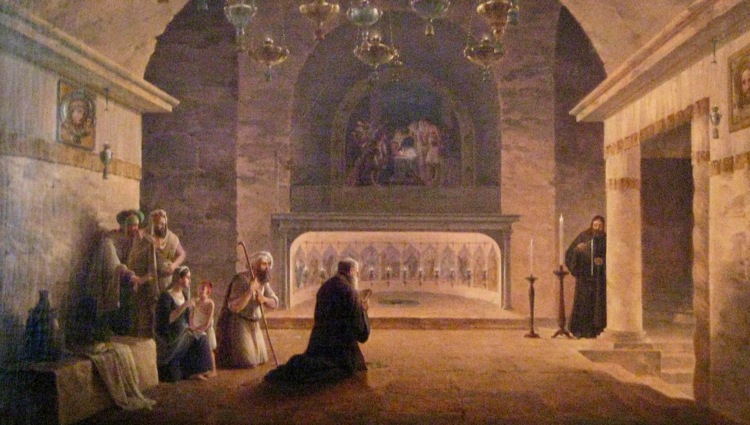
Bethlehem today is a bustling, modern city on the side of a hill, but at the time of Jesus’ birth it would have been a settlement of simple cave houses.
 In The Everlasting Man, G.K. Chesterton famously salvaged the caveman of popular imagination—suggesting that the neanderthal was a brilliant artist, not a brute. He then brings his argument around, cleverly making his point that God was himself a caveman—an artist who formed man and then was himself formed into mortal man being born in a cave.
On pilgrimage to the Holy Land, one of the things you find strange is the number of historic holy places that are in caves. “Here is the cave of Elijah the prophet,” says the guide. “Here is the cave where John the Baptist was beheaded.” “Here is the cave where the Bethlehem Shepherds lived.” “Here is the cave where Joseph, Mary, and Jesus lived.” “Here is the cave where the Blessed Virgin Mary was visited by the Angel Gabriel.”
The skeptic may well observe that it is rather convenient that these holy dwellings were in caves and thus preserved for posterity. “Why all the caves?” the modern traveler will ask. “Didn’t they live in houses?”
When you visit Israel, you soon learn that the rolling hills of soft limestone are pockmarked with caves. Go into one and you realize, in the unremitting heat, living in a cave is not such a bad idea. It’s cool in the summer and (if you have some animals in there with you) warm in the winter. Sure, it’s a bit dark, but you’re not spending time there during the day. It’s mostly just a place to sleep.
As you travel in Israel and the West Bank, if you have a sharp eye, you can spot Bedouin encampments in which the semi-permanent tents are erected in front of a cave. The tent is for the family. The cave is for storage and stabling. Even today some of the shepherds in Israel and the West Bank live in caves. This article from 2009 explores the phenomenon.
Bethlehem today is a bustling, modern city on the side of a hill, but at the time of Jesus’ birth it would have been a settlement of simple cave houses. Once they arrived in Bethlehem, Mary and Joseph would have gone to the home of Joseph’s extended family. As they didn’t have space in their guest room, they offered the stable/cave as a place of shelter for the Holy Family.
The most famous cave—especially at this time of the year—is in the crypt level of the ancient church of the Nativity in Bethlehem. The original structure built by the emperor Constantine was a grand five-aisled basilica with an octagonal apse encircling the grotto, allowing pilgrims to view the sacred cave from above. An ambulatory and atrium completed the design, making it a prototype for early Christian architecture. Constantine’s church was already in use by 333 AD, as noted by the anonymous Bordeaux Pilgrim, one of the earliest recorded visitors.
After a sixth-century fire, the present church was built by the Emperor Justinian I on the site of Constantine’s church. Justinian’s version expanded the design, adding a narthex, replacing the octagonal sanctuary with a cruciform transept and three apses, while retaining the nave and four side aisles.
Constantine had built the original basilica at the precise spot indicated by the locals after his mother Helena’s pilgrimage to the Holy Land. Our skeptical pilgrim will ask, “In the fourth century how did they know that was the right place?”
St Luke records that the Bethlehem shepherds told everyone what they had witnessed, so we can conclude that the residents of Bethlehem knew of the location and passed the knowledge down to the next generation.
Justin Martyr—writing from the Holy Land in the mid-second century—records the location and tradition. The location was remembered in Justin’s time because a few decades earlier (just about 100 years after the death and resurrection of Jesus) the Emperor Hadrian, in an attempt to obliterate Christianity, erected a temple to Adonis on the site. This confirms that the site was at that time already sacred to Christians.
St Jerome, who himself occupied a cave adjacent to the grotto of the nativity, attested to Hadrian’s attempt, writing in the early fifth century that Hadrian’s pagan temple was “consecrated to the worship of Adonis” and overshadowed by a sacred grove planted “to wipe out the memory of Jesus from the world.”
Ironically, Hadrian’s effort to obliterate the burgeoning young religion actually preserved the location for posterity. Two hundred years later, Helena discovered the site, her son built the first church, and through two thousand years of wars, fires, earthquakes, and various other depredations, the church—magnificently restored in 2013—stands today to welcome pilgrims to the cave where Christ was born.
__________
Fr Longenecker’s book, The Secret of the Bethlehem Shepherds is published by Sophia Institute Press.
The Imaginative Conservative applies the principle of appreciation to the discussion of culture and politics—we approach dialogue with magnanimity rather than with mere civility. Will you help us remain a refreshing oasis in the increasingly contentious arena of modern discourse? Please consider donating now.
The featured image is “Cave of the Nativity in Bethlehem” (1833), by Maxim Vorobiev, and is in the public domain, courtesy of Wikimedia Commons.