Over the next few months we are featuring some of our unsung writer heroes and their best articles. Men and women with their hinterlands of knowledge, expertise, sound judgement and ability to write cogently and grammatically. A rare and set of skills, often absent elsewhere!
Ivor Williams has been a fellow of the Royal Meteorological Society since 1984 and has been writing for us since December 2020. This week we are republishing a selection of his best articles from this year. Today’s ‘How long before the dissidents turn into a mob?’ was first published on July 29 last year.
MY CURRENT bedtime reading is a tale about how seemingly harmless protest groups can so easily become vast crowds. Then it just needs a demagogue to generate anti-government actions so violent and dangerous that the Army has to be called in. I realise our lot are not doing very well, in fact doing remarkably badly, but surely we would never get to that?
The author of my book thinks this could happen. It only needs, he implies, several groups gathering to protest about a recent government edict to be joined by others more concerned with poverty and the cost of living. The crowds quite quickly become rioting mobs, marching around night after night attacking and setting fire to anything connected with officialdom.
‘A mob,’ he writes, ‘is usually a creature of very mysterious existence particularly in a large city . . . the contagion spreads like a dread fever, an infectious madness. And society began to tremble at their ravings . . . Because of the publicly announced intentions of the rioters . . . all men knew there must ensue a national bankruptcy and general ruin . . .
‘Three great parties met at Westminster as a signal it was time to take possession of the lobbies of both Houses . . . a moral plague ran through the city . . . they all hoped that the government they seemed to have paralysed would, in its terror, come to terms with them in the end . . . [they] never reasoned or thought at all but were stimulated by their own headlong passions, by poverty, by ignorance, by the love of mischief and the hope of plunder.’
The destruction reaches its peak when the mob attempts to storm the Bank of England. The rioting continues for the next two nights but by Friday the Army finally gets control and ‘the disturbances were entirely quelled and peace and order were restored to the affrighted city’.
If you were suspicious of the old-fashioned style of writing, award yourself a well-deserved drink. These were the Gordon Riots of 1780 and the quotations are from Barnaby Rudge by Charles Dickens, published in 1841. The second half of this book describes the turmoil, despair and violence in detail. Dickens wrote it only 61 years after the events took place and as a child he would have heard many stories from people who witnessed that time of madness and terror.
Historian J H Plumb comments that the Riots were ‘an expression of the deep discontent of the working class in the face of the nation’s disasters’. At the time George III and his government were accused of disastrous incompetence in their war with America. Are you beginning to see where we’re going?
Here in 2025 there is both disastrous incompetence and deep discontent. Already in its first year the Starmer regime has surely broken the record for achieving the least while having the greatest majority of any party in the Commons since 1997 (Tony Blair).
The country already has a seething multitude of angry pressure groups. Some of them are content that sloshing a tin of paint about or stopping traffic for an hour or two is enough to show how strongly they feel. There may be others who consider that a waste of time. They may realise we are living in a dysfunctional country and that rather stronger actions are needed. Great Britain in 1780 was also simmering. The protests that ended in the Gordon Riots were ostensibly led by an unhinged Lord George Gordon and were sparked by resistance to the Catholic Relief Act of 1778. He gave rousing speeches, crowds gathered and over a couple of days the groups of ordinary people who were fed up with both government and king became a mob. Several mobs, in fact.
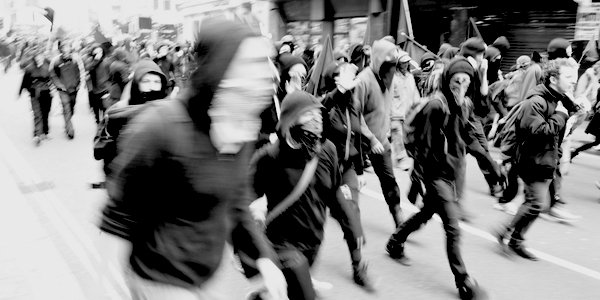
That wouldn’t happen today, of course. Of course? When does an angry protesting multitude turn into a mob? Because it will. Most UK protests are non-violent, but social media could easily generate a huge following of those who think they can’t wait four years to get a better life.
Maybe they are given a date and time to meet in London, just to show their disapproval. Maybe it happens to be a fine day, and half a million turn out. Perhaps the police overreact or some rabble-rouser goads them with needle-sharp references to benefits, wages, living costs, immigrants, house prices, pensions, and why don’t they do something about all that, NOW!
The worked-up angry crowd, now looking to make serious trouble, is urged to march on Parliament Square. Once there they become what every emperor, dictator and Prime Minister has feared throughout history: a mob. Protests can be controlled, but a mob is brave and dangerous, capable of worse behaviour than any of its individuals.
You think I’m exaggerating? A quote here from the July 6 edition of the Sunday Telegraph, the stalwart Conservative newspaper: ‘Labour’s colossal failure shows Britain is heading for disaster . . . the country seems to be slipping into a state of abject anarchy . . . when the rioting starts the state will be woefully unprepared for it.’
Can’t happen here?