Joseph Pearce Interviews Iranian Composer Farhad Poupel

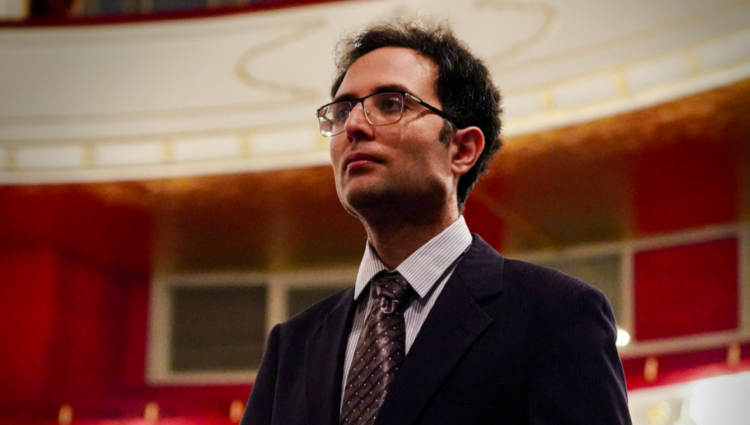
Farhad Poupel
Now when Jesus was born in Bethlehem of Judaea in the days of Herod the king, behold, there came wise men from the east to Jerusalem, Saying, Where is he that is born King of the Jews? for we have seen his star in the east, and are come to worship him. (Matthew 2:1-2)
Joseph Pearce writes: As we approach the feast of the Epiphany, it is good to look to the east in expectation of the promised return of the King. It is also good to remember the three kings, or wise men, who followed the star in the east to Bethlehem. According to tradition, these kings or wise men came from Persia, even though my good friend Fr. Dwight Longenecker has argued in his book The Mystery of the Magi–The Quest to Identify the Three Wise Men that they actually came from the Nabatean kingdom in Jordan. Irrespective of these mysteries of history, I would like to celebrate a new star in the east, Fahrad Poupel, a classic composer in the Western tradition, who was born in Persia, or what is now called Iran, but whose music is being widely celebrated from east to west for the goodness, truth and beauty that it manifests. What follows is my interview with him.
Could you please begin by providing some basic biographical details, such as your date and place of birth, and your education, especially in music?
I was born in Isfahan, Iran, in April 1989. My family aren’t very artistic, at least professionally. They’re mostly doctors, engineers, and so on. My father is a pharmacist, and my mother is a retired university teacher.
I had a little background in music from my mother, since she plays the piano. My first instrument was the Santour (the Persian hammered dulcimer). At the same time, I tried experimenting with electronic dance forms until I heard Beethoven’s Sonata no.16. It’s not a famous sonata, and I heard it through a MIDI recording, but I was so struck by it that I started writing my first piano work. The work was almost a classic rondo, which shows how natural these “traditional” forms are. If it is used ungrammatically, it is due to the composer, not the form itself. I was thirteen or fourteen at the time.
After that, my mother found a teacher, and my musical journey began. We had “Western” (for the lack of a better term, which I’ll explain later) music education in Iran, but it wasn’t very systematic at that time. (Now it’s very different). So, I didn’t have teachers to persuade me to continue music seriously as a professional.
I ended up studying pharmacy, and in Iran, it’s straight up to the doctorate, so our studies take at least six or seven years.
During that time, when I was 23, I heard an excerpt from Saeed Sharifian’s music and was so struck by its dramatic power that I wanted to study with him. Sharifian was based in the UK at that time, but, much to my fortune, he had decided to move his base to Iran and started having classes. I started going to his classes every week for five and a half years. The class was in his home in Tehran, which is 6 hours away from Isfahan by car, but I was determined to go. This was the beginning of my serious musical life.
Could you say something about the cultural implications of studying Western music and culture in Iran?
Generally speaking, Western music has always been respected by the society in Iran, more so now than ever (When I say Iran, I mean purely the society, not the government). Now there are many independent orchestras in Iran, and some of them are quite good. I’m a composer in residence with one of them.
Iranian classical music isn’t fundamentally different from Western classical music. (I’m not saying that about Chinese or Indian music at all). It is basically a modal system, very similar to the medieval musical system (or ancient Greek). The only difference is that it hasn’t been developed as Western music has developed after the development of notation. That’s why, for example, harmonization of Iranian folk melody can work perfectly well with Western modal harmonies. One great example to prove this is my work, Childhood Memories, which has become very popular both in the US and Iran. I tried to write Persian folk-inspired music (including my grandmother’s lullaby), but I’ve heard from many of my American friends that it sounds very American to them.
I think this idea of difference between Iranian and Western music is mostly a myth, mostly developed to exoticise the Iranian culture. I am mostly following Alinaqi Vaziri in my thoughts, who has been the most influential musician in Iran for the last 200 years or more.
How does being from Iran impact your engagement with the music and culture of the west?
This is a very interesting question. As I said before, I don’t see that much of a difference between Iranian and Western classical music. Having said that, I grew up with a mixed bag of cultures from different places, particularly American cinema, music and culture (maybe that’s one of the reasons my music has been performed mostly in the US). I grew up with video games, Iranian pop music, classical music and other sorts of influences as well. Because of that, it is very difficult to determine how my home culture has influenced my thinking and how my culture has influenced my interaction with Western culture. I try to just absorb whatever I like, regardless of where it came from.
When did you move to London?
March 2022. Although I have moved to Leeds recently.
How would you describe your own music and your approach to composition?
This is a very interesting question. I don’t try to differentiate between influences, both musically and non-musically. As long as I’m interested, I’ll use them. I try to compose music that I can listen to and enjoy myself because everyone is different and one can’t try to appeal to everyone. Having said that, I don’t want people to assume that I’m composing “academic” music at all; quite the contrary, my music is very listenable, because that is the music I enjoy.
From the beginning, I tried to compose music that has a narrative feeling to it (I hear Sibelius symphonies in this way). I also try to develop material by gradually creating new themes out of the previous materials, which always leads to the challenge of repeating the older themes. The best example of this method is my Prelude from Prelude and Demonic Waltz. These led me to pay attention to the form and thematic relationship. I try to imagine the general form of the work before composing anything. For example, in The Legend of Bijan and Manijeh, I knew that the ending should be tranquil and it should be based on scale and have a modal feeling to it. The rest was determined while I was composing.
I also draw a lot formally from non-musical arts. For example, the form of The Legend of Bijan and Manijeh is partly inspired by Bruckner’s adagios but also by The Lord of the Rings movies! It is a constant A-B form, each time more developed but, at the same time, each subsequent section continues the previous section. For example, we hear a theme comes out of the materials at the end of the A2, and that same theme is becoming one of the main themes of A3. Another example is Orpheus: Symphonic Variations on Themes by Beethoven, which is inspired by the form of a statue in Sweden. (Here is the computer-generated recording.) The work will have its world premiere by the West Valley Symphony in Arizona).
Which of your own compositions would you suggest serve as a good introduction to essential characteristics of your own work?
That’s a very good question. I’d say these three works, Laughter of Gordafarid; Foroud, Overture for a Tragic Hero; and Childhood Memories. The first two are from The Book of the Kings (Shahnameh), a book that is one of my main passions in composition and life.
Laughter of Gordafarid is a work for narrator and music in three arrangements: Piano solo, String orchestra, and Full orchestra. The Oscar and Bafta-nominated writer, William Nicholson (Gladiator, Shadowlands, Les Misérables) wrote the text, and it tells a story of a female Persian warrior from The Book of the Kings. The string orchestra arrangement has been recently performed in Iran in two sold-out concerts as the debut of my residency with Mithra Orchestra. I have been called the ‘Voice of Shahnameh’ because of that, which is truly an honour.
Childhood Memories is my first full orchestral work and has been my most performed work to date. It had its world premiere by the Portland Youth Philharmonic and has been performed several times in the US by different orchestras. It recently had three sold-out premieres in Iran as well. I tried to write a simple and easy-listening work that, at the same time, has complexity underneath. It is completely based on Persian folk-inspired original melodies.
Foroud, Overture for a Tragic Hero is a ten-minute overture based on another story from The Book of the Kings. It will have its world premiere next year in Florida.
You have cited Vaughan Williams, Sibelius, Mussorgsky and Shostakovich as influences. What is it about these composers that has inspired you?
Each one is different. I was heavily influenced by Vaughan Williams especially in terms of melodic writing and harmonies. I also learned orchestration partly by copying his symphonies. I don’t know why, maybe because film music is heavily influenced by him, or my teacher was a pupil of his pupil.
For Sibelius, his formal method and thematic relationship still influence me. His last three symphonies feel as if one is listening to a story being told in music.
Shostakovich and Mussorgsky are very interesting. I always loved Mussorgsky’s Boris Godunov, but I started enjoying Shostakovich much later. This began by listening to his Symphony No.13 (Babi-Yar), which is still one of my favourite orchestral works of all time. Then I started studying his symphonies intensely. What I particularly like about him is his simplicity in everything. His orchestration is astonishing but very direct, as with other aspects of his music, even his notation is very simple and without complications (as opposed to Stravinsky). I always tried to compose without unnecessary complications. There’s no point in writing something difficult just for the sake of being difficult.
Another thing that influenced me in Shostakovich is his cinematic sound, especially Symphony No.11, which is basically a movie without any picture. I love to write music that has the same feeling, not just producing images in the audience’s mind, but having a narrative feeling to it, as if they are listening to a story.
I am also influenced by both the melodic and harmonic structures of Shostakovich and Mussorgsky.
You also cite American cinema as a musical influence. Could you elaborate? Which film scores and which composers have had a particular influence?
American culture has generally influenced me a lot, including literature as well, since I grew up with it. But cinema was the biggest influence of all. I’m very happy that some of the great film composers are gaining the respect they’ve always deserved. John Williams, in particular, is a favourite of mine. I even started studying leitmotif technique, not by studying Wagner but by studying Howard Shore’s score of The Lord of the Rings (although I think Wagner’s approach is different) but I’m not sure if we can call The Lord of the Rings “American Cinema”.
As for specific scores, there are a lot of them that I really liked, and I think was influenced by them subconsciously. Danny Elfman’s two Batmans, Star Wars (particularly the Battle of Hoth and Asteroid Fields), James Newton Howard’s works for Shyamalan (Unbreakable, The Sixth Sense, Signs and The Village), to name a few.
You have been described as a “neo-Romantic”. Are you happy with this? How would you described neo-Romanticism?
To be honest, I’m not. I don’t consider myself neo anything; I just do what I like. When they used the term neoclassical, it had a meaning, but I think the term neo-romantic is very vague. What I know is that I respect emotion and instinct, and I put a lot of emphasis on melodies and themes.
You have said that you consider Pierre Boulez to be overrated and your own tradition-oriented approach suggests that you don’t share a kinship with most post-war modernism. Why is this? What do you think is defective about most modernist music and why and how does your approach differ from modernism?
I think composing that kind of music (if we can call it that) is really, really easy. Even in terms of performance, nobody can notice the difference between many of these pieces and a cat walking on the piano. And it does make facade very easy. It claims that the artist does whatever he or she wants, but whenever someone, like me, tries to do something different, it’s for “selling tickets”. Maybe I like what I do!!!
Having said that, there are many things that I’ve learned from avant-garde composers, like Penderecki. And also pre-war atonal composers. I genuinely love Schoenberg’s Five Orchestral Pieces and studied it a lot.
Your own compositional style has been compared by a friend of mine to that of Ernst Bloch, and perhaps even to Bartok and Shostakovich. Are you comfortable with such connections?
Yes, I am. Although I don’t know Bloch that much, I think the connections might be similar influences. But I know that I’ve been influenced by Bartok and Shostakovich, either consciously or unconsciously. The idea of purely original art is a myth. Original art is originally combining distinct influences. All of the great original composers in history were influenced by many others.
I understand that you are currently collaborating with the German Catholic artist, Albrecht Behmel, on a join creative project. Could you tell us more about this?
Yes, of course. He recently contacted my manager, and she recommended me to him, which I’m really glad about. He started painting a series on biblical stories involving a moment of silence before big decisions. These stories are universal, and this idea of the moment of silence is a truly human experience. I really like the visual works and the combination of music, storytelling and painting is very intriguing to me. I do like these larger-than-life stories in general, and this project, I think, has a deeper meaning in itself which can make it very impactful.
What role do you see for tradition-oriented music and culture in the future? Does it have an important part to play in the restoration of healthy civilizational values, both in the west and beyond, including Iran?
It depends on how we define traditional. If we define traditional as something that had institutional backup, then post-war modernism, experimental and holy minimalists (like Arvo Pärt) are conservative (especially in Europe). Almost all of the festivals and universities support these styles.
If we define tradition as something that doesn’t turn its back on the past, my music can be regarded as traditional, but still, modernism can be considered that as well, since the idea of continuous progress is gone at the moment.
I think the problem is not necessarily tradition vs continuous progress, but this anti-audience attitude. This idea, to put it crudely, is that whatever the general public likes is necessarily vulgar. What I learned from the Persian culture is that one can have a really sophisticated yet popular art, and Hafiz is the best case in point. Beethoven is another, whose compositions are still among the most popular.
Another idea is the obsession with “originality”. Ironically this makes everyone very similar. If you listen to Beethoven, his first and last periods are more different from the music of some of the living composers with each other.
To find out more about Farhed Poupel, visit his official website: Works | Farhad Poupel.
__________
The Imaginative Conservative applies the principle of appreciation to the discussion of culture and politics—we approach dialogue with magnanimity rather than with mere civility. Will you help us remain a refreshing oasis in the increasingly contentious arena of modern discourse? Please consider donating now.