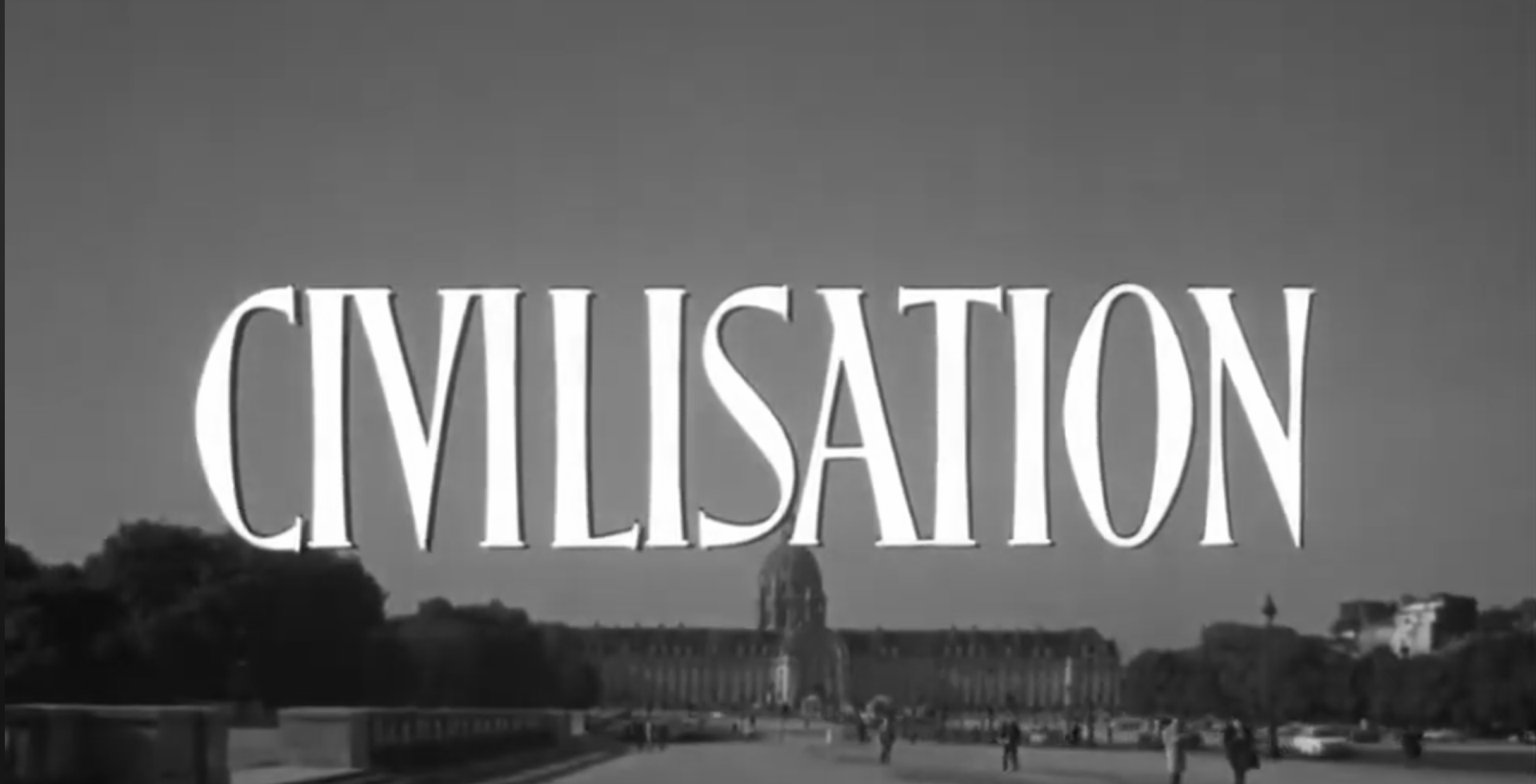
THIS final episode of the series is perhaps the most ‘political’ and the most negative; the one in which Clark is the least detached from his subject matter. It is inevitable perhaps, and not just given the momentous events of the First and Second World Wars he lived through, or the spectacular technological achievements of the decades that ran up to the making of the series, from the atomic bomb to man’s landing on the moon, to supersonic flight and computerisation. This was very much his own historical period – the end of one he was born into but by the time of his maturity was shaped by anti-Victorian attitudes. He sees it as the most materialistic of all the eras he had led us through. An era of continuing industrial and technological revolution whose socialist artists, like Gustave Courbet, and critics like Engels marked the quest for equality that would dominate the 20th century. He might well have called the episode ‘the machine age’, or even the brain age. For he focuses more on the machine and mamon than on the hero. Many of the latter (in my book) were writers, Bronte, George Elliot, Jane Austen, Thomas Hardy and Thackeray nine of whom, apart from Dickens, get a mention.
Watching this episode again for the first time in literally years, I was surprised to find no reference to Modern Times, Charlie Chaplin’s brilliant take on man’s subjection to and domination by the relentless factory machine and time control. Disappointingly there’s also no reference to those two 19th century inventions on which this TV series fundamentally depends – photography and film. Yet the original film of Tolstoy’s funeral is one of the most memorable features of the episode.
It begins with Clarke deploring the iniquities of slavery, the new urban poverty and exploitation of and disregard for the poor that accompanied the industrial revolution – those ‘satanic mills’ etc, a theme still being played out at our own turn of the century ‘millennium’ celebrations. It is the political heroes he applauds. William Wilberforce and other 19th century reformers such as Lord Shaftesbury and Dickens ‘who more than anyone else’, he said, stirred people’s consciences. From the oppression of the masses he sees a new virtue emerging in the 19th century. Kindness. Replacing and, seemingly, in his view more humane than the dominant virtues of the past – obedience and duty. He does acknowledge, though somewhat eliptically, that man’s materialism has brought about a rise in living standing.
He condemns as unique the brutality of 20th century machine war, our special urge to destruction yet still celebrates the new iron age heroes, the engineers who created the wonders of the Menai Bridge and later the most beautiful of them all – the Clifton Suspension Bridge – and the steam train and ocean liners. Isambard Kingdom Brunel features large, and rightly so.
Clark’s conclusion is powerful however and still holds. They are words we should heed, as relevant today as they were in 1969, if not more so:
'I believe that in spite of the recent triumphs of science, men haven't changed much in the last two thousand years ; and in consequence we must still try to learn from history.
History is ourselves. I also hold one or two beliefs that are more difficult to
put shortly. For example, I believe in courtesy, the ritual by which we avoid
hurting other people's feelings by satisfying our own egos. And I think we
should remember that we are part of a great whole, which for convenience
we call nature. All living things are our brothers and sisters. Above all, I
believe in the God-given genius of certain individuals, and I value a society
that makes their existence possible.'This series has been filled with great works of genius, in architecture,
sculpture and painting, in philosophy, poetry and music, in science and
engineering. There they are; you can't dismiss them. And they are only a
fraction of what Western man has achieved in the last thousand years, often
after setbacks and deviations at least as destructive as those of our own time.
Western civilisation has been a series of rebirths. Surely this should give us
confidence in ourselves.'I said at the beginning that it is lack of confidence, more than anything
else, that kills a civilisation. We can destroy ourselves by cynicism and
disillusion, just as effectively as by bombs. Fifty years ago W B Yeats,
who was more like a man of genius than anyone I have ever known, wrote a
famous prophetic poem.Things fall apart; the centre cannot hold;
Mere anarchy is loosed upon the world.
The blood-dimmed tide is loosed, and everywhere
The ceremony of innocence is drowned;
The best lack all conviction, while the worst
Are full of passionate intensity.'Well, that was certainly true between the wars, and it damn nearly de-
stroyed us. Is it true today? Not quite, because good people have convic-
tions, rather too many of them. The trouble is that there is still no centre.
The moral and intellectual failure of Marxism has left us with no alternative
to heroic materialism, and that isn't enough. One may be optimistic, but
one can't exactly be joyful at the prospect before us.'