 Saint John of the Cross restores, to a world which had nearly lost it, a sense of the transcendence of Almighty God. This is not to say that he loses sight for a moment of the Divine immanence, a subject which no mystical work treats with more delicacy and insight than the Spiritual Canticle. But the overpowering impression produced by the terms in which he speaks of God is one of awe. Upon his realization of God’s greatness, as we have shown, depends his whole system; and, although by Divine grace he was himself enabled to attain mystical Union, and urges others to strive for the same goal, he never allows his conception of God to be attenuated by the intimacy of his communion with Him.
It is, on the contrary, in his Living Flame of Love, the work in which he has the most to say of this most intimate communion, that he conveys the most vivid impression of God’s infinite greatness. Nowhere does he create a deeper hush of receptive reverence than in his commentary on the stanza beginning “Oh, lamps of fire…” in which the attributes of God—omnipotence, wisdom, holiness, and all the rest—shed the soft radiance of many and wondrous lamps over the soul’s faculties, and yet, at the same time, combine in the “one and simple Being” of the Godhead. Each of these attributes, in fact, is “the very Being of God in one single simple reality,” and in each of them “He gives light and burns as God.” Thus, although there is a way in which the soul can approach God, this way is not the use of its unaided faculties. For
God, towards whom the understanding is journeying, transcends the understanding and is therefore incomprehensible and inaccessible to it; and thus, when it is understanding, it is not approaching God, but is rather withdrawing itself from Him.
As we read such passages as these, we realize, perhaps with a shock, how far our conception of God has strayed from that which we find in Holy Scripture. Popular theology, for generations past, has been insisting more and more upon the “divinity of man,” and upon “God’s need of man,” with the result that we have grown more and more oblivious of our own insufficiency and of God’s majesty. We have attempted to make God complementary to ourselves, to take Him into collaboration with us, to think of Him as aiding us, at our request, in what we do—at any rate if it meets with His approval. So accessible have we believed His spiritual gifts to be that we have asked for them in mere forms of words, sometimes even unquickened by any reality of desire, and wondered why they have not reached us. It is remarkable if we have not presumed to think of mystical Union itself as something to be had for the asking: we are certainly apt to take it for granted that, when this life is over, we, with all our friends, and just because they are our friends, shall go to Heaven.
St. John of the Cross, like St. Augustine, impresses upon us continually a vivid realization of man’s littleness and God’s greatness—“l’infiniment grand et l’infiniment petit”—and by so doing corrects our unworthy and presumptuous actions, strikes us dumb with the sense of our own nothingness and drives us to our knees in adoration and awe. The experience, humiliating though it be, is also purifying: we emerge from it with the sense of having at last seen things as they are, of having passed from a conventional atmosphere of vaguely pious idealism to one of reality.
For, secondly, St. John of the Cross is a realist. He has no comfortable illusions, either about himself or about mankind in general. He writes as a thinker, a letrado, who has worked out the pronouncements which he makes on human nature; and as a skilled director of souls, fully cognizant of human weakness, putting his finger on vices that masquerade as scruples, or as virtues, and unflinchingly exposing them to the light of day. Fearlessly, if sometimes perhaps less bluntly and crudely than St. Teresa (who, strange to say, often strikes one as the more masculine character of the two), he calls things by their proper names, refuses to excuse or parley with vice and error, rejects euphemisms, compromises and benefits of the doubt, sees and presents things as they are.
His own life, as we have already observed, will triumphantly pass the acid test of comparison with his teachings. In him we find material poverty conjoined with poverty of spirit, detachment of spirit allied to that of sense, a continual attentiveness to the voice of God coupled with a continual care for the needs of men. Anyone who supposes withdrawal from the world to be selfish, spiritual mortification unpractical or converse with God impossible has only to study a life in which are so clearly portrayed purgation, illumination, union, and the Dark Nights of the Soul—in short, the Mystic Way in its entirety.
All this, provided he can accept the Saint’s postulates and share his ideals, the Christian of today finds in the highest degree attractive. Whatever the faults of our age, the time has gone, let us hope never to return, when among professedly Christian people calculated and consistent hypocrisy is recognized, tolerated and even admired as being artistic and clever. A man may succeed in living a double life, in professing and preaching virtue while practising vice, in deceiving his closest associates as to his ideals and conduct, but he will keep his duplicity to himself, for, once he is found out, his credit and reputation will vanish. Sincerity, consistency, outspokenness, courage are the qualities in a man which make the widest and most powerful appeal. Facing the facts, knowing the worst, seeing problems and difficult situations as they really are—these are the attitudes which we try to cultivate in ourselves and in others. These virtues, these qualities, these attitudes we find to a very high degree in St. John of the Cross.
Next, I believe that, once he understands the Saint’s teaching, the genuine Christian of today will welcome its severity. For so long as its ideal of self-sacrifice was regarded from a Victorian easy-chair, it looked like mere barren and pointless asceticism, to a modern and enlightened civilization quite unintelligible. But now that nineteenth-century standards have gone, and we have come to a moment in history when we have to fight and struggle and suffer for things which in our simplicity we had thought of as our inalienable birthright, the life and ideals of St. John of the Cross look very different. Once we realize that the asceticism in his teaching is a means to the greatest end within the conception of man, it assumes a new light altogether. We have learned from our national experience that suffering, even to death, may often be necessary, and is always well worth while, for the sake of attaining intangible and imponderable benefits. Choosing the difficult instead of the easy, the wearisome instead of the restful, the disagreeable rather than the pleasant has today, in our ordinary world, become almost a commonplace. Is it, then, any wonder if the heroes of the spiritual life, who have long since learned to do this, should begin to seem more practical folk than we had ever supposed them to be? For, after all, we are making sacrifices to obtain a corruptible crown, but they an incorruptible.
_________
This essay is taken from Spirit of Flame.
Republished with gracious permission from Cluny Media.
Imaginative Conservative readers may use the code IMCON15 to receive 15% off any order of not-already discounted books from Cluny Media.
The Imaginative Conservative applies the principle of appreciation to the discussion of culture and politics—we approach dialogue with magnanimity rather than with mere civility. Will you help us remain a refreshing oasis in the increasingly contentious arena of modern discourse? Please consider donating now.
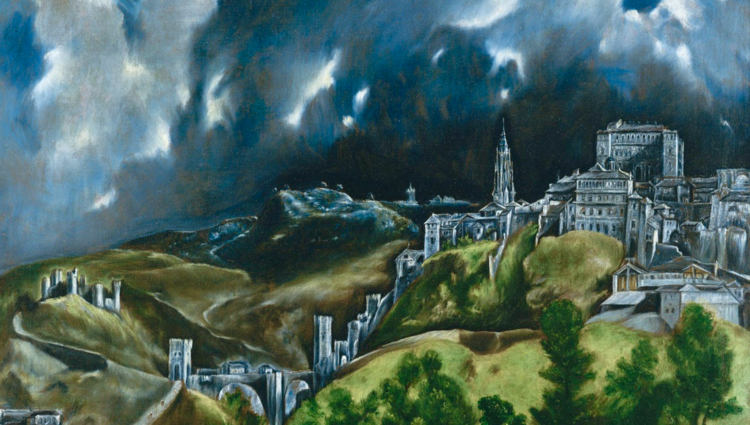
The featured image is “View of Toledo” (between circa 1596 and circa 1600), by El Greco, and is in the public domain, courtesy of Wikimedia Commons.