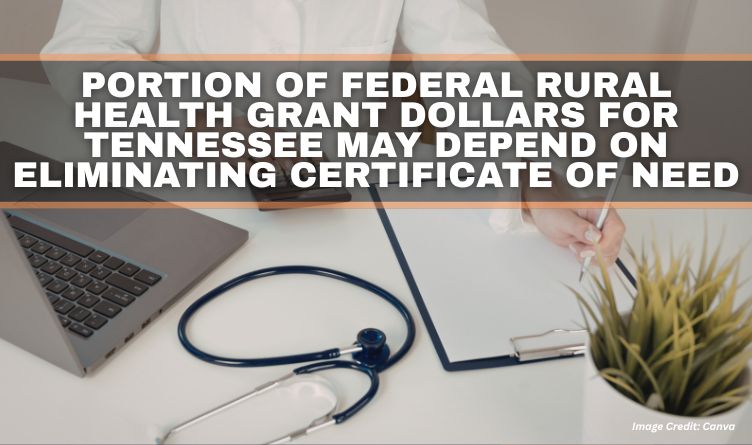
Tennessee’s grant application said legislature would pass law eliminating CON in 2026.
Image Credit:
***Note from The Tennessee Conservative – this article posted here for informational purposes only.
By Cassandra Stephenson [Tennessee Lookout -CC BY-NC-ND 4.0] –
A portion of Tennessee’s federal grant money from the Trump administration’s Rural Health Transformation Program may depend on state lawmakers’ ability to pass legislation eliminating the certificate of need law — something the Tennessee Hospital Association has resisted for years.
The Joint Ways and Means Committee voted unanimously on Jan. 14 to accept nearly $207 million in federal grant dollars for the grant’s first year, but not without reservations.
Tennessee anticipates receiving up to $1 billion from the program over the next five years, but not all of that funding is guaranteed.
The state will receive $100 million in baseline funding for each of the five years, but additional competitive funds are granted each year based on states’ application strength, alignment with the Trump administration’s goals and “commitment to meaningful reform,” J.W. Randolph, deputy commissioner for population health infrastructure at the Tennessee Department of Health, told the committee.

Tennessee’s application for the program includes several policy commitments, including introducing and passing legislation in 2026 that would:
- Eliminate certificate of need across facility categories, to be implemented by Jan. 1, 2027
- Enable “full scope of practice” for nurse practitioners and physicians’ assistants, “full authority” for pharmacists, and “unrestricted scope of practice” for dental hygienists by Jan. 1, 2027
- Require schools to reestablish the Presidential Fitness Test, with implementation by Dec. 31, 2028
- Require nutrition to be a component of continuing medical education for physicians, with implementation by Dec. 31, 2028.
These promises raised concern from Rep. Bud Hulsey, the joint committee’s co-chair, Sen. Bo Watson and Rep. Ryan Williams.
“Is there a bill in the pipeline, and how are you so sure that the legislature is going to pass it? Because I’ve seen them blow up, more than one time, on the floor,” Hulsey asked. “And if it does not pass, how does that affect the outcome of next year’s money?”
Randolph said no specific legislation has been filed and potential fiscal impacts have not yet been studied. The filing deadline for legislation is Jan. 31.
The Centers for Medicare and Medicaid Services, which administers the Rural Health Transformation Program, has not “provided a specific rubric to say how much funds we could get in addition from passing those policies … or how much we may lose out on subsequent years,” Randolph said.
He described the grant program’s structure as “an invitation to reform” and said the federal government indicated it would provide more financial support to states that show commitment to transformational change.
“They have indicated that we as a state would be more competitive for more funding through policy change, and that some share of this year’s funding, if policies are not implemented, might be clawed back,” Randolph said.
Certificate of need laws require hospitals or health systems to show community need before establishing or expanding certain health care facilities or services. The law supports nonprofit hospitals by allowing limited competition, so they can use revenue from high-demand services like heart and knee surgeries to subsidize the cost of mandatory charity care.
But opponents of the law have claimed it restricts competition, and therefore reduces access. HCA Healthcare and the Center for Individual Freedom — a group whose donors are legally anonymous — advocated for the complete repeal of certificate of need in 2024.
Tennessee enacted a partial certificate of need reform law removing restrictions for satellite emergency rooms in counties with existing hospitals that year. The law also made it easier to open a hospital in a county where a hospital does not already exist.
What the money would pay for
Tennessee outlined five focus areas in its application for the program:
- Improving access
- Maternal and child health
- Technology infrastructure
- Preventative health and wellness
- Workforce development
Gov. Bill Lee’s Rural Healthcare Resiliency Program, a competitive state grant program that has invested more than $300 million of TennCare shared savings dollars since 2023, will be used as a model for funding distribution for competitive grants within those categories.
Initiatives proposed in the application include several competitive grants within each category, a Last Mile Initiative for emergency medical services, expanding Tennessee’s Safety Net program, creating a Memory Care Assessment Network, a dental pilot extension, technical assistance investments and a $100 million expansion of value-based payments led by TennCare for hospitals as well as maternity and dental care in rural areas.
Value-based care focuses on patients’ overall health with the goal of coordinating across practices and doctors, improving patient experience and helping patients avoid hospital stays and trips to emergency departments.
It’s not clear which portions of Tennessee’s plan for the Rural Health Transformation grant would be reduced or eliminated should Tennessee not receive all of the anticipated $1 billion in federal funding.
Rural Health Transformation Program funds cannot be used for construction (anything that requires permits), clinician salaries, loan repayment, hospital operating deficits or historical debt. There are restrictions on payments for providers, and the funding cannot be used for higher reimbursement rates.
The first tranche of funding would need to be expended by Sept. 30, 2027.

Williams, a Cookeville Republican, asked if the funding could help raise reimbursement rates for rural providers.
“We know that expenses in rural communities look different than they do in metropolitan areas, so as we think about the value-based payment approach, we really believe that the funds can be used to drive better health outcomes and paying for those types of services, whether it’s infrastructure, whether it’s around the way that they serve members that are TennCare, will result in more dollars going to those providers that won’t be going through a provider rate increase,” TennCare Chief Medical Officer Victor Wu said.
Williams and Watson said the plan does not seem “transformational” to them. Williams added that payor mix — the breakdown of revenue from different medical insurance payors — is key in rural health care.
Smaller hospitals tend to rely more on Medicare and Medicaid payments than larger hospitals, which tend to have a higher percentage of commercial or private insurance payors and self-pay patients.
“I think it’s really important for us to know that the reason why we moved to licensure and payor mix is because it is the last best effort for us to provide some kind of protection for those small rural hospitals, of which 75% have disappeared under this administration,” Williams said.
The Rural Health Transformation grant program is a result of $50 billion earmarked in the One Big Beautiful Bill Act for rural healthcare over the next five years. The budget act is also expected to reduce federal Medicaid spending by more than $900 billion over the next decade. The act’s changes to Medicaid, the Affordable Care Act Marketplaces and Medicare and policy interactions are expected to increase the number of people without health insurance in 2034 by 10 million, according to the Congressional Budget Office.
Tennessee is projected to see roughly 68,000 more uninsured residents by 2034, according to estimates published by KFF Health News. The majority — 40,000 people — would become uninsured due to changes in the ACA Marketplace, while 24,000 people would lose insurance due to Medicaid changes.