 Father Nussbaum was under no illusion. Like all great missionaries he was thinking of martyrdom. He accepted it in advance, and even, deep in his great Christian heart, he hoped for it. He remembered all those who before him had wet this hostile soil with their blood. He thought of Father Mussot who, on April 6, 1905, was attacked by a mob incited by the lamas, stripped of his clothes, beaten until he bled, then shot to death point blank. He thought of Father Soulié who, a week later, was shot through the head and through the heart, and then decapitated so that the mob could use his head for a football. He thought too of the Christian natives of this very Yerkalo, the converts of Father Mussot and Father Soulié, who four days later, on April 18, had been massacred to the last man, woman and child. He thought of Father Bourdonne, bristling with arrows like a Saint Sebastian; of Father Dubernard, whose torture had lasted two days, dragged barefoot for miles, mocked and sneered at for hours and hours by the lamas, who suggested that he adopt their faith and finally had him decapitated by an executioner so clumsy that it took three sword strokes to sever his head. The last on the list of martyrs in Tibet was Father Monbeig, ambushed and shot in a mountain gorge. The last? Or was he the last?
The fury of the Grand Lama of Karmda grew with each new Christian convert. He had just sent a delegation to the Dalai Lama in Lhasa, urging him to expel every Occidental priest in Tibet, those in Yerkalo as well as those at Latsa Pass, when the first World War broke out. The hospice was already two stories high, and the two missionaries at Yerkalo were winning more souls to Christ every day. When the news from Europe reached this distant land, there was great rejoicing among the lamas. The Japanese advance into Yünnan would soon isolate the Christians on the Upper Mekong, leaving them to the ill will of the lamas. Communication with Europe being for all practical purposes cut off, the missionaries were in a desperate situation that lasted for years. They sold their poor belongings, even their clothing, in an attempt to maintain their groups of young Christians. Lack of money halted construction of the hospice, and the half-finished walls were soon crumbling under the impact of high winds and driving snow.
The people themselves, however, showed no hostility to the priests. Their limitless kindness had won many hearts, and their care and medicines had been a godsend to the sick. Some of the young Christians went into business to help support the missionaries. Months passed.
The Grand Lama of Karmda had bided his time. His envoys to the Dalai Lama had not returned, perhaps the victims of bandits or the weather. Now he decided to take advantage of the circumstances and act on his own. Rather than soil his own hands with blood, even European blood, he took counsel with a bandit chief named Tchrachi, well known in the region for his countless misdeeds. Head of a gang of footloose men who lived by holding up caravans, pillaging villages, and plundering at random, he seemed immune from control or punishment. The Chinese officer commanding the little post at Sido-weisi learned this to his sorrow. When he tried to put a stop to the gang’s activities, the bandit chief kidnapped and killed the officer’s son. The gang leader’s morals were worthy of the blackest days of the Middle Ages. He profited by the chaotic state of the country which was not sure whether it was under Chinese or Japanese control—or was it the Communist generals who were running things?
The great enemy of the Lama of Karmda was Father Nussbaum, whose very presence in Forbidden Tibet was a crime in the eyes of the theocrat. Moreover, he was more vulnerable than the other priests, who lived in groups. Father Nussbaum was almost always alone. And yet even the lonely missionary of Yerkalo was not easy to dispose of. To attack him in the village itself would be risking a battle with his native Christian converts. He would have to be closely watched during one of his frequent journeys to visit a colleague or to carry the Word of God to some distant group of Tibetan Christians.
Early in September 1941, Father Nussbaum left to go into retreat at Tse-chung where his superior, Father Goré, and his friend, Father Lovey, were stationed. He left Canon Tornay in charge of the mission at Yerkalo. On the way out he was indeed ambushed and surrounded by bandits. They were not the terrible Tchrachi’s men, however, but of a lesser breed, and the missionary was able to bribe his way to freedom.
The return trip was a different story. Father Nussbaum’s little caravan consisted of a bearer and three Tibetan Catholic girls who were going to Yerkalo with him to teach catechism. The first two stages of the journey were without incident. At the end of the third day, however, the missionary sensed danger in the air.
The travelers reached Napu, a little village at the start of the long steep climb to the pass leading to Yerkalo, intending to spend the night there. When the villagers refused shelter to the Christians, however, they pushed on. Several lamas they passed on the road eyed them with hate. Then, as they started the climb, a friendly woman whom they met warned Father Nussbaum that Tchrachi lay in ambush at the pass.
The little caravan returned to Napu, where every door was still locked against them. They camped in the village marketplace—but not for long. The mice would not come to the cat? Then the cat would come to the mice.
The darkness was filled with bandit yells and the terrified screams of the three Tibetan maidens. Then came threats, arguments, and the usual bargaining for ransom. The brigand chief demanded three hundred piasters. Father Nussbaum offered thirty. They compromised on thirty pieces of silver, plus all the tea in the caravan and two blankets.
The three weeping maidens could not believe they were free to proceed. They thanked God for having delivered them. And the Christian caravan moved on to Pamé.
At Pamé they had reason to believe themselves safe. The mission there was solidly built and fortified. There was food, and they could rest. The night was warm, so the bearer and the three girls slept outside on the terrace. Father Nussbaum retired to his room to read his breviary.
During the night six armed men climbed to the terrace. Awakening with a start, neither the bearer nor the girls had time to cry out. At gun’s point they were forced from bed and their hands tied behind them.
The bandits then battered down Father Nussbaum’s door, tied his hands, and bound him to a post. The moment he had been expecting, the moment of martyrdom, had come at last.
But the bandits were in no hurry. First they sacked the mission, stealing everything they could carry off, eating and drinking their fill. Then they marched their prisoners out of the village while the terrified villagers, even the Christians among them, stood by helplessly.
Father Nussbaum was without shoes. The rocky path tore his socks to shreds, then drew blood from his feet. Where were they taking him? Wasn’t this the path leading down to the stream, to the deserted mill? Wherever the path led, the missionary knew that God would be waiting for him at the end. He could not delude himself. The brigand walking behind him held the muzzle of a gun pressed against his back between his shoulder blades.
Father Nussbaum staggered a little, as the stones bit painfully into his feet. He prayed as he walked, raising his eyes to the stars from time to time. When they reached the edge of the ravine and the path started down steeply toward the stream, the man behind the missionary pulled the trigger. One shot was enough. The bullet pierced the priest’s heart. Father Nussbaum fell dead.
One after the other, the bandits stepped up to peer at the body of the dead priest. Then they set the four other prisoners free. Their job concerned only Father Nussbaum. They had done their work. They disappeared into the night.
At daybreak the diabolic clangor of gongs and bells at the Lamasery of Karmda proclaimed victory for the Grand Lama, while a little group of Christians from Pamé walked sadly to the edge of the ravine to recover the saintly remains of a man of God. The Church could count one more martyr. A new name had been added to the honor roll of God’s Adventurers, the name of a hero.
_________
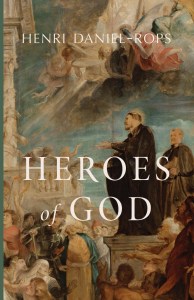
This essay is taken from Heroes of God.
Republished with gracious permission from Cluny Media.
Imaginative Conservative readers may use the code IMCON15 to receive 15% off any order of not-already discounted books from Cluny Media.
The Imaginative Conservative applies the principle of appreciation to the discussion of culture and politics—we approach dialogue with magnanimity rather than with mere civility. Will you help us remain a refreshing oasis in the increasingly contentious arena of modern discourse? Please consider donating now.
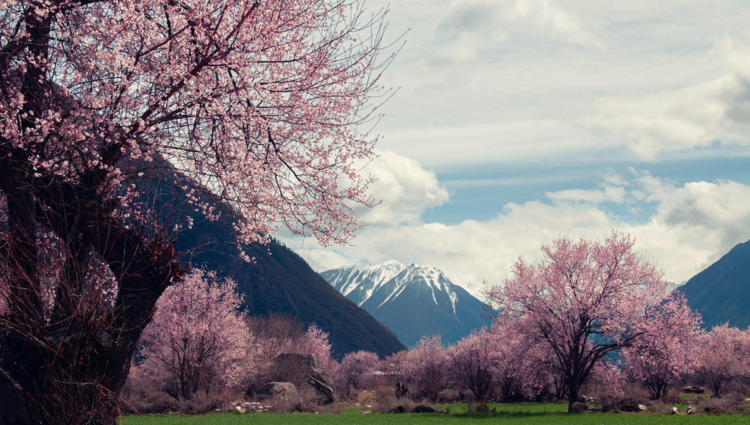
The featured image is courtesy of Pixabay.