At a recent well publicised employment tribunal in Scotland Sandie Peggie took action against a hospital in Fife over the alleged mistreatment she received after she dared to raise objections about the doctor, a transsexual who claimed to be a female, changing in the space which had been designated for female nurses. The tribunal found that she had been harassed by her employer, but crucially it dismissed her allegations of discrimination, indirect discrimination and victimisation. We reported on the law making an ass of itself here.
Further problems emerged with what turned out to be an AI assisted legal judgment. The Daily Telegraph revealed two made up AI quotes in the Peggie judgement while a thread on X listed further errors both reported by Jonathan Engler here.
In the article below he reveals further misinterpretation of the much quoted and referred to 2011 Swedish ‘trans’ study published by Cecilia Dhejne and colleagues in which the authors reported on mortality, suicidality, psychiatric care and conviction rates among individuals who transitioned in Sweden between 1973 and 2003. This paper informed the judgment of the tribunal. Now Engler exposes a double layer of error hidden from AI ‘interpretation’. Not only is it a study that been widely misinterpreted and misused, but the authors themselves Engler finds obfuscated the most important conclusions of their own work.
***
I suspected then that further scrutiny of the Peggie judgement would reveal further errors, and sure enough I just spotted this post on X:
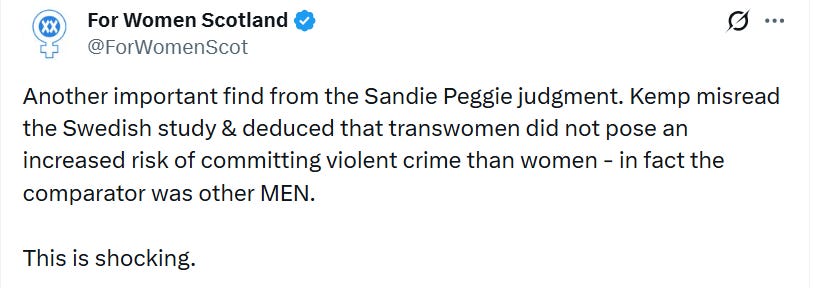
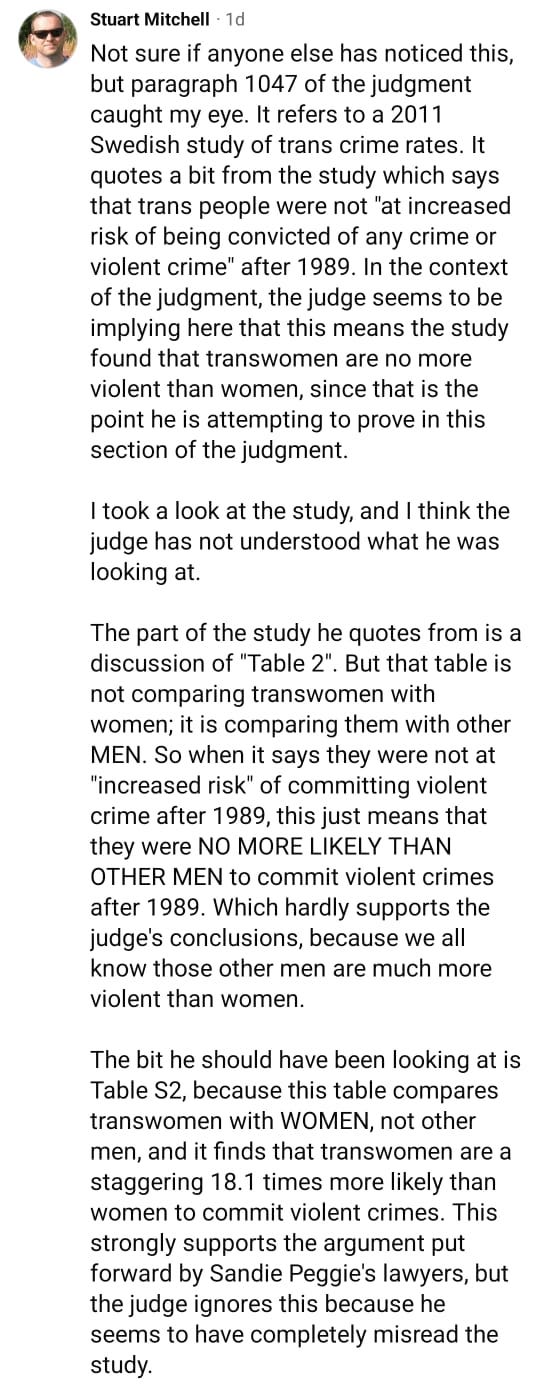
I was intrigued by this so thought I would take a close look at the 2011 Swedish study referred to.
It is fair to say that not only has the judge made a monumental and highly misleading error in the way in which he has interpreted this study, but the authors have – quite deliberately it appears – obscured and downplayed findings which fly in the face of “progressive” thinking on this issue.
The judgment (corrected) is below and downloadable from here:
This is para 1047:
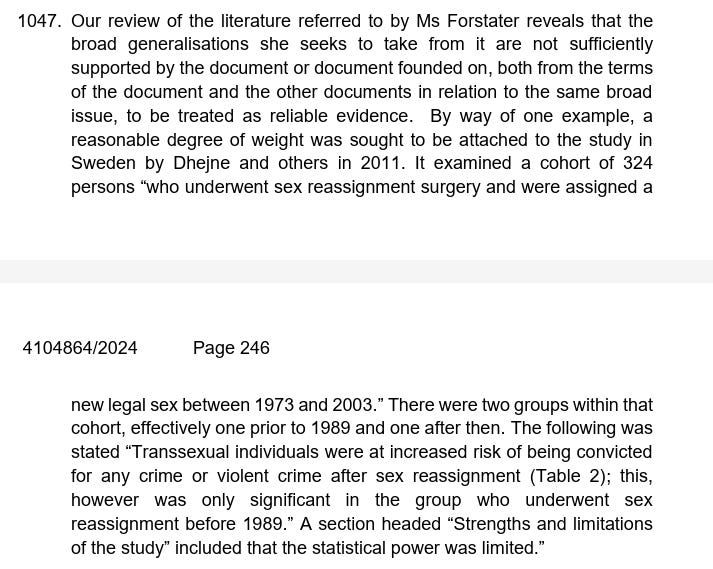
The judge mistakenly cites a metric of dubious relevance.
Stuart Mitchell (the author of the commentary posted on X) is quite right in that the judge does indeed appear to be specifically and selectively referring to the commentary to Table 2 in the paper.
Here’s that table:
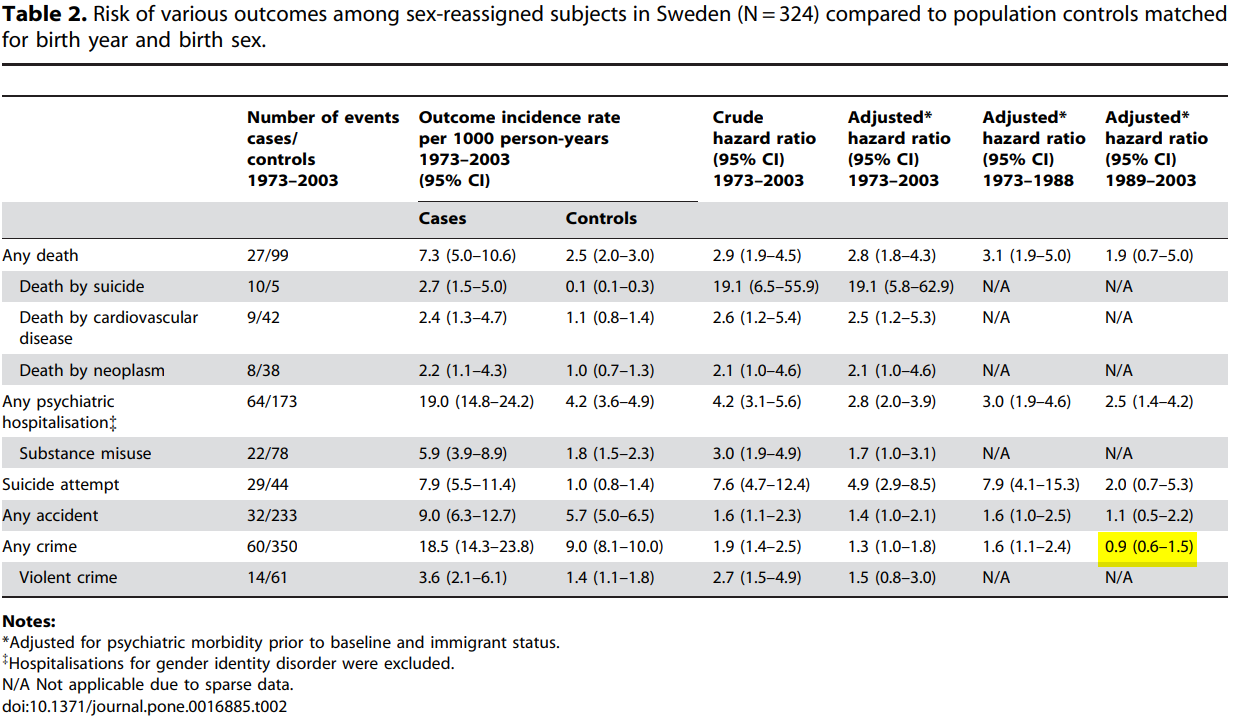
The commentary in the paper reads:
Transsexual individuals were at increased risk of being convicted for any crime or violent crime after sex reassignment (Table 2); this was, however, only significant in the group who underwent sex reassignment before 1989.
And Stuart is quite correct that this is a table which compares various outcomes to controls matched to birth sex – that is to say, comparing men who had transitioned to women to male controls, and women who had transitioned to men to female controls.
That has nothing to do with one of the arguments being put forward by Sandie Peggie – that it was perfectly natural that she should feel frightened about the presence of a male (who had claimed to be a woman) in her (female) changing room.
However, even that metric is misrepresented by the study’s authors.
In any event, it’s worth pointing out that the quote above (which is from the published paper) is, anyway, misleading in that, taken as a whole, the results certainly don’t refute the possibility that transexuals are more likely to be associated with a conviction for violent crime – including for those undergoing transition after 1988.
The differences are diluted by the adjustment process (adjusting for prior psychiatric illness and immigrant status), but even after such adjustment the lower bound of the confidence interval for the metric said to be not significant (which I have highlighted) is only just below 1, suggesting a result close to statistical significance, which it may well have reached with a slightly larger sample size.
So to say “this was, however, only significant in the group who underwent sex reassignment before 1989” is technically true, but misleading and certainly not to be taken as a refutation of a hypothesis that similar differences may have been seen in those transitioning after 1988.
More information, as is often case, can be found buried in the supplementary information.
Table S1 thereof (downloadable from here) shows the data from the above comparison (risks of various outcomes in sex-reassigned persons in Sweden compared to population controls matched for birth year and birth sex) broken down differently.
Here, they don’t divide up the data according to the date of the transition, but instead split the data by whether the transition was female to male or vice-versa:
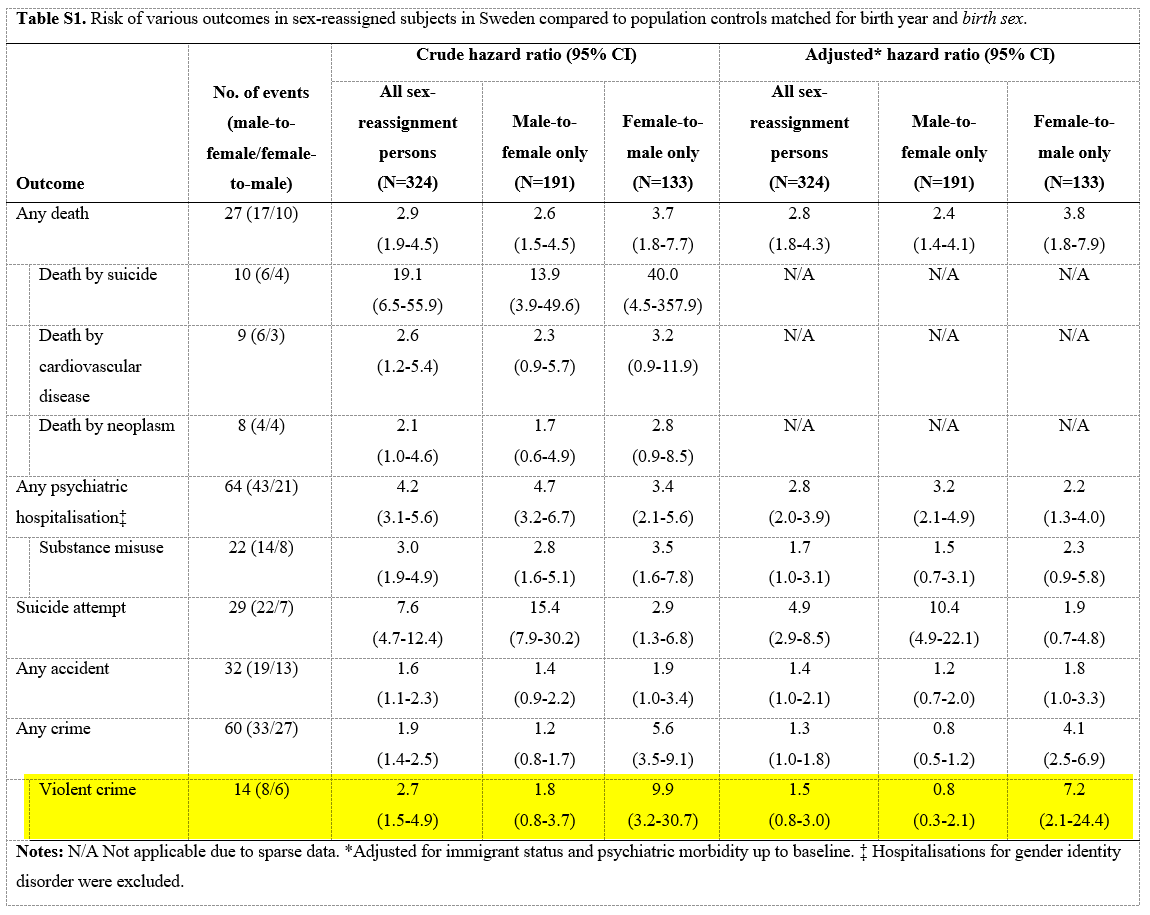
According to this view of the data, those who transitioned from female to male were 7 times more likely to commit violent crime (and 4 times as likely to commit any crime) than female born controls. Numbers are small, hence confidence intervals are wide, but these results ARE certainly highly statistically significant.
Hence the extract from the paper – and the judge’s quotation of it – are BOTH selective reading of the data (based on chopping up the numbers differently) and hence quite misleading.
Incidentally, in the absence of the original protocol, it is impossible to say whether this splitting of the data by date of transition was something which was always planned, or whether it was something they’ve introduced once they’ve seen the data so as to reduce its impact – so-called “hypothesising after the fact”. Supporting the latter is that this breakdown isn’t mentioned in the methods section at all, and no convincing justification is given for it anywhere else.
What does the more relevant metric suggest?
However, as Stuart pointed out, this isn’t, in any case, the most relevant metric in the context of this case. Much more relevant to Sandie Peggie’s concern was whether someone claiming to be a female having been born a male had a propensity to violent crime greater than the women for whom her changing area had been traditionally reserved; put differently, do male to female transitioners retain the proclivity to violent crime of males, who are undeniably associated with more violent crime than females.
For that, a comparison to final sex is required, and that is provided by table S2 however (here):
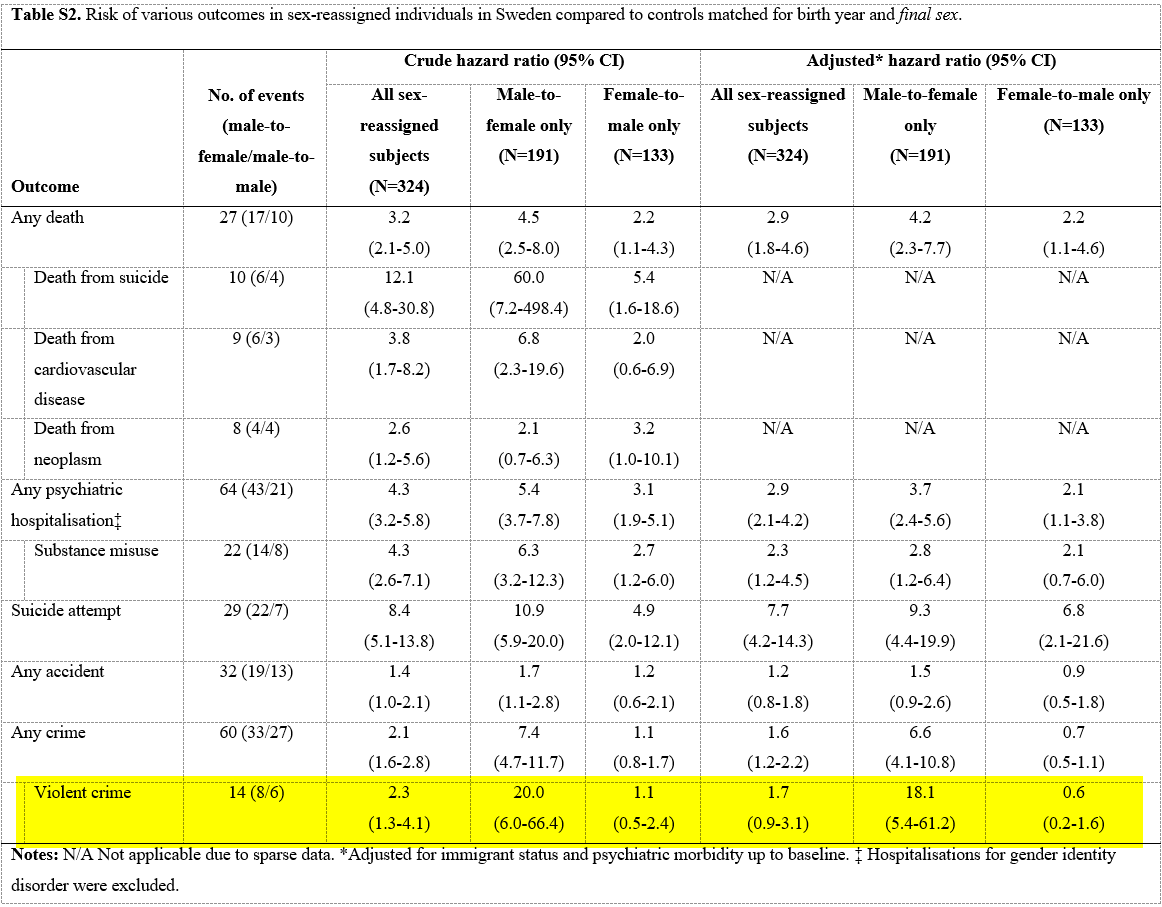
Here, we can see that the hazard ratio for violent crime committed by male to female transitioners (compared to female controls) was, even after adjustment, a highly (statistically) significant 18.
The authors fail to mention this in their abstract.
The abstract (often the only thing most people read) does in fact refer to the increased criminality for female to male transitioners compared to those born female, but does NOT make reference to the specific data for violent crime:
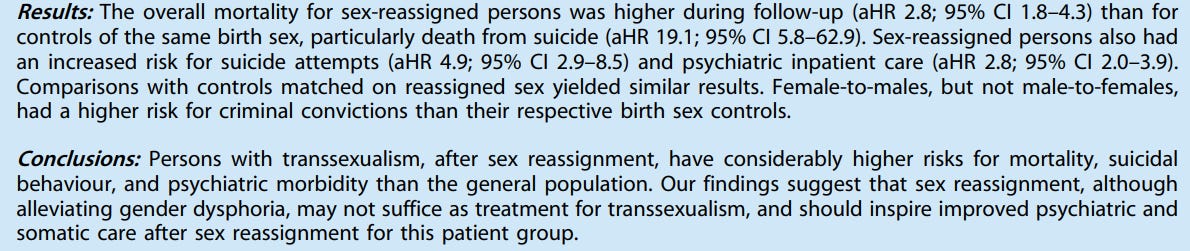
However, a close reading of the main text does reveal that the authors were well aware of the association, but chose not to mention it in the abstract.
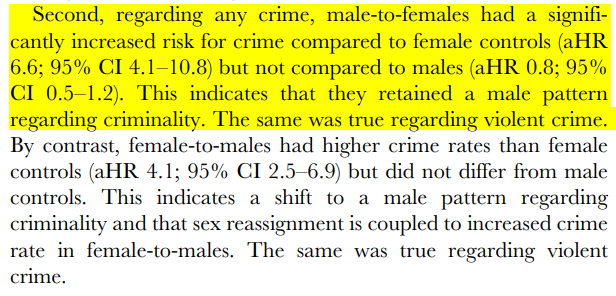
These obfuscations and misrepresentations become ‘ground truth’ through replication.
According to this post:
This study is routinely misread by activists in this way. They have training points about how the author really meant that trans identified makes have the offending profile of women.
The judge is either familiar with these distortions or the AI has learned them. Either is not good.
I am not that familiar with this area, so cannot comment on how this study has been read or misread by activists, though would note that even as presented by its authors it is highly misleading.
However, I agree that this does look to be an example whereby AI’s progressive bias has directly infiltrated itself into the judge’s thinking and decision.
Of course, once it becomes part of such a judgment, it can be amplified as if it were true, as this ‘Doctoral Researcher’ has done without bothering to trouble himself as to whether the judge was correct:
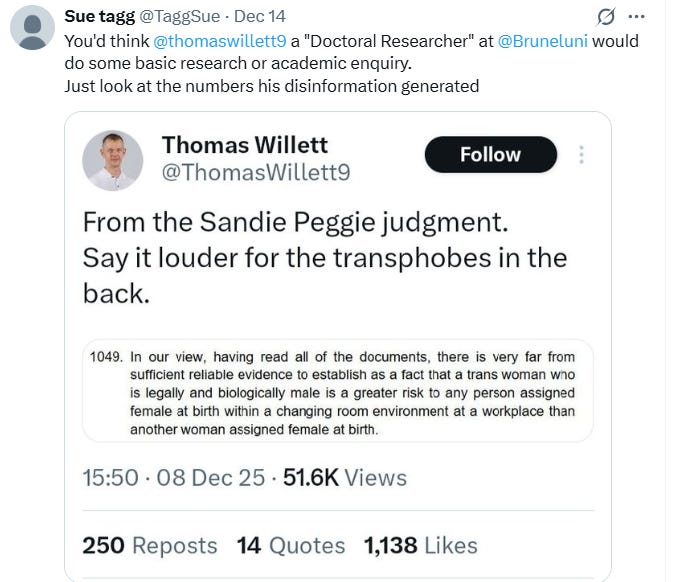
I need to make it clear that sitting above all of this debate is another observation which is this: we surely do not need to be looking at the statistical significance of data from studies to decide whether a woman is or isn’t justified in feeling uncomfortable with a man (identifying as a woman) in her changing room.
That we are even having the debate according to these rules of engagement is a scary reminder of how technocratic policy and decision-making has become.
Concluding remarks
It’s worth emphasising here that this piece isn’t primarily about the transgender movement. Many of the comments I have made above apply to other topics, such as the branch of fiction known as “climate science”.
This article was actually an attempt to articulate 2 major concerns:
- how AI is rapidly facilitating the inclusion of ‘progressive’ bias in a wide range – if not all – institutional thinking.
- the poor quality of published science generally, and how its authors will also obscure and misrepresent data to appear to remain consistent with liberal establishment expectations.
This article was first published on Sanity Unleashed and is repblished here by kind permission