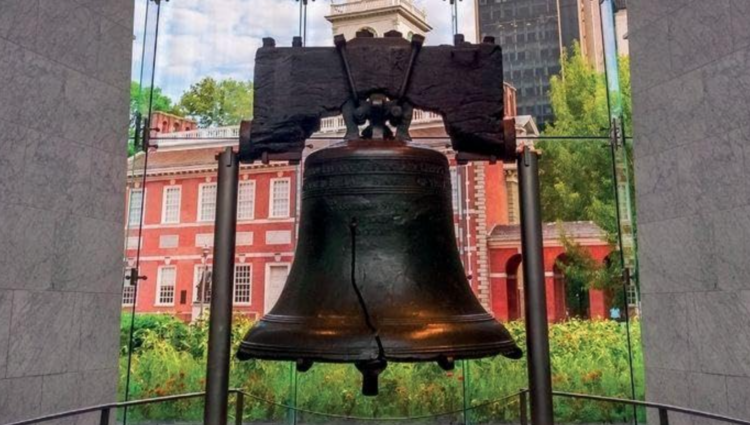
Chris Gibson’s “The Spirit of Philadelphia” helps us to rethink the role of Common Sense Realism as a unifying principle of American life. But that idea rests on a greater idea. The spirit of Philadelphia has no sustaining power to preserve order in soul or republic unless wedded to the genius of Christianity.
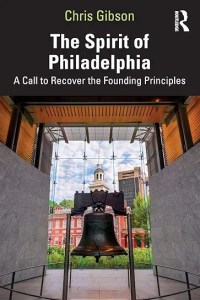
The Spirit of Philadelphia: A Call to Recover the Founding Principles, by Chris Gibson (268 pages, Routledge, 2025)
 Russell Kirk, father of modern conservatism, noted that “if we lack order in the soul and order in society, we dwell ‘in a land of darkness, as darkness itself.” The American Republic survives in darkening twilight. The Spirit of Philadelphia: A Call to Recover the Founding Principles is former US Congressman Chris Gibson’s attempt to rekindle an exceptionally American light. Gibson is well-equipped for the task. A true son of the founding fathers, Gibson’s life has combined deep thought and heroic action as a soldier, a statesman, and a scholar. He is our upstate New York Cincinnatus.
Gibson’s book is a timely defense of our founding liberalism against the encroaching darkness of authoritarianism. Timely not only because the darkness has many allies, but because many friends of the light have lost faith in the foundational principles of American order. American Conservatives have historically sought to preserve the best of classical liberalism. But newly minted post-liberal conservatives increasingly view the founding order as illegitimate from the start. Gibson has written a defense of classical liberalism supported by a philosophical framework he calls American Common Sense Realism. Gibson’s work responds to Patrick Deneen’s 2018 book, Why Liberalism Failed, offering a rejoinder, not because liberalism was flawed, but because it was betrayed.
The book is divided into three sections. The first explains how Western Philosophy has influenced American political thinking and introduces the balanced philosophical approach of Thomas Reid and the Scottish Common Sense Realism school of thought. Gibson notes that the Common Sense Realism was central to the thinking of our Founding Fathers and remained the de facto American philosophical standard through the end of the Civil War. He argues that the best forms of philosophical foundations help to maintain a balance that recognizes our whole humanity.
The battle of ideas tends to push toward extremes, with some schools advocating for the common good and unity of the whole, while others emphasize the centrality of the individual and the diversity of the multitude. One philosopher holds that all reality is material. Others see all things as spirit or idea. However, a balanced approach to life and philosophy recognizes that we are, individually, a unity of body and soul. We are collectively a unity seeking the common good, yet we are individuals endowed with unalienable rights and corresponding duties. Truth and virtue are complex. Applying them to personal decisions or public policy debates requires the wise balancing of various goods while mitigating harms. This calls for a realistic, common-sense approach that is willing to learn from reality rather than forcing it into preconceived ideological molds. This process of avoiding extremes makes compromise both possible and beneficial, as it requires the discovery of truth through debate and experience. This Gibson finds in the American Common Sense Realist tradition.
The second section provides a more in-depth exploration of the rise and decline of Common Sense Realism. Here, Gibson offers an explanation of how American Common Sense Realism informed the Declaration of Independence as well as our Federal Constitution. Although it is popular to think that Americans reject philosophy, the Founders were learned men who inherited the Western intellectual tradition by way of the Reformation and the Enlightenment, especially the Scottish Enlightenment. Consistent with his focus on the founders’ classical liberalism, Gibson emphasizes philosophy rather than theology. However, Gibson also acknowledges that the strength of that liberalism was its balance of individual liberty (shaped by John Locke and Francis Hutcheson) with community solidarity (a gift of Puritan and First Great Awakening Christianity).
So what is Common Sense Realism? Common Sense Realism was an attempt to answer the question of how we know what is true. To generalize, our options are either to look up and intuitively grasp the meaning of great ideas in our minds (Plato/idealism) or to look down and study the facts that are perceived by our senses (Aristotle/empiricism). A third and far more dangerous possibility presents itself: that truth cannot be known at all. Common Sense Realism seeks to confront this third possibility by arguing that we directly perceive the reality of the world around us. Perceiving reality through our senses, mankind is endowed by its Creator with the ability to process and understand it.
What Americans gained from this practical philosophical foundation was a belief that people could grasp the world as it exists. The mind accepts fundamental truths as self-evident (as in, e.g., “that all men are created equal and endowed by their Creator with certain unalienable rights…”). Debate was seen as both possible and desirable because understanding facts through first principles would lead to a shared understanding of truth. However, in a complex world, facts can sometimes conflict. Multiple perspectives can present plausible cases for the truth. Perceptions of truth are reliable but not perfect. As Gibson points out, we are fallen, and the effects of sin distort our hearts and minds. In such a world, disagreement is inevitable and even beneficial. Compromise is not a betrayal of principles but a means of discovering truth and achieving the common good. For Gibson, this capacity to compromise embodies the true spirit of Philadelphia. But when compromise fails, the only way to judge policy or practice is by allowing ideas to compete through the political process and choosing the winner by majority.
But in a fallen world, majorities can be misled. That is why our Founders made sure we were not a pure democracy but a republic with institutional checks and balances designed to protect the rights of the minority and shield individual liberty from the potential tyranny of the majority. The common good must be balanced with individual rights. Individual rights must be balanced with individual duties. These duties are judged by our highest obligation to love God with all our heart and our neighbor as ourselves. This balanced, moderate, realistic approach to life together is the genius of the Federal Constitution and the American ideal that Gibson wants to see restored.
However, everyone knows that common sense is no longer common. What happened? Section Three of the book explores how America lost confidence in its own mind. Common Sense failed to find a way to resolve the Founding era’s most significant moral challenge, slavery. The trauma caused America to lose its historic mind. Remember that Common Sense Realism was hardwired for compromise. And compromises were found, but that result was that slavery continued to endure as a sin against the principle that all men were created equal and endowed with unalienable rights. Only four years of earth-shattering violence could purge the land of its original sin. Common Sense Realism was another casualty of the war. From the ashes of cultural cataclysm rose Romanticism, Hegelian idealism, and logical positivism, all of which led to the transformation of benevolent liberalism into malevolent progressivism. As a result, the 20th century saw the rise of big government and the welfare/warfare state. Old liberalism was realist. The new Progressivism was idealistic. Progressivism rejects the idea that man has a fixed nature, much less a fallen one. It views humanity as clay to be shaped according to its own ideological vision. All that was once understood as divinely created nature is reduced to “social construct” because progressivism has a new social construct to impose, sometimes at gunpoint.
The final section is titled “Recovering Founding Principles and Common Sense Realism.” So how does Gibson propose to restore the balanced, moderating principles behind “the spirit of Philadelphia”? Gibson offers hope through strong educational reform that emphasizes returning to the old liberal values of free inquiry and lively debate. Additionally, Gibson presents a public policy agenda based on common sense and a realistic worldview. Whether aiming for a balanced budget, reducing debt, securing borders, or pursuing strategic, pragmatic diplomacy, Gibson relies on the idea that people can see the truth of an argument and accept it when it aligns with common sense.
But can Common Sense be restored through education or a policy agenda? That is a more challenging question. Common Sense becomes rare when people lack shared theological commitments. The American Republic was founded not just on Common Sense Realism but also on a shared Protestant theology and practice. Although the U.S. had no established Church, it was culturally rooted in classical Protestantism. This widespread cultural commitment to Jesus, the Bible, and the Ten Commandments fostered a common conscience that made Common Sense Realism practical and seem inevitable. Today, 21st-century American culture lacks such theological unity. Mainline Protestantism has faltered. Evangelicalism has never obtained the cultural clout of the so-called “Main Line”. The remaining authentic classical Protestantism is too small to have a significant cultural influence. Catholics, especially Roman Catholics, must carry the cultural weight. Thomism (also an Aristotelian, inductive approach to reality) does more to preserve culture today than its Scottish Enlightenment counterpart.
But Rome and classical liberalism are not easy friends. Though they made peace in the 20th century, Deneen’s Why Liberalism Failed is more a return to an older Roman Catholic dissent from liberalism, than an innovative critique. Deneen rightfully diagnoses the ills of progressive ideology but does not see this as a betrayal of liberalism, but as its fulfillment. Deneen cautions that true freedom is the liberty to do the right, and that instilling virtue must be the goal of good government. It’s tempting for conservatives to adopt that critique along with the entire continental conservative tradition—Chateaubriand, De Maistre, and Bonald—with their ultramontanism, medieval romanticism, and organic unity of crown and altar. But for a nation like America, which lacks a true tradition of crown and altar, that path leads only to the authoritarian fantasy of fascism. America’s tradition is rooted in Protestant theology, republicanism (small “r,” please), and classical liberalism. These principles are what our conservatism must uphold to remain truly conservative. Reactionary Roman Catholics, whom I deeply respect, may hope to influence America’s future, but they cannot claim its past.
Can a renewal of Common Sense Realism reinvigorate the classical liberal tradition it helped found? Does it offer a key to conservative renewal that could help restore the much-needed balance to our debates and bring order to both our souls and our republic? Gibson makes a strong case when dealing with the mundane matters of politics. But his handling of America’s second great moral crisis, Abortion, suggests that Common Sense Realism is not enough. Relying on Common Sense, Gibson suggests “reasonable” policy compromises, including a federal ban on states interfering with abortion rights before the unborn baby reaches twenty weeks old. Gibson assures us that this policy is based on science and not religion, an assurance that betrays the problem of Common Sense Realism.
Further, as a conservative Presbyterian who considers himself catholic in the small “c” tradition, I am skeptical of Common Sense Realism’s ability to understand the genuine nature of things and to place them in proper context. Common Sense can easily grasp physical reality but struggles to see the spiritual reality connected to it. As a Presbyterian, I am used to defining a sacrament as an outward sign of an inward reality. Matter and spirit are not enemies but intertwined throughout God’s creation, culminating in not only mankind’s unity of body and soul but also in the incarnation of God in Jesus Christ. Common Sense struggles to see the spiritual united to the physical and is therefore easily tempted by the twin sins of materialism and pragmatism.
The point is illustrated by an interesting comment from Gibson regarding his opposition to Hegel, in which he admits to an increasing sympathy for the idea that reason is ontologically real. Still, he explicitly denies that reason is an independent force guiding humankind (Page 28). That’s fair when talking about an abstraction, but what if the reason at the universe’s center is a person? What Gibson misses is that Jesus Christ is the ontological Logos (reason, thought, Word) of God, who not only exists but also draws all things to Himself. He is the fullness of all truth. He is the great scientific, mathematical, and philosophical reality. Through Him, all things were created. In Him is all knowledge. He is the meaning of history, for He is its ultimate end. He became flesh and dwelt among us. His name is Jesus Christ, and His death, burial, and resurrection disarmed principalities and powers. He is currently enthroned at the right hand of His Father with all authority in heaven and earth. He rules the nations. Providence unfolds by His hand. While His Kingdom is not of this world, the kingdoms of this world cannot rebel against His universal reign without consequence. This is the greater, overarching meaning of history. Ask St. Augustine.
An authoritarian imposition of virtue will not resolve liberalism’s discontents. Nor will renewed philosophical commitment to the Scottish (or American) Enlightenment, or to Plato or Aristotle. Only when liberalism recognizes that its proper context and ultimate purpose are found in the Logos of God, only when Jesus Christ is honored by individuals, families, communities, and nations, will they find their pursuit of happiness crowned with actual significance. Liberalism in its classical form is not anti-Christian. It is a cradle Protestant. At its best, it offers a beautiful balancing of the claims of the common good and individual liberty. Jesus Christ is the only secure basis to secure human dignity, moral right, and individual liberty.
Chris Gibson is a good man. He has written a good book in defense of the American idea—a book that helps us to rethink the role of Common Sense Realism as a unifying principle of American life. But that idea rests on a greater idea. The spirit of Philadelphia has no sustaining power to preserve order in soul or republic unless wedded to the genius of Christianity. Two cheers for a restoration of Common Sense Realism, and three for a restoration of the light of Christian order.
__________
The Imaginative Conservative applies the principle of appreciation to the discussion of culture and politics—we approach dialogue with magnanimity rather than with mere civility. Will you help us remain a refreshing oasis in the increasingly contentious arena of modern discourse? Please consider donating now.