The first and most fundamental principle, if one would undertake to alleviate the condition of the masses, must be the inviolability of private property. The main tenet of socialism, community of goods, must be utterly rejected.
 The fact that God has given the earth for the use and enjoyment of the whole human race can in no way be a bar to the owning of private property. For God has granted the earth to mankind in general, not in the sense that all without distinction can deal with it as they like, but rather that no part of it was assigned to anyone in particular, and that the limits of private possession have been left to be fixed by man’s own industry, and by the laws of individual races. Moreover, the earth, even though apportioned among private owners, ceases not thereby to minister to the needs of all, inasmuch as there is not one who does not sustain life from what the land produces. Those who do not possess the soil contribute their labor; hence, it may truly be said that all human subsistence is derived either from labor on one’s own land, or from some toil, some calling, which is paid for either in the produce of the land itself, or in that which is exchanged for what the land brings forth.
Here, again, we have further proof that private ownership is in accordance with the law of nature. Truly, that which is required for the preservation of life, and for life’s well-being, is produced in great abundance from the soil, but not until man has brought it into cultivation and expended upon it his solicitude and skill. Now, when man thus turns the activity of his mind and the strength of his body toward procuring the fruits of nature, by such act he makes his own that portion of nature’s field which he cultivates—that portion on which he leaves, as it were, the impress of his personality; and it cannot but be just that he should possess that portion as his very own and have a right to hold it without anyone being justified in violating that right.
So strong and convincing are these arguments that it seems amazing that some should now be setting up anew certain obsolete opinions in opposition to what is here laid down. They assert that it is right for private persons to have the use of the soil and its various fruits, but that it is unjust for anyone to possess outright either the land on which he has built or the estate which he has brought under cultivation. But those who deny these rights do not perceive that they are defrauding man of what his own labor has produced. For the soil which is tilled and cultivated with toil and skill utterly changes its condition; it was wild before, now it is fruitful; was barren, but now brings forth in abundance. That which has thus altered and improved the land becomes so truly part of itself as to be in great measure indistinguishable and inseparable from it. Is it just that the fruit of a man’s own sweat and labor should be possessed and enjoyed by anyone else? As effects follow their cause, so is it just and right that the results of labor should belong to those who have bestowed their labor.
With reason, then, the common opinion of mankind, little affected by the few dissentients who have contended for the opposite view, has found in the careful study of nature, and in the laws of nature, the foundations of the division of property, and the practice of all ages has consecrated the principle of private ownership, as being pre-eminently in conformity with human nature, and as conducing in the most unmistakable manner to the peace and tranquility of human existence. The same principle is confirmed and enforced by the civil laws—laws which, so long as they are just, derive from the law of nature their binding force. The authority of the divine law adds its sanction, forbidding us in severest terms even to covet that which is another’s: “Thou shalt not covet thy neighbor’s wife; nor his house, nor his field, nor his man-servant, nor his maid-servant, nor his ox, nor his ass, nor anything that is his” (Deut. 5:21).
The rights here spoken of, belonging to each individual man, are seen in much stronger light when considered in relation to man’s social and domestic obligations. In choosing a state of life, it is indisputable that all are at full liberty to follow the counsel of Jesus Christ as to observing virginity, or to bind themselves by the marriage tie. No human law can abolish the natural and original right of marriage, nor in any way limit the chief and principal purpose of marriage ordained by God’s authority from the beginning: “Increase and multiply” (Gen. 1:28). Hence we have the family, the “society” of a man’s house—a society very small, one must admit, but none the less a true society, and one older than any State. Consequently, it has rights and duties peculiar to itself which are quite independent of the State.
That right to property, therefore, which has been proved to belong naturally to individual persons, must in like wise belong to a man in his capacity of head of a family; nay, that right is all the stronger in proportion as the human person receives a wider extension in the family group. It is a most sacred law of nature that a father should provide food and all necessaries for those whom he has begotten; and, similarly, it is natural that he should wish that his children, who carry on, so to speak, and continue his personality, should be by him provided with all that is needful to enable them to keep themselves decently from want and misery amid the uncertainties of this mortal life. Now, in no other way can a father effect this except by the ownership of productive property, which he can transmit to his children by inheritance. A family, no less than a State, is, as We have said, a true society, governed by an authority peculiar to itself, that is to say, by the authority of the father. Provided, therefore, the limits which are prescribed by the very purposes for which it exists be not transgressed, the family has at least equal rights with the State in the choice and pursuit of the things needful to its preservation and its just liberty. We say, “at least equal rights”; for, inasmuch as the domestic household is antecedent, as well in idea as in fact, to the gathering of men into a community, the family must necessarily have rights and duties which are prior to those of the community and founded more immediately in nature. If the citizens, if the families on entering into association and fellowship, were to experience hindrance in a commonwealth instead of help and were to find their rights attacked instead of being upheld, society would rightly be an object of detestation rather than of desire.
The contention, then, that the civil government should at its option intrude into and exercise intimate control over the family and the household is a great and pernicious error. True, if a family finds itself in exceeding distress, utterly deprived of the counsel of friends, and without any prospect of extricating itself, it is right that extreme necessity be met by public aid, since each family is a part of the commonwealth. In like manner, if within the precincts of the household there occur grave disturbance of mutual rights, public authority should intervene to force each party to yield to the other its proper due; for this is not to deprive citizens of their rights, but justly and properly to safeguard and strengthen them. But the rulers of the commonwealth must go no further; here, nature bids them stop. Paternal authority can be neither abolished nor absorbed by the State; for it has the same source as human life itself. “The child belongs to the father,” and is, as it were, the continuation of the father’s personality; and speaking strictly, the child takes its place in civil society, not of its own right, but in its quality as member of the family in which it is born. And for the very reason that “the child belongs to the father,” it is, as St. Thomas Aquinas says, “before it attains the use of free will, under the power and the charge of its parents.” The socialists, therefore, in setting aside the parent and setting up a State supervision, act against natural justice, and destroy the structure of the home.
And in addition to injustice, it is only too evident what an upset and disturbance there would be in all classes, and to how intolerable and hateful a slavery citizens would be subjected. The door would be thrown open to envy, to mutual invective, and to discord; the sources of wealth themselves would run dry, for no one would have any interest in exerting his talents or his industry; and that ideal equality about which they entertain pleasant dreams would be in reality the leveling down of all to a like condition of misery and degradation. Hence, it is clear that the main tenet of socialism, community of goods, must be utterly rejected, since it only injures those whom it would seem meant to benefit, is directly contrary to the natural rights of mankind, and would introduce confusion and disorder into the commonweal. The first and most fundamental principle, therefore, if one would undertake to alleviate the condition of the masses, must be the inviolability of private property.
_________
This essay is taken from The Great Encyclicals, Volume One: The Social Letters.
Republished with gracious permission from Cluny Media.
Imaginative Conservative readers may use the code IMCON15 to receive 15% off any order of not-already discounted books from Cluny Media.
The Imaginative Conservative applies the principle of appreciation to the discussion of culture and politics—we approach dialogue with magnanimity rather than with mere civility. Will you help us remain a refreshing oasis in the increasingly contentious arena of modern discourse? Please consider donating now.
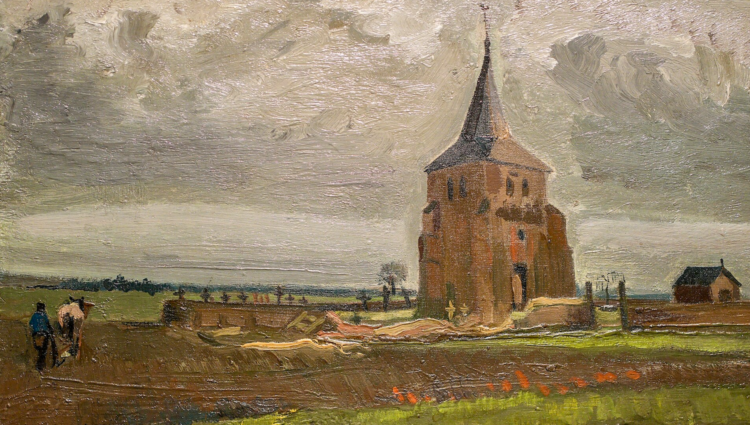
The featured image, uploaded by vangoghgallery.com, is “The Old Tower at Nuenen” (1884), by Vincent Van Gogh” This file is licensed under the Creative Commons Attribution-Share Alike 4.0 International license, courtesy of Wikimedia Commons.