Image Credit: Nashville Electric Service / Facebook
Submitted by Steve Abramowicz of Heartland Journal–
For years I’ve been a town crier in Tennessee warning against making the same cultural and legislative mistakes of my former home states of Washington and California. In a few instances I must give credit where it is due when those blue states get it right and my new home state gets it wrong. California’s Prop 13 real estate property tax cap is my best example. Tennessee is still one of only 5 states that don’t have a cap and sure enough their counties hike on a whim.
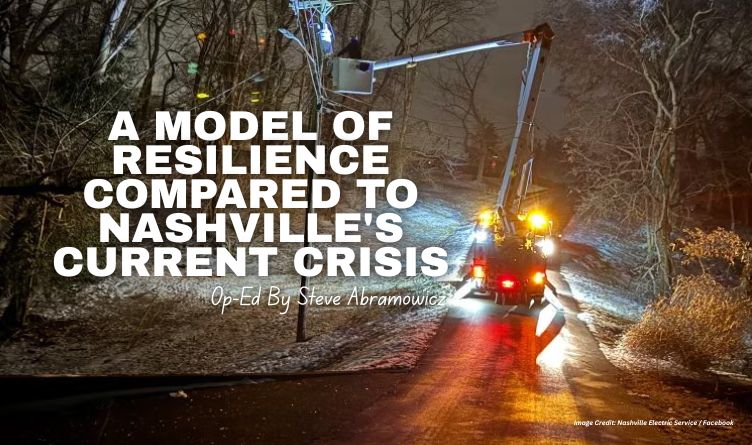
As Nashville Electric Service (NES) struggles to restore power to thousands of residents following Winter Storm Fern, the contrast between their emergency response and that demonstrated by Puget Sound Energy (PSE) during past extreme weather events highlights fundamental differences in utility readiness, communication strategies, and infrastructure investments. The current Nashville crisis reveals systemic failures that PSE has spent years addressing through strategic planning and technological innovation.

PSE has consistently demonstrated superior restoration capabilities during severe weather events. When faced with Pacific Northwest storms that brought similar ice accumulation and wind damage to what Nashville is experiencing, PSE typically restored power to 80-90% of affected customers within 48-72 hours. By contrast, Nashville is reporting that tens of thousands of customers remained without electricity nearly a week after the ice storm, with officials warning that complete restoration could extend well into the following week.
PSE’s strategic advantage lies in their pre-storm preparation protocols. Rather than merely reacting to weather events, PSE implements comprehensive readiness procedures when severe conditions are forecasted. Their crews are staged strategically across service areas, with equipment prepositioned where damage is predicted to be most severe. They maintain mutual aid agreements through coordinated networks across multiple states, ensuring additional resources can be deployed rapidly when needed.
According to reports from Tennessee’s state leadership, Governor Bill Lee expressed concern that “Tennesseans need a clear timeline for power restoration, transparency on the number of linemen deployed, and a better understanding of when work will be completed in their neighborhood.” This criticism highlights fundamental shortcomings in NES’s response that PSE has addressed through their established protocols.
Perhaps the starkest difference between PSE’s past performance and NES’s current response lies in their communication with customers. During Nashville’s ongoing crisis, tens of thousands of residents received incorrectly automated text messages alerting them that their power had been restored when they remained in darkness—a technical failure that created additional anxiety and confusion.
PSE has invested significantly in communication infrastructure that includes real-time outage maps, estimated restoration times by zip code, regular social media updates, and text alert systems with proven accuracy. Their outage management system allows customers to report outages through multiple channels and receive timely updates specific to their locations. The company maintains transparency about restoration priorities, explaining clearly that critical services like hospitals and emergency stations receive attention first, then areas with the largest affected populations, before moving to smaller outages.

Nashville officials appear to have struggled with communication transparency throughout this event, with Mayor Freddie O’Connell initially calling NES’s leadership response “successful” before later changing course to state he was “not satisfied” with restoration efforts. This wavering confidence further eroded public trust in an already strained situation.
The foundation of PSE’s superior performance lies in their long-term infrastructure investments. According to their reliability reports, PSE has systematically modernized their grid with underground lines in vulnerable corridors, equipment hardened against ice accumulation, and smart grid technologies that allow for faster outage identification and isolation. Their Seattle service area reports that “for the 20th consecutive year, service reliability experienced by [Seattle] customers was well above that experienced by all PSE customers in the aggregate.”
PSE has embraced cutting-edge technologies to enhance their response capabilities. They’ve implemented advanced analytics and artificial intelligence to predict vulnerable infrastructure areas before storms hit. Their grid modernization includes real-time monitoring systems that automatically detect outages without customer reports, allowing for immediate dispatch of repair crews. Most notably, PSE has invested in Splunk’s integrated monitoring platform which has “improved customer experience during power outages” and provided maintenance teams with unprecedented visibility into facility data.
The contrast with Nashville’s situation is telling. Reports indicate that NES faced 444 broken poles during the ice storm, with only 107 fixed by the fourth day of restoration efforts. While the volume is certainly substantial, the slow progress suggests insufficient workforce allocation and potentially inadequate infrastructure hardening for known weather vulnerabilities.
PSE’s workforce planning demonstrates superior strategic thinking. They maintain robust training programs that ensure crews are prepared for extreme weather conditions, with certification standards that exceed state requirements. Their mutual aid agreements through regional partnerships allow for rapid scaling of workforce when damage exceeds local capacity.
Reports from Nashville suggest that while NES ultimately deployed more than 1,000 lineworkers, this ramp-up appeared to happen after the crisis had already escalated, rather than as a precautionary measure. The delayed response extended outage durations and amplified community frustration.
The institutional culture at PSE emphasizes proactive crisis management rather than reactive problem-solving. Their leadership has established clear protocols for decision-making during emergencies, with designated spokespeople trained in crisis communication. By contrast, Nashville’s crisis has featured shifting narratives from officials, with the Governor’s office requiring direct intervention to demand transparency from NES.
The company’s reliability reporting demonstrates their commitment to data-driven continuous improvement. PSE regularly publishes detailed performance metrics including System Average Interruption Duration Index (SAIDI) and System Average Interruption Frequency Index (SAIFI) figures. This transparency builds public trust and holds leadership accountable for maintaining service standards.

The difference between Puget Sound Energy’s performance during past extreme weather events and Nashville Electric Service’s current crisis response comes down to organizational philosophy rather than merely meteorological or geographical factors. PSE treats infrastructure resilience and emergency preparedness as core business functions with dedicated budgets and executive oversight. They understand that reliable electricity isn’t just a convenience—it’s essential for public safety, economic stability, and community well-being.
Nashville’s current suffering demonstrates the cost of inadequate preparation. Extended power outages in freezing temperatures create life-threatening conditions, particularly for vulnerable populations including the elderly and those with medical needs. The economic impact extends beyond direct utility costs to lost productivity, food spoilage, and alternative energy expenses.
As Nashville struggles to recover from this crisis, the utility industry should look to PSE’s approach as a model for excellence. Their investment in technology, transparent communication, strategic workforce planning, and infrastructure hardening creates capacity for resilience in the face of increasingly frequent extreme weather events. The choice isn’t between rate increases and service reliability—it’s between strategic investments now and crisis costs later.
Puget Sound Energy has proven that comprehensive grid modernization and preparedness initiatives pay dividends when disaster strikes. Their track record demonstrates it’s possible to maintain reliability even in the face of severe weather. Nashville’s current struggles suggest there are valuable lessons to be learned from utilities that have prioritized resilience over short-term cost savings.