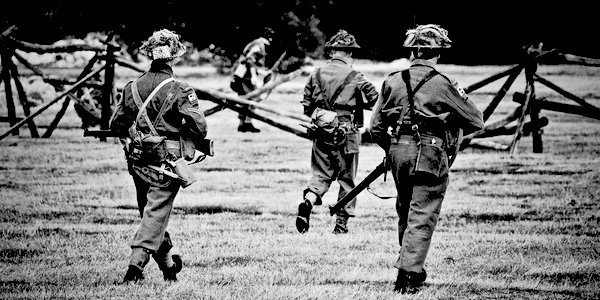
HAVING grown up on a healthy diet of my grandfather’s war stories, from a young age I had a military itch to scratch. However, with a character ill-suited to a full-time military career I decided against joining the Regulars. Instead, about five years ago I joined the Army Reserve, or, to use its more evocative former name, the Territorial Army.
This rebranding was undertaken to move away from the image of the TA – ostensibly a drinking society with an army problem – and towards a professionalisation which would see the Army Reserve meaningfully integrated into the broader Army, backfilling and supplementing where necessary. Sceptical minds can decide whether the aim was to obscure ever-falling troop numbers.
To be fully transparent: I am a small fish in the Reserves. I am no Lieutenant Colonel, nor do I have any battle honours. The fiercest combat I have witnessed is in Brecon, with the rain the most ubiquitous enemy, and in Harrogate, where bored Gurkhas dutifully played enemy, firing blank rounds at clueless recruits as they stumbled across the Yorkshire countryside.
I have, however, been through both soldier and officer training, the former as an infantryman and the latter as a REMF (rear-echelon motherf*cker). I have spent evenings, weekends and fortnights strutting around in MTP (camouflage), cleaning my rifle and polishing my boots. What I have learned during my time as a reservist hardly bolsters my confidence in Britain’s war-fighting capability.
Let us first consider the numbers. The trained strength of the Army Reserve currently stands at just under 24,000 – less than a month’s losses for the Ukrainian army. Not only is this 6,000 under target – and part of a decrease in numbers since 2020 – but I would use the term ‘trained’ with a degree of trepidation. A two-week battle camp in Harrogate does not a fully trained infantry soldier make.
This slide comes amid – or perhaps because of – a drop in selection standards, driven by the desire to remove different fitness standards for men and women, particularly as women can serve as front-line infantry soldiers after a Tory-era shift in policy.
Part of the Army Officer Selection Board (AOSB), when candidates are assessed over a number of days for their suitability to attend Sandhurst, is an assault course. This is an ordeal which sees aspiring Army officers going full pelt across a number of obstacles. It lasts only a few minutes but I vividly remember feeling as if I was running in dream-like slow motion at the end due to the sheer exertion.
Yet it was not as bad as it could have been. During my preparation I had developed a fear of ‘the wall’ – a high wall which must be scaled successfully. I needn’t have worried. On the day a set of lime-green steps like something out of a playground had been set up in front of them so that female aspirants would not be disadvantaged. Good for my chances of scoring highly on the course, but bad for sifting the athletic wheat from the chaff. Tests involving press-ups and sit-ups had been done away with too, replaced by easier, more ‘functional’, alternatives.
Those of us who had got so far as selection were a minority, not just for officers but across the military as a whole, with about 7 per cent of initial officer and 10 per cent of soldier applications resulting in someone starting basic training. The stringent medical procedure sees a large number of applicants fall out of the process, with dreams of serving king and country crushed due to a forgotten childhood health episode. Between the recruiting years 2019-20 and 2023-24, 76,187 candidates failed the medical, me included – having a three-year deferral for a one-time flare-up of eczema.
I have met very few reservists in the wild but many people who tried to join. Almost universally, it is either the hyper-cautious medical that stopped them or simply the excessively long application process which can easily take a year; many simply lose interest in jumping through tedious bureaucratic hoops.
The numbers falling out of the process stand in comic juxtaposition to the tragic recruitment targets set by reserve units. Speaking to a serving officer in south London, whose unit has a catchment area of many hundreds of thousands, they have a target of four recruits per year: two years’ worth of recruitment just to fill an eight-man section.
Perhaps more would be drawn to the cause if the financial incentives weren’t quite so dire. While nobody expects to become rich as a reservist, as it stands it may end up making you poorer. A private soldier is on the princely sum of £68 per day. This, bear in mind, is the pay received for giving away one’s weekends and evenings, which those serving in the Regular Army generally don’t do unless on exercise. To compensate for this inconvenience, reservists get a 5 per cent pay supplement. If, as is increasingly common, your day job puts you in the 40 per cent tax bracket, after a reservist weekend (2.5 days) you will take home in the region of £80: a pathetically small sum.
Part of one’s annual training requirement is to attend a two-week annual camp. Many employers will give unpaid time off for this. This, however, will mean that anyone whose civilian wage is higher than their equivalent military wage will be losing money to attend.
While this is, in part, made up for by a tax-free bonus, this takes five years to build up to roughly £2,200 and is earned by 27 days’ annual service. It is an incentive structure designed to discourage those with families and financial commitments, depriving the Army Reserve of vital human capital. If we want an Army Reserve full of competent, skilled people with varied backgrounds to draw upon during times of national crisis, this is surely not the way to go about it.
Of course, with a government that is totally skint there will be no improvement in financial terms of service, despite repeated hollow commitments to bolstering our armed forces. Making reservist pay tax-free up to a certain limit, for example, would be one simple way of improving the poor terms of service. It might even result in more than six or seven people per unit turning up on an average weekend exercise.
Yet one cannot ignore the broader cultural trends at play. Being in the military can be a bit of a time warp as regards demographics. Overwhelmingly, those involved are of ethnic British stock, although of course there is a large contingent of Commonwealth troops – all of whom are welcomed. Were anyone to insult one of our unit’s Fijians, I dare say that the white British contingent alone would sort them out, let alone the famously fierce Pacific Islanders.
Nevertheless, one wonders what we would be fighting for. A society which regards its past as shameful, or cringes at singing the national anthem, does little to foster martial pride. The feeble bellicose warblings of our leaders (think Sir Keir posing unconvincingly in a camo jacket or Liz Truss desperately recreating Thatcher’s famous tank photo) will not inspire a single soul to take up arms.
Recent polls suggest that a majority would refuse to fight for the country were they called upon to do so. It is tempting to call them yellow-bellied refuseniks, but this reluctance is now spreading into the communities which, previously, would have seen military service for one’s nation as the utmost act of civil participation. The fraying of the social contract – and, many would argue, Blair-Brown-Cameron era misuse of British military power overseas – means that this is no longer widely accepted.
Listening recently to a talk given by a high-ranking officer of seemingly limited intellectual capacity about how we, broadly clueless subalterns, were at some point in the near future likely to be thrown into the meat grinder of a war against Russia made me wonder what the sense would be and for what conception of ‘Britain’ our lives would be so readily thrown into a game of geopolitical poker.
Nevertheless, there is a romance in the forlorn endeavour of serving. It provides a rare space where those of a common disposition, seeking camaraderie and adventure, can do something interesting with their time and serve their country. I firmly believe in the utility of having a well-trained domestically focused reserve military capability. It should be part of our social fabric. That said, I do not think my service will last much longer.
This article appeared in A Last Bastion of Sanity on February 2, 2026, and is republished by kind permission.