It is not only the beginning and the end of our history that consist in actions on a cosmic scale. The central point is also a creative act, the resurrection of Christ, himself the Word of God, by whom all things were made, who is to come in the fullness of time to make all things new.
 The inclusion of Christianity in history: this is a real incarnation. As Christ himself belonged to one nation, one culture, one period of time, so the Church is embodied in successive cultural forms—which are themselves no less transitory than the very civilizations they represent. Karl Marx may show how the economic conditions of first-century Galilee were reflected in the primitive Christianity; or how the Byzantine orthodoxy conformed to the theocratic theory of the Eastern emperors; or how the Reformation followed the economic expansion of the Renaissance, disrupting the medieval forms of social organization: he is discussing what we may call successive Christendoms. In Marxist terminology, these unstable, more or less ephemeral phenomena belong to the superstructure, not to the unchanging, permanently valid infrastructure, which is represented by the Church itself.
The distinction is clearly applicable to the circumstances of the present day. There has been, over the last four centuries, a perfectly normal materialization of Christianity in terms of western civilization. This Christianity of the bourgeois has borne fruit in miracles of charity and holiness. But our world is now in the throes of such a cultural crisis as previous history hardly records: the old world of the bourgeois is in collapse, with all its categories of civilized life and behavior. This is something quite independent of individual preferences, neither to be applauded nor deplored; but we are witnessing the last convulsions of a dying world, a dying culture; and everything about the Church that intrinsically belongs to this particular culture dies with it. The Christianity of the bourgeois has had its day, and Christian people are well aware of the fact; only what is passing is not Christianity itself, but the particular embodiment of Christianity in a given social organization.
This is critical for the purposes of our analysis. Christianity ineluctably requires, always, both an incarnation and a detachment. Incarnation, solidarity, is a matter of simple duty. Any attempt to withdraw the Christian religion from its historical settings, into some timeless ideality, is a plain case of mistaken identity. There are critics of our present-day movement towards a workers’ Christianity, who complain that this movement is a dangerous error, comparable with Constantine’s, when he incorporated fourth-century Christianity into the forms of Byzantine civilization, or with the error of the seventeenth-century Jesuits who imbued Christianity with the culture of the new triumphant bourgeoisie. On the contrary, these earlier incarnations were not mistakes, either they are only obsolete, or obsolescent. As we have seen, this all-important issue is a question of chronology. The emergence of new social patterns does not mean that the old patterns were not right in their day, but only that they are no longer right.
For detachment is just as much a matter of duty as integration. Christianity is not finally identified with any of the types of culture in which it is successively embodied. Just as the distinctive error of Judaism has been a refusal to die and rise again, or a failure to grow up, so it is, in a measure, with those who would petrify Christianity in its former shapes, preserving the incrustations of social custom that belong to past ages. Each one of us is under the obligation to “die daily” and to be born again “a new man”: St. Paul meant what he said, and his language has an application to Christianity itself, which must necessarily adopt the forms of human societies, becoming incarnate as the appropriate Christendom of its time—but each successive Christendom will be only provisional and transitory; garments to be put away when they are worn out. The stripping-off of these familiar coverings is always a painful business. That is the nature of the crisis through which we are passing at the present time. It would be wrong to underestimate the scale and the difficulty of the process, or to be impatient (as sometimes people are) with the slow and gradual responses of the Church in such a deeply tragic situation, where every decision is loaded with immeasurable consequence.
This is the crux of the business. A middle way must be found between two opposite and equally dangerous errors. On one hand there is what Cardinal Suhard called intégrisme, a conservative attachment to inadequate categories and conceptions wrongly identified with imperishable truth. This archaizing tendency takes various forms, according to the particular stage of history chosen to represent the ideal of Christianity—it may be a nostalgic hankering after the Primitive Church of the first centuries, or a more or less romantic medievalism, or a desperate attachment to the vanishing outline of bourgeois Christendom. On the opposite side there is the danger of modernism, whereby the necessary process of adaptation is allowed to endanger the essential structure of the depositum fidei, discarding the substance along with its ephemeral accidents.
Of course, any exaggerated concern with the outward forms of religious activity would be symptomatic of a certain superficiality in spiritual understanding. If we have insisted upon the contemporary need for a renewal of these patterns, we are at least entitled to emphasize also our conviction that this does not affect the heart of the matter. What is required of the Church is primarily that it should bestow the gift of Christ’s life upon men; what is required of priests is primarily that they should be holy. It is not so important that they should be up to date. Many Christian institutions show their age without loss of vital energy. The roots of Benedictine monachism obviously lie deep in an irrecoverably archaic economic system; the Summa of St. Thomas is inextricably bound up with the Aristotelianism of the thirteenth century; the Ignatian spiritual method is conceived in terms of chivalry; but all the same, St. Benedict is still the father of all monks, St. Thomas the doctor of all schools, and St. Ignatius the master of the Spiritual Exercises. We are not such iconoclasts as to pull down our cathedrals to make room for reinforced concrete churches; there is in fact room for both.
With these qualifications, then, it is clear how and to what extent the Church is a part of history, and subject to the laws that govern the rise and fall of civilizations. The complementary assertion, and much the more important, is that secular history is entirely comprised within sacred history. The latter is strictly the whole of history; the former, a distinct and limited subdivision. As Cullmann has well shown, this has been the Christian philosophers’ point of view from primitive times: for though it is true that Christians as such were then chiefly concerned with those historical events upon which our salvation depends, yet they also passed judgment on secular history itself. The Bible insists that God the Lord of creation is one and the same as God the Redeemer of his people; St. Irenaeus makes the same point against the gnostics. The history of salvation embraces not only the history of mankind, but the whole of cosmic history. It is not to be conceived as an intrusive enclave within the round of nature and natural history, but as embracing this physical development, for which indeed it provides the meaningful structure: the person of the Redeemer is himself the Creative Word.
In the Christian tradition, the history of salvation begins, not with the choosing of Abraham, but with the creation of the world. St. Augustine constantly makes his point. The narratio plena starts with “in the beginning God made heaven and earth.” So the shape of catechetical instruction follows the order of holy scripture, which itself constitutes the authentic and authoritative chronicle. St. Irenaeus held the same position, and emphasized this line of thought with particular reference to the gnostics’ doctrine of two demiurges, one creating, the other redeeming. Thus the creation of the universe is the first step in God’s plan, which is to culminate only in the creation of new heavens and a new earth. Creation is a wonderful work of God. In it appears the absolute immediate dependence of all that is upon the divine will. But it remains an historical event, itself the inauguration of the time-process, and as such belongs to the general history of salvation.
Then, as we have just observed, the final consummation of this history is to consist in another cosmic event—the resurrection of the body, or, to use what is really a more appropriate terminology, the creation of the new cosmos, for this event, properly understood, is not simply a physical transformation of mankind, but of the whole creation. So the history of salvation extends from one cosmic event to another, each involving the totality of existence. St. Augustine explicitly traces the parallelism of these two creations, in reply to the heathen who find the Christian hope of resurrection a principal stumbling-block: “Why should you not believe you will exist again after this existence, seeing you exist now after non-existence? … Is it harder for God…who made your body when it was not, to make it anew when it has been?”
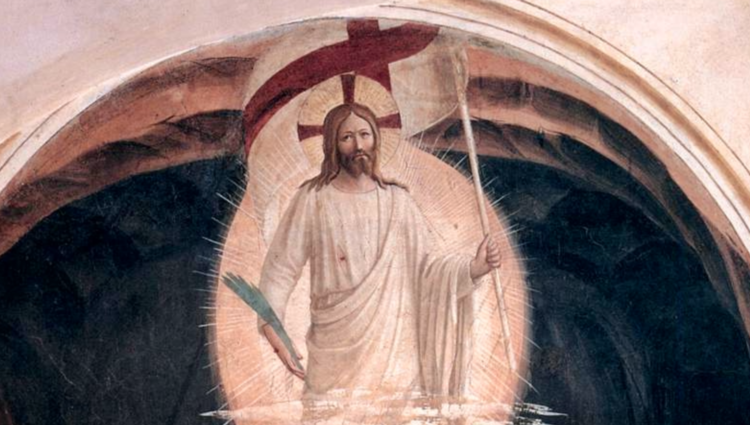
It is not only the beginning and the end of our history that consist in actions on a cosmic scale. The central point is also a creative act, the resurrection of Christ, himself the Word of God, by whom all things were made, who is to come in the fullness of time to make all things new.
__________
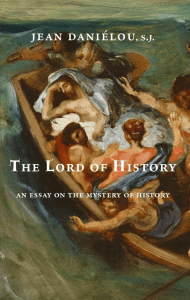
This essay is taken from The Lord of History. Republished with gracious permission from Cluny Media.
Imaginative Conservative readers may use the code IMCON15 to receive 15% off any order of not-already discounted books from Cluny Media.
The Imaginative Conservative applies the principle of appreciation to the discussion of culture and politics—we approach dialogue with magnanimity rather than with mere civility. Will you help us remain a refreshing oasis in the increasingly contentious arena of modern discourse? Please consider donating now.
The featured image is “Resurrection of Christ and Women at the Tomb” (between 1439 and 1443), by Fra Angelico, and is in the public domain, courtesy of Wikimedia Commons.