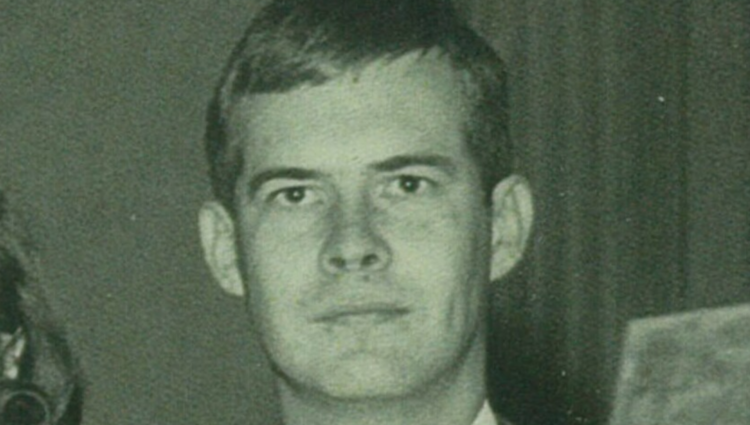
James Matthew Wilson judges American poet John Martin Finlay “practically the only contemporary writer to practice a genuinely metaphysical poetics.” A sinner and a man of imperfect ear, trite phrasing, and occasionally wayward philosophical judgment, Finlay was nevertheless a man whose pursuit of God who is Truth and Love demands our admiration.
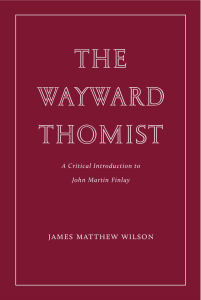
The Wayward Thomist: A Critical Introduction to John Martin Finlay by James Matthew Wilson (63 pages, Wiseblood Books, 2025)[*]
 The disappointing truth is that most lives are failures from the general human standpoint. Many of us rarely move from wish to purpose. Those who do often move, if at all, slowly. I still haven’t replaced a hubcap lost somewhere on the Texas highway system last November. For those who do execute this jiu-jitsu of the will by which daydreams are converted to to-do lists and calendar appointments, the resulting plans, even—perhaps, especially—brilliant plans, have a strange tendency to gang agley. Aft, even.
This depressing phenomenon holds in both natural and supernatural endeavors. To start with the former, the old joke has it that the two greatest moments for a boat owner are when he buys the boat and when he sells it. The dream of becoming a captain sailing the seven seas, or even the lakes and rivers nearby, comes to the rocks of keeping the tub shipshape and afloat. The aye-ayes rarely have it. The naysayers, those “nattering nabobs of negativism,” to borrow from eventual failure Spiro Agnew (speechwriter William Safire came up with the phrase), whether they be journalists or wives who know one too well, often have the last word as the would-be captain cashes the check with a sigh of relief.
In the spiritual realm, of course, one doesn’t have to hold to any extreme version of the Calvinist teaching on total depravity to realize that even the converted are usually only partially so. Every imagining that one has overcome the debilities of concupiscence and now has the freedom of the saints in Heaven in this life will almost certainly end in a sad but loud recitation of St. Paul’s lines: “Wretched man that I am! Who will deliver me from this body of death?” There is a reason that the New Testament’s language of salvation is alternately past, present, and future tense. The Christian has been saved, is being saved, and will, God willing, be saved in the end.
This is a long but perhaps expected wind-up, given the subject. My University of St. Thomas, Houston, colleague James Matthew Wilson has produced a very fine short introduction to the Southern poet and critic John Martin Finlay (1941-1991), something of a failed person himself. Like most of us failures, however, he is not without his glory.
Finlay, Professor Wilson writes, “through natural talent, single-minded but wayward determination, and the goodwill of others, all but remade himself into his own pious ideal of the poet and man of letters.” The exemplars on which Finlay based his ideal were the poet-critics Yvor Winters and Allen Tate. While Winters was a non-Christian who followed Thomas Aquinas intellectually, Tate was a Catholic convert and southern agrarian. “Finlay would follow them as closely as Dante followed Virgil,” Professor Wilson writes, “becoming a poet of the American South like Tate, an intellectualist in philosophy on roughly the model of Aquinas and Winters, a defender of classical humanism like both of the poets, and finally, a convert to the Catholic Church, in communion with which he spent the last, fruitful, but agonizing, decade of his life.”
From Winters, a poet teaching at Stanford University, Finlay took the idea that poetry was an intellectual project that allowed, if one did it right, greater speculative and practical wisdom. Professor Wilson describes Winters’s philosophy thus: “Poetry is at once a form to be contemplated, a way of knowing reality, a means to order, and a guide to living.” The very practical upshot of this vision meant for Finlay forsaking the practices of the trendy Beat and New York poets even though it meant being limited in audience. Instead, he cultivated “the practice of metrical verse in a classical plain style.”
From Tate, Finlay took “a model of the southern poet as at once rooted and universal, provincial and cosmopolitan, a poet for whom the South was a modern American heir to the ancient cultural traditions of the West.” Though the theistic Winters was influential in terms of form, the Catholic Christian Tate provided both form and substance that would help Finlay deal with his personal and poetic problems.
The personal involved Finlay’s own homosexual predilections, which led him to the darker corners of Bourbon Street to scratch certain sinful itches. Finlay believed that the sinfulness of his actions consisted not merely in the breaking of a taboo, but in unreasonable action. His poem, “To a Victim of AIDS,” judges the disease in unfashionably moral terms as a consequence of bodily desire not being governed by a rational soul. In short, he viewed sexual sin as disintegration—the unraveling of the human person who is, in Thomistic terms, a composite of body and soul, wherein the soul, with its powers of willing and knowing, is not steering the body by its knowledge of what is true, good, and, finally, beautiful.
While the non-Christian Winters still believed in God, his settled anthropology was dualistic. The body and matter were themselves evil, a husk to be shucked off or ignored. What Finlay found in Tate’s Catholic views was something different: a body and soul that are meant to be together in this life and for eternity. Finlay’s “The Fourth Watch” rejects the idea that man is a mind, made in the image of the Divine Mind, that is unfortunately bound to the messiness of flesh, blood, and guts. “My essence is not You by matter blurred,” the speaker says. In fact, the Divine Word redeemed all of humanity, body and soul, by taking a body and soul of His own.
Embedded mind sustains the complex whole
Redeemed with blood of Deity made flesh—
You save the man, not disembodied soul.
And summer burns the tireless sun afresh:
A wedding-feast out under shade of limes,
The servants brimming water-jars with wine!
Elsewhere, in his “Autobiography of a Benedictine,” Finlay writes of the comfort found in contemplating the mystery of the Incarnate God:
I feel at ease here on this earth
And love the dogma of God’s flesh.
The dogma of God’s flesh is the great amen to the doctrine of Creation, whereby God makes material things and calls them good and, all together, very good. Finlay found this doctrine both spiritually helpful and poetically compelling. Gnosticism treats the body as useless at best, an impediment to seeking God at worst. In Finlay’s view, the biblical and Thomistic view sheds light on everything, making even the cows a startling sign of the wisdom of the God of Abraham, Isaac, and Jacob.
As an essayist, Finlay could be just as lyrical about these matters as he was when rhyming. Alas, as Professor Wilson notes, his historical and philosophical judgments were not always fully informed. Finlay’s negative judgments about Newman and and Hopkins, as well as his positive depiction of Thomas Aquinas are both hampered by a worry that any trace of mysticism or Plato must be an incipient Gnosticism. Finlay thought the former two guilty of such; he failed to see that the latter, too, was mystical and Platonic as much as rational and Aristotelian.
Professor Wilson is straightforward about the deficiency of Finlay’s “narrow and textbook” Thomism in his essays, but he sees Finlay’s intellectual failure as nobly achieved while “driving toward a coherent vision of the world.” Even if the criticism did not always prove philosophically “clarifying,” it provided a “groundwork for his poetry’s attempt to critique the destructive flight from being of modern art and thought even as his poems also seek to reaffirm the goodness of natural being.”
Again, there is a hint of failure. Professor Wilson notes that the poems themselves, like the criticism, are of mixed success. Oddly enough, for a man obsessed with Gnosticism, Finlay tended “to move swiftly from the composition of place to abstract reflection,” though not always. Finlay’s literary executor, the poet David Middleton, is quoted as to Finlay’s “imperfect” ear for meter. Other witnesses are cited as to Finlay’s weakness for trite phrasing and his occasionally repetitive structures. Professor Wilson judges his poems with the South as subject some of his best. He cites “The Dead and the Season,” a poem about Finlay’s uncle Duncan Finlay, who was killed in a farming accident, as a powerful example. The final lines of the poem capture the silence of the house after Duncan’s end in a way that is all flesh, blood, and spirit together:
We lived the remnant of that morning blurred:
The chilled and silent house, engulfing light,
Some neighbors who had come to cook our meal,
The slugs of scalding whiskey for our blood.
Yes, Finlay is a failure, but a glorious one. Professor Wilson notes that Finlay’s last half-decade was a productive one. His collection American Tragedies contained many “under-imagined and uninventive” poems, but also some “impressive enough to leave us thinking it likely that his significance as a narrative poet would only have increased had he had more time and wider, more critical readership, to help him to cultivate the form.”
If his criticism and poetry were failures, great might-have-been productions, one might judge his spiritual life so, too. After all, the AIDS he caught in the Big Easy ended his life at a tragically young age. Yet his relationship with God in Christ, perhaps a bit over-intellectualized at the beginning, grew even as the death of his body approached. His emphasis on right reason knowing God gradually focused to the one thing needful, namely the love of God. His poem “A Prayer to the Father” includes this hint at what the knowledge of God is made for—namely, moving from speculative to personal knowledge, knowing God and seeing Him.
O God of love and power, hold still my heart
When death, that ancient, awful act appears;
Preserve my mind from all deranging fears,
And let me offer up my reason free
And where I thought, there see Thee perfectly.
Professor Wilson judges Finlay, along with Helen Pinkerton, “practically the only contemporary writer to practice a genuinely metaphysical poetics.” That he was a “minor talent of major ambition” might sound like a slight. But blessed are those, poets or not, whose reach exceeds their grasp. As St. Teresa of Calcutta rightly put it, God’s demand is for faithfulness and not success. A sinner and a man of imperfect ear, trite phrasing, and occasionally wayward philosophical judgment, nevertheless John Martin Finlay is a man whose pursuit of God who is Truth and Love demands our admiration. And his work, as Professor Wilson demonstrates successfully, “deserves to be remembered.”
__________
The Imaginative Conservative applies the principle of appreciation to the discussion of culture and politics—we approach dialogue with magnanimity rather than with mere civility. Will you help us remain a refreshing oasis in the increasingly contentious arena of modern discourse? Please consider donating now.
The featured image (detail) is a photograph of John Martin Finlay (right) and Professor Hudson Strode (far right). This file is licensed under the Creative Commons Attribution-Share Alike 4.0 International license, courtesy of Wikimedia Commons.
[*] Also available from Wiseblood Books are John Martin Finlay’s collected poetry and collected essays, both edited by David Middleton and John P. Doucet.