David Angten’s “The Medievalist” takes us into the grubby underbelly of Tinseltown, but there is a morality woven through the story that is convincing. A gripping, thought-provoking, entertaining, and fun novel, I hope it will not be classified as “Catholic fiction.” It’s too good for that.
 Having somewhat of a public platform in these pages and on my blog, it is my joy to be sent books, plays, screenplays, and manuscripts of various kinds. The authors and publishers would like me to read, review, comment, and help promote their work. All this for free, and in my free time. However, knowing how I myself value readers’ feedback and involvement, and not wanting to be too churlish to my fellow scribes, I have a simple modus operandi: First I pick up the book, and, if the title and cover interest me, I open it. If the Table of Contents and readers’ blurbs interest me I turn to page one and start to read. I stop reading when I am no longer interested. Unfortunately, I usually do not make it past the first chapter—whether this is due to my own stupidity and increasingly short attention span I cannot say.
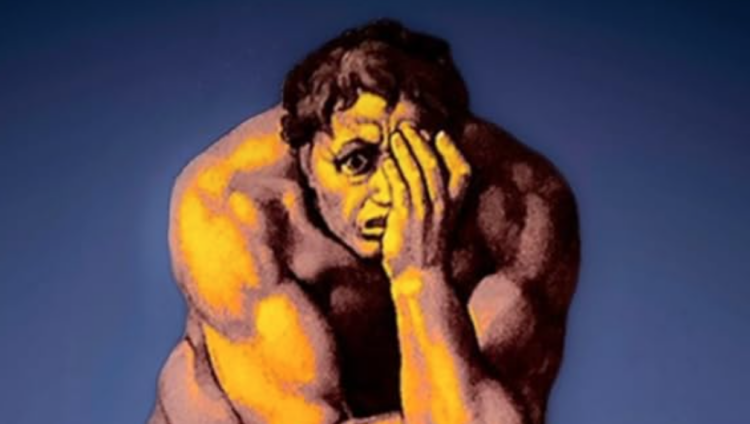
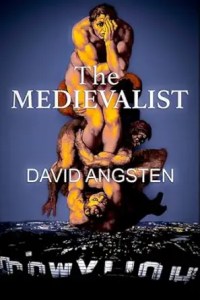
I explained this to David Angsten, the author of The Night Sea Trilogy after receiving a copy of his latest novel, The Medievalist. His book leapt over the first few hurdles: The front cover was the damned soul from Michelangelo’s Last Judgement in the Sistine Chapel, and the back was The Creation of Eve—one of Belbello da Pavia’s illuminations from a medieval Book of Hours. Such medieval horrors and glories struck me as intriguingly unusual—enough to catch my attention and push me into the first page.
The experts say Jane Austen’s opening line in Pride and Prejudice is just about perfect. It pithily sets the tone, establishes the theme, and summarizes the content. The same can be said of Angsten’s opening line (albeit not so genteel as Jane Austen’s). His reads, “In the seventh circle of hell a river of blood and fire boils the embodied souls of murderers.”
Angsten’s Hell is not Dante’s, and despite the title it is modern not medieval. The setting is not among the glorious angels, but grubby Los Angeles. Our hero, Roland Grimky—aka “the medievalist”—is a former Carmelite friar and professor of medieval studies at Notre Dame. Having gotten himself into trouble with a pretty co-ed, he has washed up in Tinseltown grubbing a living painting film background scenes, working on a screenplay, and doing Uber drives in a beat-up Volvo.
As the intricate plot unfolds, we are caught up in a murder mystery with multiple levels of interwoven stories involving compromised starlets, corrupt politicians, pushers, pimps, prostitutes, policeman, and priests.
The Medievalist reads like a mixture of Raymond Chandler, Colombo, and the DaVinci Code and visualizes like L.A. Confidential, The Maltese Falcon and Pulp Fiction. Although written by a Catholic and prefaced with a quote from the Book of Ephesians, this is not a pleasant Christian morality tale. With guns and gore, tough cops and tougher criminals, do not expect a twee fable, a cute Hallmark story, or some pablum from Focus on the Family.
Nevertheless, Angsten’s book is a kind of morality tale the way Tarantino’s Pulp Fiction and many other grim and gritty stories are morality tales. As I often advise adults with a tender conscience, “It is secondary whether a film or book features sex and violence. What we need to do is be grown up and discerning and ask how the sex and violence are presented. What is the context, what is the result, and what is the underlying philosophy that permeates the tale?” A story or film that features sin, but also shows the wages of sin (i.e. death) is far more moral than a charming little rom-com in which the hero and heroine fornicate happily with no consequences, or a nihilistic story in which the murderer is an anti-hero who gets away with his crimes.
So, for example, do you remember the classic film Butch Cassidy and the Sundance Kid? Could there have been a more attractive pair of anti-heroes? Unbelievably handsome, witty, and charming, they were in fact murderers, thieves, and ruthless outlaws. It was an immoral movie, and yes, they were gunned down in the famous final frame, but their end was portrayed almost as a martyrdom.
There are so many examples from popular culture that make my point: movies with sex and violence that, in the end, unlock justice and a moral world view, and other films and stories that, on surface, do not seem so bad, but reveal a nihilistic, depraved, and godless philosophy.
Angten’s The Medievalist takes us into the grubby underbelly of Tinseltown, but there is a morality woven through the story that is convincing. Roland Grimky solves the mystery and resolves the shadows in his own backstory, but happily, Angsten handles this deftly. There is never a preachy moment, a sappy happy ending, or moral tacked on the end of a fable.
I enjoyed Angsten’s trip into the Horrorwood of Hollywood. I liked the wisecracking movie savvy cops, the hip-hop junkies, and the Chinese takeaway toughs. However, I found the fast-paced plot and crowded cast list confusing at times. As a seasoned screenwriter, Angsten has a gift for voices and dialogue, and he builds colorful characters—each with a strong character arc. Unfortunately, too many of them compete for the reader’s attention. The minor characters needed to be toned down in order to harmonize with the larger story arc and hero’s tale.
Speaking of the hero: Roland Grimky takes his place in the gallery of clerical sleuths. (I catalogued some of them here.) While there seems to be a strong appetite for clergy cops, the problem for the author is creating a man who is, on the one hand, pious enough to be convincing as a cleric while gritty enough to cope with crime. The milquetoast curate will be too lily-livered and timid to soil his lacy cotta while a tough talking priest may not be convincingly prayerful. Roland Grimky passes on the piety, but too often he was reactive rather than proactive and didn’t have the drive and determination that the grittier gumshoes display. Declan Finn squares this circle with his Saint Tommy series (reviewed here), in which the NYPD detective is a layman with mystical powers rather than a priest playing policeman.
The Medievalist is a fast-paced, often uncomfortable read, but one which is gripping, thought-provoking, entertaining, and fun. Because I am reviewing The Medievalist from the perspective of a Catholic priest, I hope Angsten’s book will not be classified as “Catholic fiction”. It’s too good for that.
__________
Father Longenecker’s latest book, Bloodshed and Blessing-Modern Man and the Meaning of Sacrifice, will be published later this year.
The Imaginative Conservative applies the principle of appreciation to the discussion of culture and politics—we approach dialogue with magnanimity rather than with mere civility. Will you help us remain a refreshing oasis in the increasingly contentious arena of modern discourse? Please consider donating now.