FOR MANY months now, parents, teachers and councillors in England have been treated to the Paul Daniels school of public policy when it comes to Special Educational Needs and Disabilities (SEND). A series of ‘now you see it, now you don’t’ ideas for reform have been dangled in front of people only to be whisked away as soon as they start getting upset.
The same approach was evident this week when the government published its long-awaited White Paper, Every Child Achieving and Thriving, 118 pages of government-speak. If that wasn’t enough, it was accompanied by another document inviting further consultation on the proposals for SEND reform that will run until May and will likely not report until the start of another school year. This document is even longer than the White Paper.
The whole thing has an air of magic about it. There is almost no contact with the reality of trying to educate the growing numbers of children with special educational needs nor with the challenges of inclusion in large mainstream schools.
Remarkably, neither document has anything to say about the underlying causes of rising demand. We know it is autism, Speech, Language and Communication (SLC), Emotional and Mental Health (EMH) that is driving up the demand (and I’ve included some new data at the end of this post). Yet there is nothing about why the incidence of these conditions is rising so fast nor what is involved in teaching such children, nor why so many require high-level support.
There is just one half-sentence on page 12 of the consultation document that tamely suggests ‘we know needs have increased worldwide, in part through better identification’.
It is blindingly obvious that rising demand for SEND and the escalating costs of provision have prompted the White Paper. These trends have exercised politicians, policy makers, think tanks and journalists – as well as teachers – for months, if not years. And yet, when it comes to publication day, there is no mention of what is going on bar repetition of the usual rubbish that it is about better identification – which implies teachers would have missed these children in previous years – as well as a nod to the fact that other countries have the problem as well!
The White Paper completely avoids this central issue but it has much to say about the additional duties that mainstream schools and teachers will have to take on, and there are plenty of them, involving plans and training and reviews and teams of experts. (See my original article for details.)
Despite the ongoing consultation, the legislation is expected to be fully effective by the school year starting in September 2029. At that time, any children with an Education Care and Health Plan (ECHP) who are moving from primary to secondary school or from secondary into post-16 the following year, will be reviewed. About half of all current ECHPs (278,200) cover children in mainstream schools and these are likely to be severely squeezed in review.
Going forward, the government wants to retain EHCPs only for children with the most complex needs (although the criteria for this are still yet to come).* EHCPs will carry on being funded by local authorities and it is not clear if central government will help with these costs. Indeed, there is remarkably little in the White Paper and consultation about special schools.
You wouldn’t know it, but there are currently about 170,000 pupils in special schools and demand for places has exceeded supply across the country for years. The private sector has been providing additional capacity to help meet demand. While the White Paper includes an ambition to cap the costs of this private provision, there is no recognition of the knock-on effects if this space were to go.
Although it is buried in the minds of ministers rather than being clearly articulated, the expectation must be to move some of the children who are currently in special schools, and those who are assessed to have similar levels of needs in the future, into mainstream provision. This is a very big ask.
In his journey through the education system, our son with severe autism who is now 22 attended two mainstream primary schools, one private specialist primary school, and two local authority special schools. We also ran an Applied Behaviour Analysis (ABA) programme at home for the years when he was in mainstream school, funded by us.
We all tried very hard to teach him to read, to write and to learn. What went in one day was lost on the next. His learning difficulties prevented him for engaging with most of what went on school – including the specialist schools. What’s more, a school classroom is just about the worse possible place for a child with severe autism who is wholly unmotivated and unable to learn, and struggles with noise.
The White Paper contains no insights into the challenges faced in teaching children on the front line of SEND – where most of the money is spent. We are told that more children need to stay in mainstream. That teachers will be trained and experts brought in, but we know that no one really knows how to teach children with severe learning difficulties. It is a very hard thing to do.
What’s more, much of the school day is necessarily spent helping with basic care such as feeding, toileting and managing comorbid health conditions such as epilepsy and anaphylaxis. Special schools are used to providing this level of care, and they safeguard the children involved. Mainstream schools are already facing significant behaviour challenges with high rates of disciplinary action and low rates of attendance. Including more children with SEND, particularly those with much higher levels of need, will add further pressure and make things much worse.
School leaders are being asked to do all this new work – and to manage all this change – on top of everything else they are expected to do. As ever with Government announcements, there is some magic money floating about with a billion for this and a billion for that but stretched across the school estate and given the trend of increased demand, it will be a drop in the ocean and wholly insufficient to delivering change.**
In addition, any parent of a child with SEND knows how hard it is to access expert support from educational psychologists or speech and language therapists, yet the government is proposing to magic up teams of these people out of thin air; it just can’t be done.
Although it doesn’t feature in the White Paper, data collected by the Department of Education shows the scale of the problem, captured below.
The percentage of all pupils who have ECHPs is now at least 5.22 (1 in 20) in primary and 6.12 (1 in 17) in secondary age groups in England (for 2024-5). These rates have gone up dramatically since 2015 and particularly so amongst primary school kids. The majority of awards are now made for autism, SLC and SEMH – the rates of which have all more than doubled in both age groups over this time. The problems are real and severe and only ever increase.
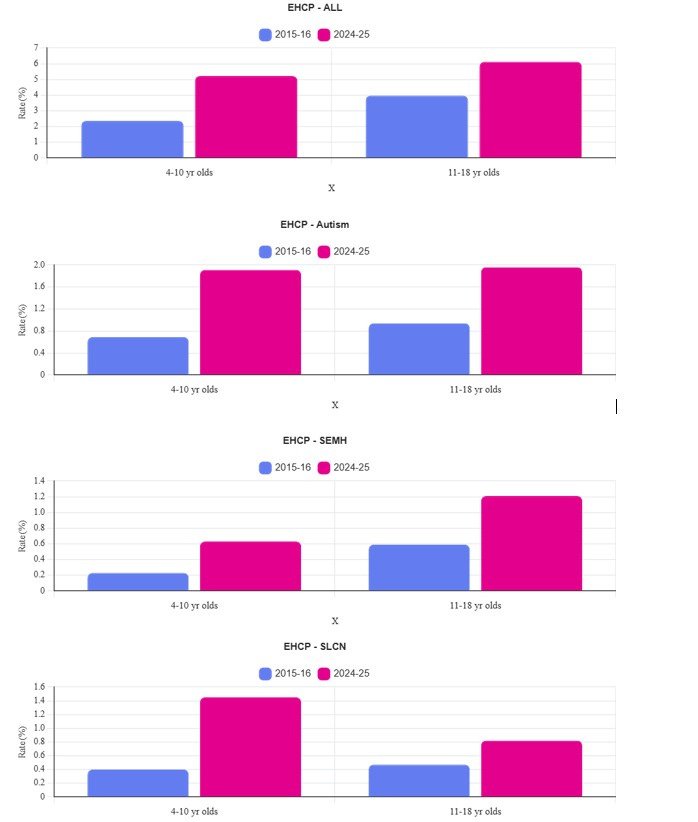
% of all pupils in the cohort showing the rate of those with EHCPs and the main conditions for which they are granted (autism; social, emotional and mental health (SEMH); speech, language and communication problems (SLC)) for England, 2015-6 and 2024-5, primary and secondary cohorts (townhalldata.com using DoE data see here.)
Ultimately, there is only one way to tackle the crisis in SEND. We have to face up to the causes of SEND. No amount of magical thinking can wish them away.
The White Paper is full of hot air – it has no chance of solving the problems, not least because there is no attempt to recognise what is causing the problems.
The poisoning of our children breaks my heart.
*Remarkably, the White Paper says this in regard to those currently in special schools with EHCPs at the moment: ‘We … recognise that, for a small number of children and young people who have very low incidence, high complexity needs, regional variations in commissioning and the location of settings and services can make accessing the appropriate support more difficult. In some local authorities this may involve one or two children or young people requiring this level of support, while others may have none’ (p65). Given that there are currently hundreds of children in local special schools at the moment, this implies that most of these children – including those with VERY severe levels of need would be educated in mainstream schools in the future. Children like my son would be one of them. When he was in mainstream school, he spent most of his time in the playground running around with the other boy with severe autism. It was not the fault of the school or the staff, who were doing their best. It was just not possible to keep him sitting at a desk and doing normal school work during the day.
**For people with an eye to the budgets, the announcement included up to £7bn of funding comprising: £20M for teacher training in SEND; £1.6bn for an Inclusive Mainstream Fund (some of it coming from money currently given to Local Authorities for high needs support via EHCPs); £1.8bn for the Experts at Hand service (managed by the ICBs/NHS); and £3.7bn for making the school estate accessible and providing more physical spaces for teaching in inclusion bases. In addition, ‘From 2027, we will consider transitional arrangements that local areas can take to further increase the amount of funding that mainstream schools receive to provide SEND support directly, in advance of statutory changes’ (p85).
A longer version of this article appeared in the Autism Tribune on February 24, 2026, and is republished by kind permission.