WE HAVE a new Green MP in Gorton and Denton, much to the palpable shock of Reform whose candidate only a few months ago was gleefully predicting a turquoise tsunami at the next general election.
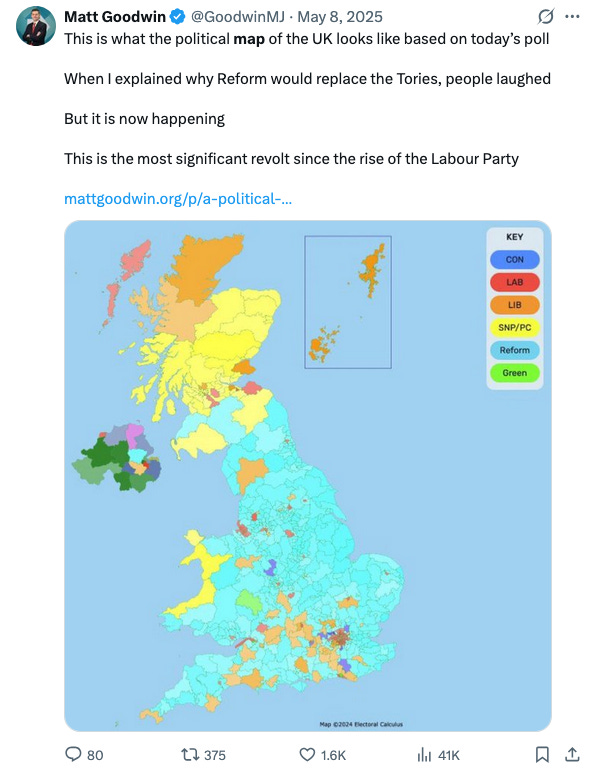
Reform were always going to have a challenge before them in Gorton and Denton. Although they came second here in the 2024 election, they were a long way off. The seat was Labour’s 38th safest seat in the country.
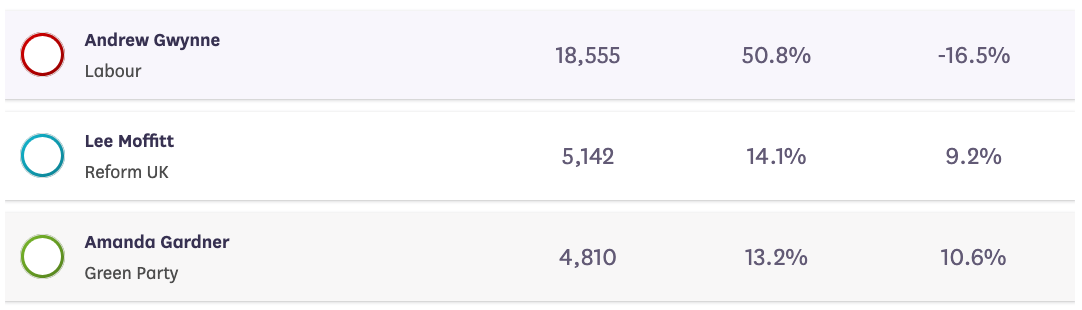
Consequently people are already dismissing this result as inevitable and not a problem for Reform. That’s a mistake.
Electoral Calculus holds a ‘sorted seat’ list, which uses the predicted difference between Labour and Reform votes to identify both safe seats and key battleground seats for each party. Gorton and Denton is a battleground seat on that list, ranked 148 for Labour, and 236 for Reform. In other words, a loss in this seat means that Labour are predicted to win 148 seats or fewer at the next election, and Reform 236 seats or fewer.
Not only is that not a tsunami of any sort, it’s not even a majority.
This by-election is (hopefully!) a wake-up call, but it shouldn’t have been. The picture was the same in the Runcorn and Helsby by-election last year. That race was won by Reform’s Sarah Pochin, giving the impression that Reform are on track for that tsunami, but the underlying figures tell a very different story and the party really should have picked up on that.
Runcorn and Helsby is the strongest possible test case for Reform: a post-industrial, predominantly white, Leave-leaning seat where national polling puts the party more than nine points clear of Labour. If the turquoise maps are correct, Reform should be winning seats like Runcorn comfortably.
Reform won by six votes. Six. Out of 32,655 cast. In a seat where they should have been dominant. Where Labour’s candidate was standing in the shadow of a predecessor convicted of assault. Where the incumbent government was deeply unpopular. Where turnout dropped 14 points from the general election. Reform’s national polling lead should have produced a comfortable margin; instead they won the closest post-war by-election in British history, a result so tight it required a recount and hinged on a margin smaller than the number of spoiled ballots.
What these two by-elections tell us is simple: the Reform majority government the polls predict is a mirage. The turquoise tsunami will be a washout. The most likely outcome at the next general election is a hung parliament, and a left-wing coalition government.
To understand why, we have to look at three factors eating away at Reform’s vote. But first, let’s start with a baseline picture: what the polling tells us should happen.
The Baseline
Here’s the seven-poll rolling average for the main parties since July 2024:
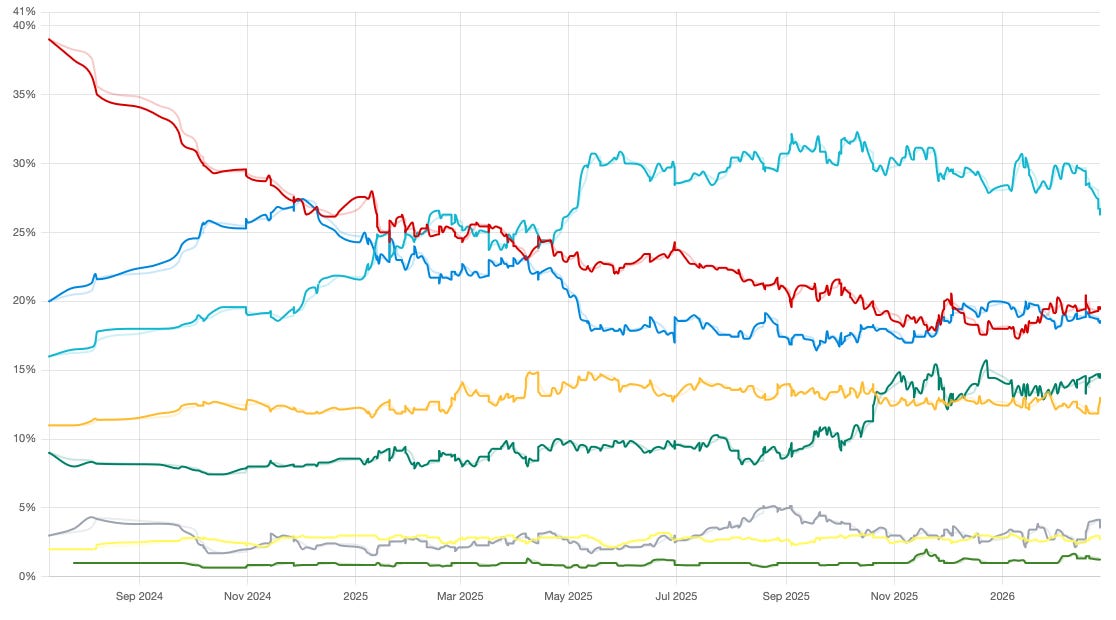
In January, More In Common polled more than 16,000 people on voting intention, and created a seat-by-seat Multilevel Regression with Post-stratification (MRP) projection for the next general election. As they explain: the MRP ‘uses data from a voting intention poll to model how people will vote based on their demographics, previous voting behaviour and information about their constituency. These results are applied to the demographic and electoral makeup of each constituency to make a constituency-level prediction. The model is ‘multilevel’ because it uses both individual and constituency-level data.’
It predicted that Reform would win 381 seats on 31 per cent of the vote, giving them a majority of 114 MPs. This is the baseline we are working from.
It’s worth noting that in its constituency-by-constituency breakdown, More In Common predicted the following for Gorton and Denton:
Reform 30.0%
Labour 28.3%
Green 23.1%
Conservative 8.7%
Liberal Democrat 7.7%
Obviously, that didn’t happen.
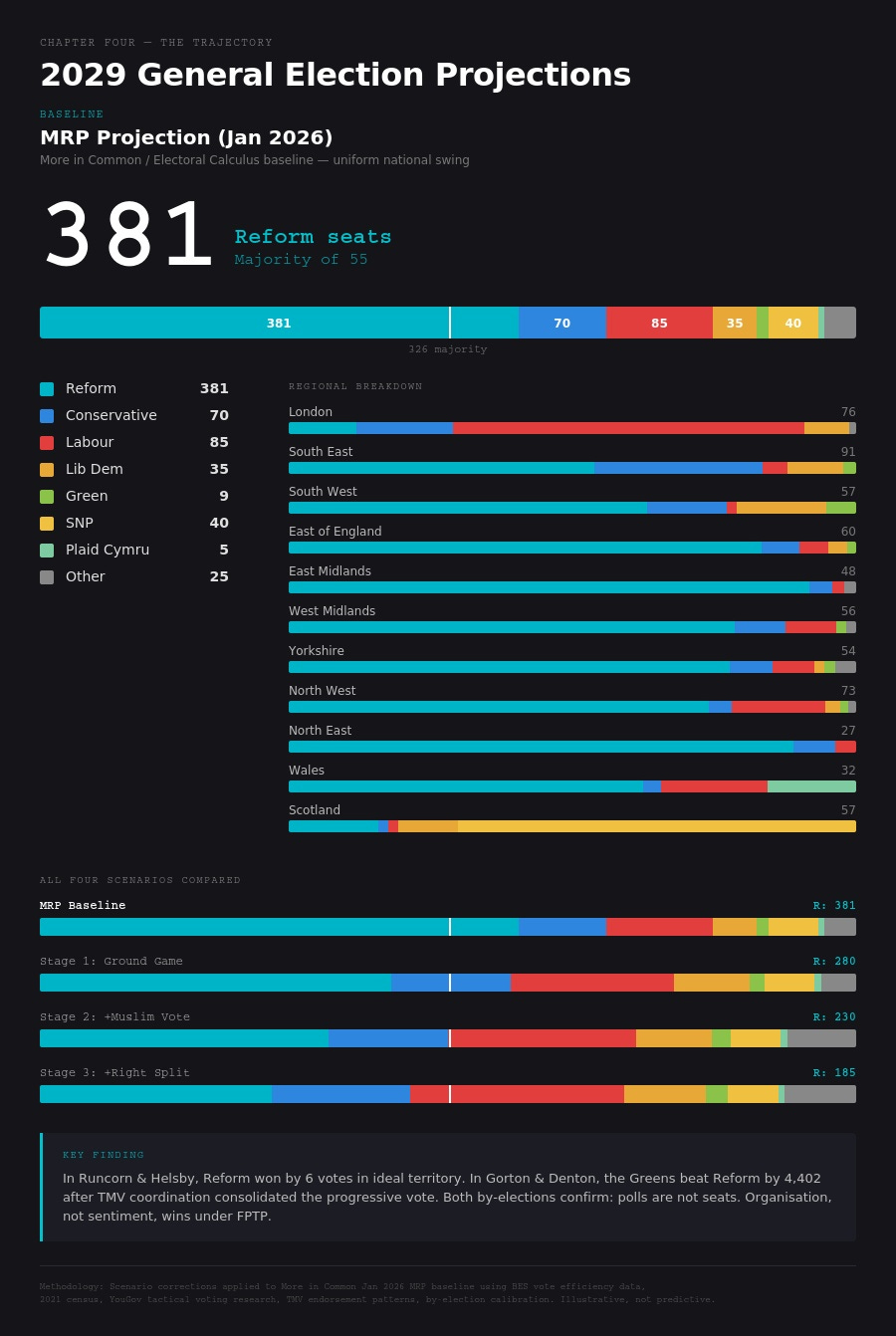
MRP Baseline Projection — Reform 381 seats
The Cascade
What follows is am attempt to quantify the effects of three different phenomena which challenge Reform’s apparent lead:
- Reform’s ground game, which is lacking;
- The Muslim Vote, which is tactical and organised;
- The right-wing split between Advance and Restore.
Together these create a cascade effect, eating away at Reform’s seat projection until the party falls far short of the 325 seats required to form a majority – so far that even a coalition with the Conservatives becomes impossible.
The methodology is straightforward: using Claude AI’s Opus 4.6 Extended model, I took the published More In Common projection as a baseline and applied three successive corrections. Claude drew upon vote efficiency data from the British Election Study; constituency-level demographic data from the 2021 census, the Henry Jackson Society and The Muslim Vote; tactical voting research from YouGov, and the organisational profiles of the competing parties. The assumptions were then tested against the two by-election results to calibrate.
The result is not an exact seat prediction – elections three years hence are too uncertain for that, and constituency-level predictions based on these factors would need more granular data to have any hope of being accurate. Rather, what’s presented here is an analytical framework for understanding why polls are not seats, and why the gap between the two is likely to be very large.
Stage 1: The ground game
The most basic flaw with the polling predictions is so fundamental to how politics works and has always worked in Britain that it’s shocking to me that no one is making any attempt to factor it in. Bluntly, the map projections assume that polling translates into seats at a roughly uniform rate. Under first-past-the-post, it doesn’t.
It never has. Local campaigning has always had the potential to buck a national trend, but as the party political landscape has grown more crowded and chaotic, there is vastly more scope for anomalous results to arise – just look at Gorton and Denton.
The level to which this factor is overlooked is crazy given the results of the 2024 election. It’s almost as though no one wants to look. We all know by now that Reform won five seats at the last election. In total across all constituencies, they secured 4,117,610 votes (14.3 per cent).
The Liberal Democrats won 3,519,143 votes (12.2 oer cent) and have 72 MPs.
4,117,610 votes —> 5 MPs
3,519,143 votes —> 72 MPs
That’s the difference a good ground game makes.
That result was the product of something MRP models cannot measure: the difference between a vote backed by a canvasser, a leaflet, decades of community politics infrastructure, and a bar chart telling you this is a two-horse race, versus a vote backed by nothing but a polling number and a vibe.
The British Election Study found that 46 per cent of all Lib Dem votes were concentrated in the 72 seats they won. Nearly half their national vote was doing useful work. Reform’s votes were spread thinly and evenly, producing impressive-looking percentages and almost no victories.
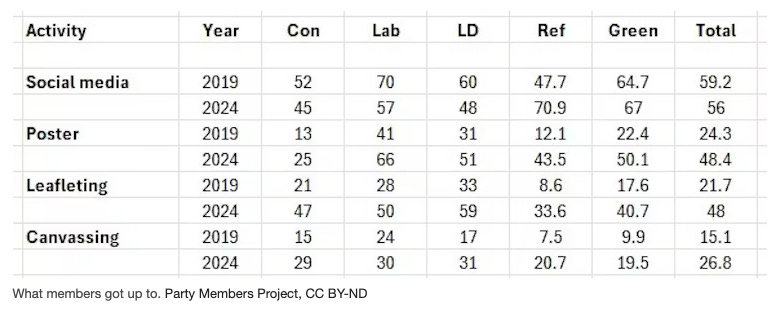
A third of Reformers did no campaigning in that election, but even among those who did, efforts were overwhelmingly concentrated online. The party lagged behind all the others when it came to getting activists out on the streets to leaflet and canvass. We can’t entirely blame the party faithful: I emailed my local branch offering to leaflet my area for them and they turned me down! They said that the party was paying for the Post Office to deliver leaflets, and were apparently happy to sit at home themselves. I never did see a Reform leaflet in that campaign.
Meanwhile, the Lib Dems enter the next election as incumbents in 72 seats, each with a sitting MP, an established office, funding pipelines, and the infrastructure that won those assets. Labour, even diminished, retains the union networks. UNISON published an explicit anti-Reform campaign guide in 2025, directing its 1.3million members to campaign in constituencies where Reform threatens to win. Those are boots on the ground – canvassers, drivers, envelope-stuffers – in precisely the seats where Reform needs to convert polling leads into victories.
Then there’s the tactical voting. YouGov’s February 2026 research found that 63 to 77 per cent of Labour voters say they would switch to the Greens or Liberal Democrats to stop Reform winning their constituency. Compass, the centre-left pressure group, has been co-ordinating progressive tactical voting since 2017 and claims its recommendations led to 35 of 41 endorsed candidates winning their seats (85 per cent) in 2024. TacticalVote.co.uk and similar websites also provide constituency-level recommendations. More in Common’s own research found that if just 60 per cent of progressive voters voted tactically – a figure well within the range suggested by YouGov’s polling – the result would be a Commons in which Reform falls well short of a majority.
Polling captures none of this, yet it matters.
AI analysis: Reform drops from 381 to approximately 280 seats, 46 short of a majority. The Lib Dems gain on incumbency and community politics infrastructure. Labour gains on union mobilisation networks. Reform loses in every marginal where the difference between winning and losing is organisation, not sentiment.
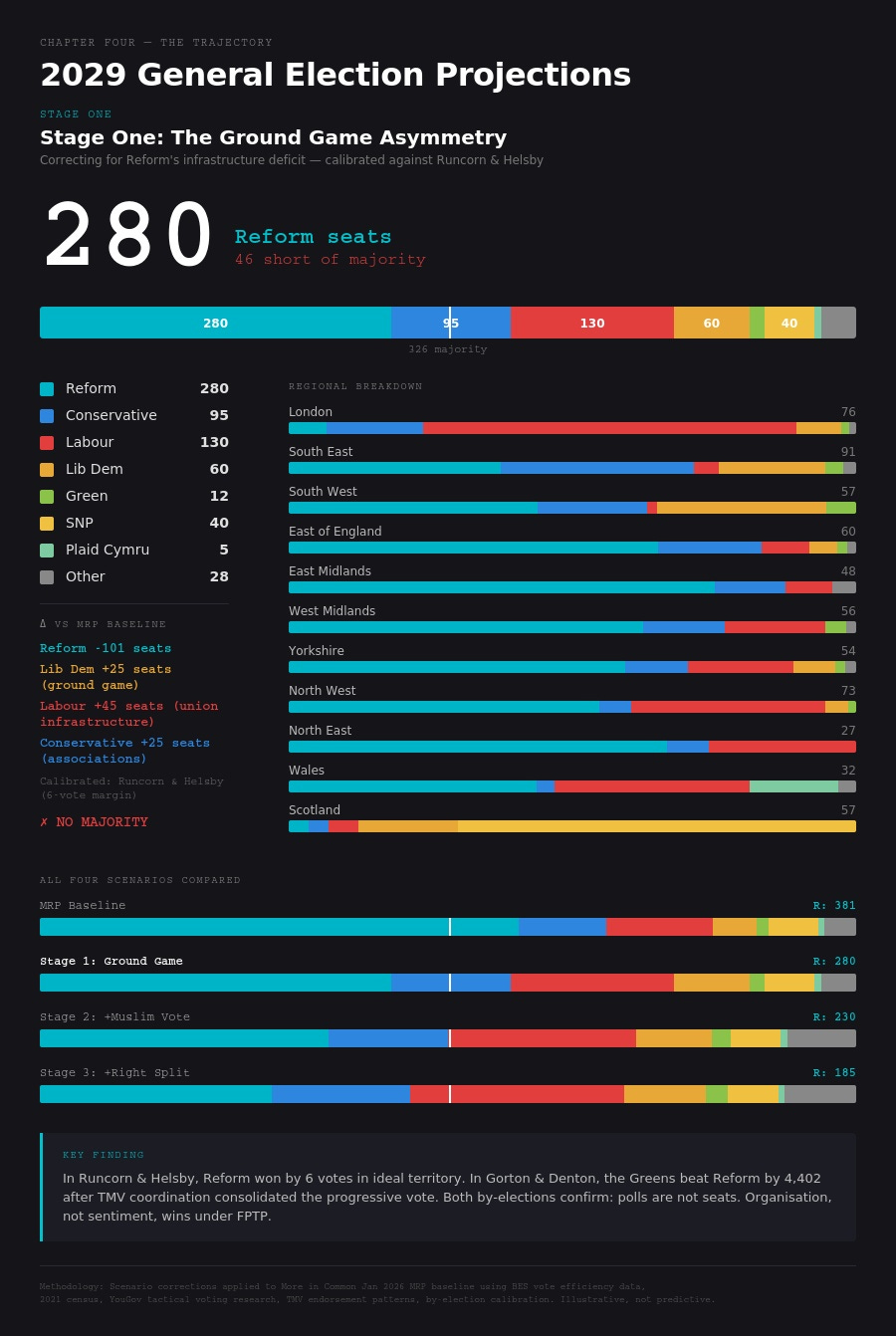
On the foundational correction alone Reform’s majority at the next election is wiped out, as the party drops from 381 to 280 seats.
Stage 2: The Muslim Vote
In 2019, 86 per cent of British Muslims voted Labour. By 2024 that support had already collapsed. A Survation poll conducted before the election found only 43 per cent of Muslims were backing the party; 70 per cent said that the Gaza question would be ‘very important’ in deciding who to back.
The Muslim Vote, an organisation set up in 2023 with the help of the former leader of Hizb ut-Tahrir Britain, Jalaluddin Patelby, and Anas Altikriti, CEO of the Cordoba Foundation which has links to the Muslim Brotherhood, has been quick to seize the opportunity to harness the British Muslim vote and direct it towards its chosen candidates.
In a statement released the morning following the 2024 general election, the organisation claimed victory for getting five independent candidates, including Jeremy Corbyn, elected to Parliament – the highest number of independents since 1950.
It also claimed:
Major wins for Lib Dems and Greens who benefited from The Muslim Vote. They have won record seats compared to recent decades (71 [sic] and 4 respectively).
Huge majorities slashed for Wes Streeting, Roshanara Ali, Jess Phillips, Keir Starmer, to name only a few. These are major lessons in seats the Labour Party was otherwise expected to steamroll. Completely unprecedented.
Key majorities slashed:
– Bethnal Green and Stepney from 37,524 to 1,689
– Ilford North has become marginal with 500 votes in it
– Birmingham Yardley has become marginal – 12,720 to just 700 votes
– Birmingham Ladywood – 28,582 to just 3,400
This was not a fluke result. It was the emergence of an organised political force, one that has identified 92 constituencies where Muslims exceed 10 per cent of the electorate, and advises voters which candidate – Green, independent, Your Party – is best placed to win. National polls cannot see it, because The Muslim Vote is not a party. It doesn’t show up when a pollster asks ‘which party will you vote for?’ It operates below the waterline of national polling, in the constituency-level machinery that determines who wins seats.
The Muslim Vote endorsed the Green candidate in Gorton and Denton. And the result was not close.
Here’s what that means at scale. In the roughly 20 seats where Muslims are more than 30 per cent of the population, the combined progressive-Muslim vote is so large that Reform cannot win regardless of its national lead. In the approximately 70 further constituencies where Muslims constitute between 10 per cent and 30 per cent of the population, the crucial question is whether the progressive vote consolidates or splits. Gorton says it consolidates. If Gorton is the rule rather than the exception – and every structural incentive points that way – a significant number of these seats are simply off-limits to Reform.
AI analysis: Adding The Muslim Vote. Layered onto the ground-game-adjusted baseline, TMV constituency coordination drops Reform from approximately 280 to 230 seats, nearly 100 short of a majority. Greens, Your Party, and TMV-endorsed independents gain across London, the West Midlands, Yorkshire, the North West, and the East Midlands.
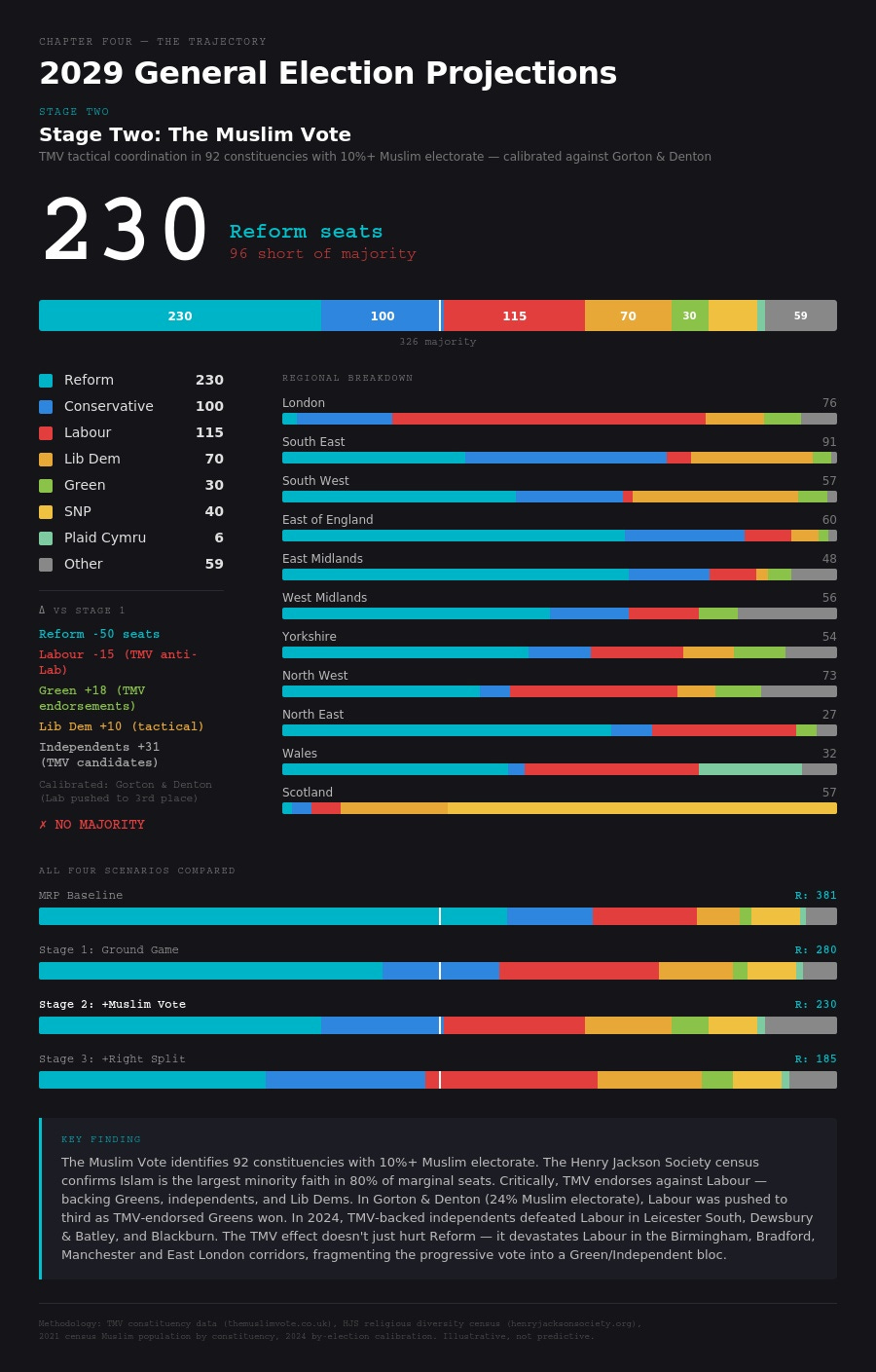
Reform drops from 280 seats to approximately 230. Nearly a hundred short of a majority.
Stage 3: The right-wing split
If the picture wasn’t looking bleak enough, in-fighting on the right has made it even more depressing. Mounting dissatisfaction within the Reform ranks has produced two splinter parties, Advance UK and Restore Britain, which threaten to siphon off just enough votes to collapse Reform’s marginal races.
Neither party has yet been properly tested at the polling booth. Advance won only 154 votes in Gorton, a fraction behind the Monster Raving Loony Party on 159, but the party is less than a year old and has not yet got a proper branch structure up and running. With three years yet to go until the next general election must be called, it has time to build enough infrastructure to stand candidates widely – but not enough to have a reasonable expectation of winning.
A comparison with previous UKIP and Brexit Party results may be illustrative. According to the Commons Library:
‘The Reform vote share (14.3 per cent) in 2024 is similar to the UK Independence Party (UKIP) vote share (12.6 per cent) in the 2015 general election when it was led by Nigel Farage, when it won one seat.
‘In 2019, the Brexit Party won 2 per cent of the vote share and won no seats. However, it only put forward 275 candidates as it did not stand in the 317 seats previously won by the Conservatives. The party won an average of 5.1 per cent of the vote in seats where they stood candidates.’
Assuming Advance can match this by 2029, it would take an average 3,650 votes in every constituency, easily enough to deny Reform victory in places like Runcorn and Gorton.
Restore is in a similar position: although it is even further behind in its mission to become a proper party capable of fielding candidates, it has fired up an active support base and claims to have attracted tens of thousands of subscribers within days of launching.
The electoral arithmetic is unforgiving. Reform’s projected majority in the polling depends on winning hundreds of seats with pluralities, not majorities. In the More in Common January MRP: ‘Reform would win 60 per cent of seats on 31 per cent of the vote, rivalling the 2024 General Election as one of the most disproportionate results in modern British history.’ This level of disproportionality is only possible because the opposition vote is split four or five ways. But the same logic works in reverse: even a small split in Reform’s own vote could cost it seats in every marginal it’s projected to win. Notably, no right-wing splinter candidate stood in Runcorn and Helsby – yet even without the split, Reform barely won.
AI Analysis: Adding the Right-Wing Split. As the final layer on top of both the ground game correction and the Muslim Vote adjustment, the right-wing split drops Reform from approximately 230 to 185 seats — some 140 short of a majority. The Conservatives are the main beneficiaries as right-wing vote splitting hands marginals back to them, particularly in the South East, East of England, and the South West.
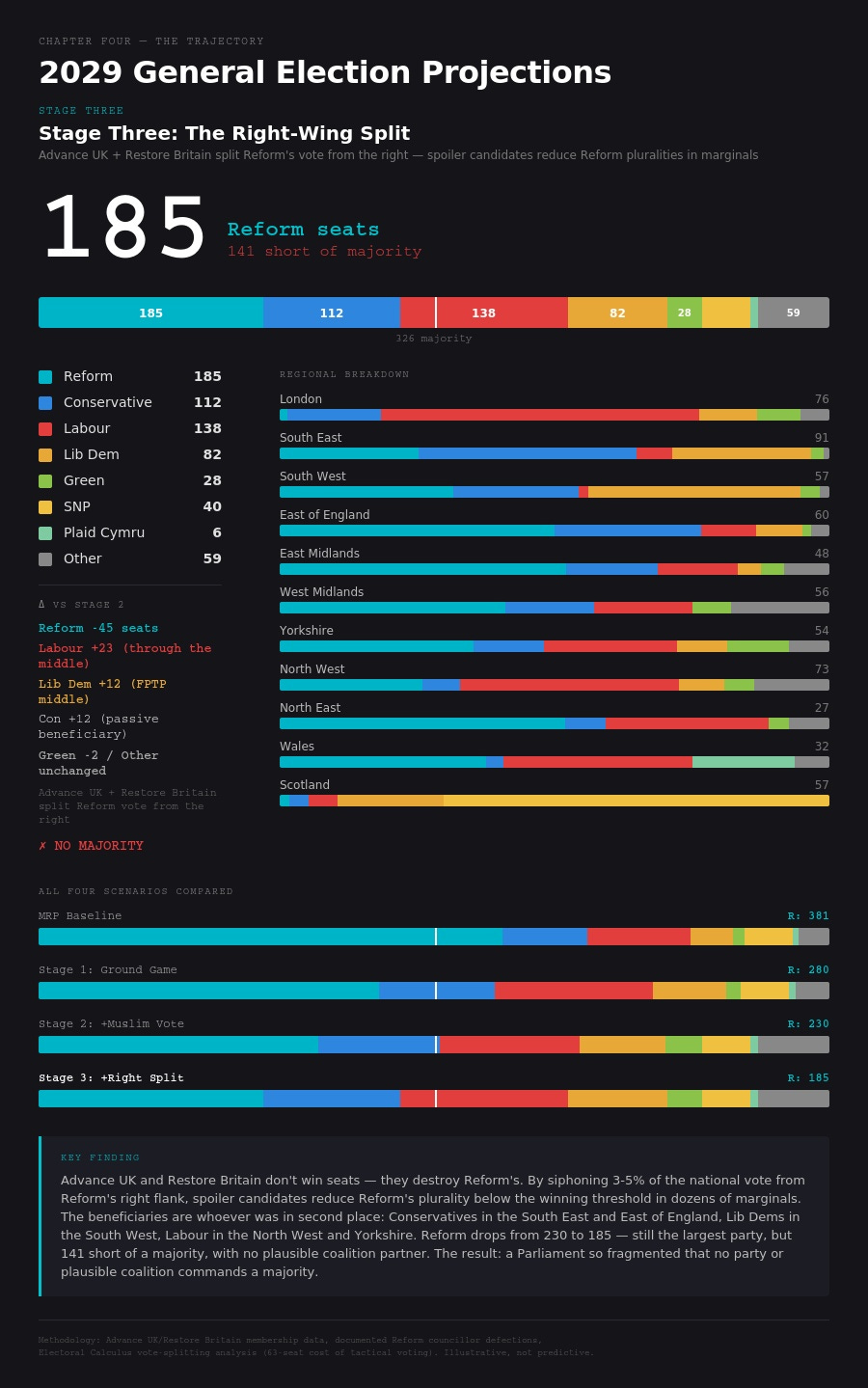
The right-wing split drops Reform from approximately 230 to 185 seats — 140 short of a majority and making coalition with the Conservatives unobtainable.
The result is a red-green coalition government from 2029 – 2034.
Why a pact isn’t the answer
The instinctive response on the right will be obvious: if vote-splitting is the problem, a pre-election pact must be the solution. But a pact treats the symptom, not the cause.
The structural disadvantage facing Reform is not primarily arithmetic, it is ecological. As the analysis above shows, the erosion of Reform’s projected majority happens at three different layers: organisation on the ground, co-ordinated tactical behaviour within key demographics, and the broader institutional environment in which campaigns are fought. A deal between parties would address only the last-mile question of candidate overlap. It would do nothing to change the terrain on which those candidates compete.
The left’s advantage is precisely that it does not rely on formal pacts. Labour, the Greens, Liberal Democrats, unions, activist networks, community organisers, charities, and demographic campaigns such as The Muslim Vote operate as a loose but mutually reinforcing system. They share data, activists, narratives, and institutional backing. Co-ordination happens culturally and operationally, not contractually. This is what a mature political ecosystem looks like: a distributed network in which each actor performs a different function but pulls in the same strategic direction. The British right has nothing to match this.
A right-wing electoral pact, by contrast, would be a thin layer of co-operation resting on top of an otherwise fragmented landscape. It might prevent a handful of three-way contests, but it would not create activists where none exist, build community trust, generate candidate pipelines, or supply the institutional reinforcement that converts votes into durable power. The scenario modelling makes this clear: even before the right-wing split is introduced, Reform’s projection has already fallen far short of a majority once organisational and ecosystem factors are accounted for.
In other words, a pact could change who stands where, but it cannot change who shows up, who mobilises, who funds, who frames the debate, or who shapes the local political culture. Those are ecosystem functions, and they are precisely where the right is weakest.
The lesson, then, is not that co-operation is unnecessary, but that it must be deeper than electoral convenience. The left wins without formal alliances because it has spent decades building the connective tissue that makes co-ordination automatic. If the right wants to compete on equal terms, it must build its own infrastructure: training networks, community organisations, policy pipelines, funding streams, and cultural institutions that persist between elections.
Until that exists, any pact will be a tactical fix applied to a structural deficit. And structural deficits, as the cascade demonstrates, always reassert themselves.
This article appeared on Freedom Radio on February 28, 2026, and is republished by kind permission.