Neither the past nor the present can be reduced to a simple morality play with unambiguous heroes and villains. This false and superficial understanding of human nature and the human condition has convinced many that American power and decency are, or ought to be, unassailable, and that the continued application of technology will forever sustain American exceptionalism and, with it, American dominance.
I.
 America was a fever dream in the minds of European thinkers long before the United States became a nation. French philosophes, English dissenters, and working-class radicals everywhere on the continent found inspiration in the American struggle for independence. Their differences notwithstanding, all of these groups, in one way or another, regarded America as the citadel of freedom, offering an escape from injustice, fanaticism, and tyranny. Europeans cultivated a “Mirage in the West,” a fantasy land in which all the problems of society would be resolved and all the needs of humanity satisfied.[i] The hope of humanity, America was exceptional.
Exceptionalism did not mean that America was merely different from other countries. America was unique. America promised deliverance from oppression and misery. America demonstrated that government and society were not unalterably fixed. Reform and, by implication, progress were possible, and even likely. The idea of America thereby enabled liberal Europeans to sustain their hope in a better future. For Americans, exceptionalism at first provided a shared identity in the absence of any other sure bonds of union. But during the 1790s, they began to reinterpret and alter its meaning, transforming exceptionalism into the basis of a grand historical narrative that elucidated the singular national destiny of the United States. Exceptionalism came to define the very essence and meaning of America itself.
Winning a war of independence had not unified Americans. Instead, it created the problem of how to co-exist once the imperative of fighting a common enemy had disappeared. The language, law, and culture that the colonists shared attached them to Great Britain, restoring the very connections they had tried to sever. In addition, few entertained anything resembling a national consciousness. They identified far more readily with their localities. Even the Declaration of Independence at last became a source of conflict. The inability to reconcile the principles of freedom and equality with the reality of slavery prompted the northern states to choose one or the other. By the end of the eighteen century, northerners had moved to abolish slavery, dividing themselves from their southern counterparts who maintained it.
The quest for union, the effort to forge thirteen independent states clustered along the Atlantic seaboard into a modern nation, was the ambition of a comparatively small number of men who were already both nationalist and cosmopolitan in their outlook. It was they who, during the 1780s, voiced concerns about the rise of disparate factions in various states that the national government could not restrain, a development that seemed almost to guarantee political fragmentation. The new Constitution that these men devised and ratified offered a more effective mechanism of national government, but the advent of “a more perfect union” came about at the expense of state and local power.
The development of American exceptionalism into a cohesive ideology took place only in the 1790s when Thomas Jefferson, James Madison, and the other leaders of Democratic-Republican Party warned their fellow citizens about the undemocratic aspirations that the Federalists clandestinely entertained. The effort to vilify the Federalists and, in particular, Alexander Hamilton as monarchists and despots coincided with the radical transformation of the French Revolution after 1793. The establishment of a republic in France inspired a cohort of American democratic radicals, who embraced the revolutionary cause as their own. The demise of the French monarchy gave substance to their belief that the American war for independence was but the harbinger of an Age of Revolution. More than a colonial uprising, it was the first act in a universal drama of political liberation. America itself was the model for the future.
Although the accusations of the Democratic-Republicans were at best exaggerated and at worst false, the Federalists had tried to strengthen the national government and to re-establish a politics of deference. They looked guilty, or at least suspicious, in the eyes of many Americans. By endorsing merit as the sole criterion for public office, the Federalists also appeared haughty and callous, for they seemingly refused to acknowledge that most ordinary men lacked the skills requisite to the exercise of power. To growing numbers of Americans, it appeared as if the Federalists intended to keep ordinary citizens subordinate and weak. If a Federalist conspiracy were afoot, it badly miscarried. A series of public demonstrations in support of the French revolutionaries defied Federalist efforts to impose a politics of deference at home. In the meantime, radicals formed political clubs in imitation of the Jacobins, and dozens of new Democratic-Republican newspapers extolled revolutionary France and criticized the government of the United States.
By 1800, the Federalists were out of favor and out of power, as the party began its slow descent toward oblivion. The turbulent politics of the 1790s had disillusioned these men, who had not anticipated boisterous egalitarian confrontations with their inferiors. Although they were the first American cultural and political nationalists, the Federalists still imagined that the United States in its maturity would be an extension of European culture and refinement. [ii] To the undistinguished masses, on the contrary, American exceptionalism offered alluring prospects. Settling western land, for instance, became a mission to spread democracy.[iii] Exceptionalism linked the quest for material wealth to the search for moral purpose. The widespread ownership of land became the foundation of true independence and civic virtue. Americans also tended to ignore the insignificance of the United States in comparison to the Great Powers of Europe, and to the cast the republic as the vanguard of democracy and progress. The future, they were certain, belonged to America–a democratic and egalitarian America.
To accomplish this legerdemain, Americans had to rewrite their past. They had to find in colonial history the origins of freedom, equality, and independence, which required excising certain embarrassing facts. Indians and Africans had to be written out of the narrative, or at least consigned to the periphery. Puritan orthodoxy and the persecution of dissent had similarly to be de-emphasized in favor of the Baptist insistence on the freedom of religion and the separation of church and state. Colonial legislatures that jailed critics had no place in the history of a people who enshrined the freedom of speech among the basic rights of all citizens. Erasing all taint of privilege and hierarchy, Americans sought ancestors worthy of themselves. Those whom they discovered, or, more accurately, invented were devoted to freedom, equality, and progress. Using only brain and muscle, relying only on unyielding grit and determination, they had transformed a wilderness, inundating it with villages, towns, farms, schools, churches, factories, courthouses, and assembly halls. The reorientation of American history and the reshaping of American values was a stunningly ambitious intellectual project and an equally breathtaking moral achievement, which we would do well neither to underestimate nor dismiss.
II.
Such distortions, of course, had troubling consequences. The grand historical narrative that rested on a belief in American exceptionalism gave rise to assumptions that have impaired the ability to understand our history and ourselves. By the early decades of the nineteenth century, if not earlier, Nature had come to dominate the American imagination–more specifically, the image of Nature that Francis Bacon, Isaac Newton, and John Locke had made popular, which rendered the natural world orderly and intelligible. The laws of Nature had disclosed regularities and uniformities beneath the endless variety and the apparent confusion. Rational Nature made sense to the rational mind. It was imperative that society and government comply with the laws of Nature and Nature’s God, as Jefferson put it. Such a conception of Nature had not only scientific but also political and moral implications. Liberty came to mean liberation from all that was contrived and artificial. If they wished to advance the ideal of freedom, Americans had to shed the accretions of a now irrelevant past, all the customs and practices that had outlived their usefulness and become both archaic and oppressive. Those who could not do so, or who, by gender or racial impediments, were prevented from doing so, could not take their place among the free and autonomous individuals who had been “endowed by their Creator with certain unalienable rights,” among them “life, liberty, and the pursuit of happiness.” These were the failures, the misfits, and the deviants. Nature had marked them as unfit.
Nature itself was pristine, Locke’s tabula rasa writ large. America, and especially the western frontier, was a “Virgin Land,” both uninhabited and uncorrupted. [iv] Such an illusory vision obscured the reality that westward migration and settlement were drenched in blood.[v] Perhaps more important, it suggested that those whom Nature had endowed with agency and individuality had the right to choose. They alone had the capacity to determine their own identities and to master their own fates unaided and unencumbered. Such individuals were free to pursue their own version of happiness even in defiance of established norms and laws. Many of their countrymen hailed them as trailblazers. They could neglect or forget the past and create a future that promised novelty and liberation–a revolutionary future of perpetually new frontiers.
Walt Whitman, in many respects the quintessential American poet and visionary, conceived every experience not only as novel but also as unprecedented. The past did not and must not intrude. It was dead, its corpse already moldering in the grave. There was only the moment, the living reality, the eternal present, unfettered by inheritance or memory. “You … celebrate bygones,” Whitman chastised the historian. “I project the history of the future.” [vi] The world that Whitman saw always for the first time was being made before his eyes, or more accurately perhaps, he was making it and, with it, himself. Without antecedents, big, expansive, and all-encompassing, the creature, the American individual, had become the creator, the source of his own being.
Yet, contrary to the tenets of American exceptionalism as well as the main currents of American thought, Whitman did not believe in Progress. Rather, he embraced change for its own sake. He made and then re-made himself without cease. It was an occupation fraught with peril, for as George Santayana observed, “when change is absolute there remains no being to improve and no direction is set for possible improvement: and when experience is not retained, as among the savages, infancy is perpetual.” [vii] A people, a culture, a nation that has lost or discarded its collective memory, that is, its history, will invariably fall into barbarism, no matter its military prowess, technological sophistication, or accumulated wealth. The aim, then, should not be to escape the past, as Whitman asserted, but to escape the present—to question assumptions and beliefs, to annul myths and legends, to eliminate untruths, and to broaden and deepen both the knowledge and understanding of self and world that only distance in time makes possible. Insofar as Americans have heeded Whitman’s impulse to rid themselves of the past, to erase and rewrite all that they are and have been, they have placed themselves in jeopardy of never overcoming their national immaturity, never outgrowing their adolescence or their adolescent barbarity.
In Whitman’s dream of America, which in important respects still defines the national character and identity of the American people, man is continually reborn anew into a new society. The race for a fresh start in America had not reached the finish line and never would. Whitman promised his countrymen that:
You shall possess the good of the earth and the sun (there are millions of suns left,)
You shall no longer take things at second or third hand, nor look through the eyes of the dead, nor feed on the specters in books….You shall listen to all sides and filter them your self. [sic] [viii]
The pursuit of an unattainable future–a future always in the making and never completed– had, in fact, just commenced. Americans were only beginning their journey along the resplendent highway that Whitman had mapped out for them.
Much of Whitman’s poetry, certainly his masterpiece Leaves of Grass, chronicles that journey. It is also a myth of creation, presenting Whitman’s dramatic account of a New World in the making, a story that this time was to have a happy ending, or better from Whitman’s point of view, to have no ending at all. Neither evil nor tragedy was present in the New World that Whitman envisioned. Although he announced himself as “the poet of wickedness,” and insisted that “I am he who knew what it was to be evil,” there is an innocence, even a naiveté, to Whitman’s moral imagination.[ix] He looked on the world as if he were gazing always at the first morning, “walking forth from the bower refresh’d with sleep.” [x] At the same time, Whitman’s sensibility differed from the childlike sense of wonder at the world that has often excited the impulse to poetry. He instead radiated a primal innocence in an innocent world of his own making, a sentiment that such poets as Dante, Shakespeare, or Donne could never have shared or emulated. Nothing alien, nothing hostile, nothing repulsive occupied the world Whitman had made. There was only discovery, affinity, and sympathy. “I reject none, accept all, then reproduce all in my own forms.”[xi] By such spiritual osmosis did Whitman intend to triumph over evil, sorrow, and tragedy.
III.
A vast delusion about human nature and history informs the heart of the American experiment as Whitman animated it. The error originated in the Enlightenment conception of Americans as New Men and New Women poised to transcend the limits that nature, history, and Providence imposed upon all human beings. Although the mechanical philosophy of the Enlightenment is now hopelessly obsolete, American Gnosticism remains its most important and enduring legacy: the belief that society is perfectible, that original sin is irrelevant, and that humanity, especially the New Men and New Women who inhabit the New World, can, though their own agency, alter the very nature of being. Such is the philosophical essence of American exceptionalism
“What are the Great United States for,” asked Charles Dickens, “ if not the regeneration of man?”[xii] Long before Columbus set sail, there had already developed a body of imaginative literature celebrating the New World as the symbol of emancipation not only from the crimes and sins of the Old, not only from the fixed order of society that was divinely ordained, but also, and of greater significance, from the ravages of time itself. The redemption from history and the regeneration of man became the very ethos of America to which all Americans were obliged to give unconditional assent. Together, these ideas became providential and assumed the force of revealed truth.
In this new Eden, human beings could recover their lost innocence, solve their problems, satisfy their desires, and begin life anew.[xiii] Philip Freneau’s and Hugh Henry Brackenridge’s “Poem on the Rising Glory of America,” published in 1772, marked an early but momentous expression of this literary tradition. Freneau and Brackenridge imagined a “paradise anew” in America where the Fall would be reversed, and “by no second Adam lost.” [xiv] In America:
No dangerous tree with deadly fruit shall grow
No tempting serpent to allure the soul
From native innocence. A Canaan here,
Another Canaan shall excel the old…. [xv]
This “new Jerusalem, sent down from heaven” promised freedom from toil, illness, and death.[xvi] Here the bounty of Nature would be restored and the violence of Nature quelled. The destructive human passions would be calmed; war and crime would cease. America, the city on a hill, a beacon to all humanity, was destined to lead the rest of world into this radiant future millennium:
Such days the world,
And such America thou first shall have,
When ages, yet to come, have run their round,
And future years of bliss alone remain.[xvii]
“The American myth saw life and history as just beginning,” argued R. W. B. Lewis. “It described the world as starting up again under the fresh initiative, in a divinely granted second chance for the human race, after the first chance had been so disastrously fumbled in the darkening Old World.”[xviii] America offered an alternative to corruption and sinfulness, thus revitalizing civilization, which elsewhere perched on the threshold of the abyss.
During the fifteenth and sixteenth centuries, the sense that the earth was more accessible than it had ever been before, and that it presented untold opportunities for adventure, profit, and enlightenment, had quickened the imaginations of European thinkers and explorers. Lured by curiosity and greed, by a desire to spread Christianity, and by the hope of demolishing ancient limits, whether geographical, intellectual, political, or spiritual, Europeans threw caution to the wind and ventured across the great uncharted oceans. From the outset, they believed that the New World to which they were going would exceed the world they were leaving behind. In the coming age, humanity would accomplish more during the next one hundred years than it had during the previous thousand.
According to European hopes, the New World, with its ecological variety, its teeming wildlife, its natural abundance, and its hidden treasures, was a land of promise—in fact, it was a land of many promises designed to satisfy all the needs of body, mind, and soul. Given the opulence they had apparently discovered, charity may forgive Europeans for entertaining the dream that the New World would lift the curses of war, injustice, poverty, hunger, and want, which had so unremittingly tormented the Old. Until at least the nineteenth century, if not beyond, the unspoken name for the New World, for America, was Utopia.
IV.
The fantasy that the New World permitted Europeans to cultivate was, in essence, the ability to evade time and the cumulative effects of time, namely history, national old age, decline, and death. The dissent from orthodox religion, the conquest of virgin lands, and the establishment of new communities each, in their own way, endowed the New World with its revolutionary character and mission: to make over humanity and society and to prepare for the arrival of the heaven on earth that would appear once feudalism, monarchy, and orthodoxy had passed away. The impulse to wipe clean the slate of the past and to make a new beginning arose from the acknowledgement that civilization in the Old World had gone profoundly wrong. Rather than submitting to this unfortunate circumstance, and attributing it to some ineradicable defect in human nature, the theological name for which was original sin, European thinkers as dissimilar as Denis Diderot and Jean-Jacques Rousseau sought to overcome time and to begin anew. Therein lay the trap they set for themselves and subsequent generations. However unconcealed their hostility toward the past, they could neither deny nor flee from it in the hope either of obeying the laws of reason (Diderot) or restoring the primitive and the instinctual (Rousseau). They had, instead, to confront it, to reexamine tradition in view of experience, and to acknowledge the enormities and traumas of history, which were often beyond redemption. Unless they could meet such challenges, they were doomed to repeat the mistakes of the past, as Santayana made clear, and thereby to condemn themselves.
Near the beginning of the Modern Age, René Descartes had embarked on his philosophical inquiry by conceiving the existence of the self thinking as the one truth he could not doubt. The self thinking became for Descartes a fixed and certain identity amid a varied, fluctuating, and uncertain reality. The masterless American self, by contrast, was from the outset less unitary and more variable, confronting new situations, adapting to new circumstances, and taking advantage of new opportunities by reconstituting and, as was the hope, improving, its essential nature and being. The limitless malleability of the self afforded unrivaled possibilities for advancement and success to men of intelligence, perseverance, cunning, and ambition. Inconceivable in Europe, such a transformation of self and world could take place this side of heaven only in America. [xix]
Myriad inconsistencies, distortions, and untruths have issued from this fable of American exceptionalism. Most disturbing, many Americans, usually without giving the matter a second thought, have come to espouse some version of an optimistic, progressive world view that has cast the United States as the most powerful as well as the most virtuous nation that has ever been and that in all likelihood will ever be. Is not America, after all, the most radiant beacon to shine forth in the long, dark, sorrowful history of the world? Americans like to think so, and cannot, or in any event do not, resist the temptation to consider that what is good for America is good for the rest of the world. Europe is debased. Africa is chaotic. China is corrupt. Russia is evil. The rhetoric of American exceptionalism posits the United States alone as the embodiment of sanity, goodness, and truth, thereby confirming the supremacy of the New World over the Old and the West over the East.
Assuming the inevitability of secular progress, Americans have also projected the image of millennial perfection onto the national existence of the United States. The beneficent social and political order of America, they avow, negated the uncertainties of history and the vicissitudes of nature, handsomely rewarding American confidence in the “fresh, green breast of the new world.” [xx] Such assurances notwithstanding, the bravado with which Americans so often extolled their accomplishments, their mission, and their destiny concealed the fatalism that lies at the heart of American thought and that at times has approached despair. For if the advent of the United States marked the culmination of history, the historian John Lukacs has discerned that it has also meant:
the opening of the last—and not merely the most recent—phase of the very existence of mankind, indeed, of the great globe itself. If the United States were to decline, the entire world would decline with it; and after the passing of the United States nothing would follow…. Whether Americans still think this is a moot question, but by no means a theoretical one: for the fate of mankind indeed seems catastrophic if Americans do not liberate themselves from the thought that they are the last hope of earth—from the vision of an American Götterdämmerung, especially in the nuclear age.[xxi]
Even as Americans have inscribed their own variant of the Edenic myth, even as they have born witness to the expansion of a prosperous civilization across a continent, they have not suppress the fear that they will one day lose their purity, their innocence, their wealth, and their power, and have to face the disappointments of history, the sorrows of the human condition, and the sinfulness of man, which, they worry, would place them beyond the pale of hope.
Perhaps many sensed that history has already compromised, if it has not discredited, the transcendent meaning and the moral authority of America. The American is not the epitome of innocence and virtue any more than America itself is the City of God. In addition, Americans cannot forever denigrate or neglect their European inheritance or deny that, like Europeans and other peoples, they are subject to the perennial mysteries and afflictions of the human condition.
Time and again, some Americans have tried to keep pure their national soul and to ensure their moral superiority by cleansing the world of its crimes and sins. It is, by now, a familiar preoccupation. Others have embraced a defiant, bellicose, and intractable nationalism to accompany their uncritical belief in everlasting American power. In so doing, they have come to see themselves as the Chosen People of History. They have attempted to keep pure their national soul by withdrawing from the world and retreating into near isolation. But neither the past nor the present can be reduced to a simple morality play with unambiguous heroes and villains. This false and superficial understanding of human nature and the human condition has convinced many that American power and decency are, or ought to be, unassailable, and that the continued application of technology will produce neither military nor environmental disaster, but will instead forever sustain American exceptionalism and, with it, American dominance.
The rejection of limits on power suggests an inability or unwillingness any longer to live as human beings. We Americans have given ourselves over to the ecstatic and the therapeutic as we announce and advertise the self. We have come to seek happiness and diversion without measure, end, or purpose. We hold nothing back and keep nothing private. We strive to keep the body perpetually young, while eschewing the wisdom that comes only with experience and age. We ensnare ourselves in an often vicious adolescence, having no desire to attain, and not even recognizing the need for, emotional, intellectual, and spiritual maturity.
Instead, like Whitman, Americans have grown suspicious of limits. Their enduring optimism commonly rests on nothing more than wishful thinking, having embraced spontaneous feeling and a drowning mysticism, and having convinced themselves that they will bring forth the natural goodness that inheres in every true American heart. American mysticism, as Whitman expressed it, does not end in isolation and silence, in a denial and abnegation of the self. It culminates, rather, in egotism, in the expansive affirmation of self as the object of worship. “I believe in you my soul,” Whitman intoned:
the other I am must not abase itself to you,
And you must not be abased to the other. . . .
And I know that the hand of God is the promise of my own,
And I know that the spirit of God is the brother of my own,
And that all the men ever born are also my brothers, and the women my sisters
and lovers. [xxii]
But as Santayana long ago pointed out, in the welter of unintelligible noise that encumbers such a fevered imagination:
not only are chance and divination welcomed into the world but they are reverenced all the more, like the wind and fire of idolaters, precisely for not being amenable to the petty rules of reason…. The true contrast is between impulse and reflection, instinct and intelligence. When men feel the primordial authority of the animal in them and have little respect for a glimmering reason which they suspect to be secondary but cannot discern to be ultimate, they readily imagine they are appealing to something higher than intelligence when in reality they are falling back on something deeper and lower. The rudimentary seems to them at such moments divine; and if they conceive a Life of Reason at all they despise it as a mass of artifices and conventions. [xxiii]
At the end of the long, dark road down which he careened, Whitman found America balancing “on the edge of a great precipice. Over the precipice, blue distances, and the blue hollow of the future. But there is no way down. It is a dead end.” [xxiv] There was in America no Promised Land, no City on a Hill, no Eden, no heaven on earth. There was only the open road, and the isolated, unfettered self “moving forward then and now and forever.” [xxv]
The American was a wayfarer who knew no rest, who was almost pathologically agitated. As Whitman suggested, and as Jack Kerouac later confirmed, the American soul, restive and turbulent, found its being in perpetual motion. There was no staying put, no sending down roots deep into the soil. There was in America, as D. H. Lawrence explained, only “the incarnate mystery of the open road.” [xxvi] Every other proposition was illusory.
Even as Lawrence celebrated the vibrant activity of the American soul as an alternative to the “morality of salvation,” which had so long predominated in a Europe more interested in redemption than in liberation, he admitted that America often moved without direction or purpose. The road went nowhere because it went everywhere, spreading out in all directions at once. America is hard to see, Robert Frost wrote, because America never settles down, never stops changing, never stops moving, never stops remaking itself, its pulse quickening as it races past.
The time has long since passed when Americans should have exited the road on which Whitman set them. History matters. A people without a history, a people who have forgotten or mangled their past, are lost, just as individuals without memory no longer know or understand themselves or the world. The judgments of history have called into question the American vision of millennial perfection. It is errant nonsense to assume that history marks the cumulative advance of enlightenment and progress, especially when confronted with the hard truth that failure, defeat, loss, and tragedy are the universal experience of mankind. Ralph Waldo Emerson once famously remarked that “great men, great nations, have not been boasters and buffoons, but perceivers of the terror of life, and have manned themselves to face it.”[xxvii] A more diffident and sobering philosophical realism, grounded in history and thus fully conscious of its own limitations, may at last remedy the enduring myth of American exceptionalism–the belief in unassailable American purity, righteousness, and success–and thereby better prepare the American people to confront “the terror of life” that awaits them, as, in one way or another, it has awaited everyone who have ever lived, and everyone who will.
__________
The Imaginative Conservative applies the principle of appreciation to the discussion of culture and politics—we approach dialogue with magnanimity rather than with mere civility. Will you help us remain a refreshing oasis in the increasingly contentious arena of modern discourse? Please consider donating now.
Notes:
[i] Durand Echevetta, Mirage in the West: A History of the French Image of American Society to 1815 (Princeton, NJ, 1957), 69.
[ii] See Seth Cotlar, Tom Paine’s America: The Rise and Fall of Transatlantic Radicalism in the Early Republic (Charlottesville, VA, 2011), 213-14; Stanley Elkins and Eric McKitrick, The Age of Federalism (XXX, 1991); Joseph J. Ellis, After the Revolution: Profiles of Early American Culture (New York, 1979), 29-33; Gordon S. Wood, Empire of Liberty: A History of the early Republic, 1789-1815 (New York, 2009), 276.
[iii] See Frederick Merk, Manifest Destiny and Mission in American History (New York, 1963).
[iv] Henry Nash Smith, Virgin Land: The American West as Symbol and Myth (Cambridge, MA, 1950).
[v] See Richard Drinnon, Facing West: The Metaphysics of Indian Hating & Empire Building (New York, 1980).
[vi] Walt Whitman, “To A Historian,” in Leaves of Grass (New York, 1958) 32-33.
[vii] George Santayana, Reason in Common Sense in The Life of Reason, or The Phases of Human Progress, One-Volume Edition (New York, 1954), 83.
[viii] Whitman, “Song of Myself,” Section 2, in Leaves of Grass, 50.
[ix] Whitman, “Song of Myself,” Section 22, in Ibid., 66; “Crossing Brooklyn Ferry,” Section 6, in Ibid., 147.
[x] Whitman, “As Adam Early in the Morning,” in Ibid., 112.
[xi] Whitman, “By Blue Ontario’s Shore,” Section 2, in Ibid., 273.
[xii] Charles Dickens, The Life and Adventures of Martin Chuzzelwit (Boston, 1880; originally published in 1844), 423.
[xiii] For various analyses of the image of America as a new Eden, the following books have been especially helpful. Conrad Cherry, ed., God’s New Israel: Religious Interpretations of American Destiny, 2nd ed., (Chapel Hill, NC, 1998); Hugh Honour, The New Golden Land: European Images of America from the Discoveries to the Present Time (New York, 1975); Walter McDougall, Promised Land, Crusader State: The American Encounter with the World Since 1776 ( Boston, 1997); Perry Miller, Errand into the Wilderness (New York, 1964); Ernest Lee Tuveson, Redeemer Nation: The Idea of America’s Millennial Role (Chicago, 1968. For a brief but incisive analysis and critique of this tradition, see C. Vann Woodward, “The Fall of the American Adam,” The New Republic (December 2, 1981), 13-16.
[xiv] Philip Freneau and Hugh Henry Brackenridge, “A Poem on the Rising Glory of America,” in The Poems of Philip Freneau, Fred Lewis Pattee, ed. (Princeton, NJ, 1902), 82. The quoted text is from the 1809 edition. Compare Genesis 3: 16-19. See also Edwin H. Cady, “Philip Freneau as Archetypal American Poet,” in Literature and Ideas in America: Essays in Memory of Harry Hayden Clark, Robert Falk, ed. (Columbus, OH, 1975), 1-19
[xv] Patte, ed., The Poems of Philip Freneau, 83.
[xvi] Ibid., 82.
[xvii] Ibid., 82-83.
[xviii] R.W.B. Lewis, The American Adam: Innocence, Tragedy, and Tradition in the Nineteenth Century (Chicago, 1955), 5.
[xix] See D. H. Lawrence, Studies in Classic American Literature (New York, 1977; originally published in 1924), 15-27. On the American self and American concepts of individualism, see Sacvan Bercovitch, The Puritan Origins of the American Self (New Haven, CT, 1975); Daniel Walker Howe, Making the American Self: Jonathan Edwards to Abraham Lincoln (Cambridge, MA, 1997), Wilfred M. McClay, The Masterless: Self and Society in Modern America (Chapel Hill, NC, 1994), Barry Alan Shain, The Myth of American Individualism: The Protestant Origins of American Political Thought (Princeton, NJ, 1994); Charles Taylor, Sources of the Self: The Making of the Modern Identity (Cambridge, MA, 1992).
[xx] F. Scott Fitzgerald, The Great Gatsby (New York, 1925), 227.
[xxi] John Lukacs, A New Republic: A History of the United States in the Twentieth Century (New Haven, CT, 2004), 6, 25.
[xxii] Whitman, “Song of Myself,” Section 5, in Leaves of Grass, 52-53.
[xxiii] Santayana, Reason in Common Sense, 51.
[xxiv] Lawrence, Studies in Classic American Literature, 179.
[xxv] Whitman, “Song of Myself,” Section 32 in Leaves of Grass, 73.
[xxvi] Lawrence, Studies in Classic American Literature, 181.
[xxvii] Ralph Waldo Emerson, “Fate,” in Essays and Lectures (New York, 1983), 944.
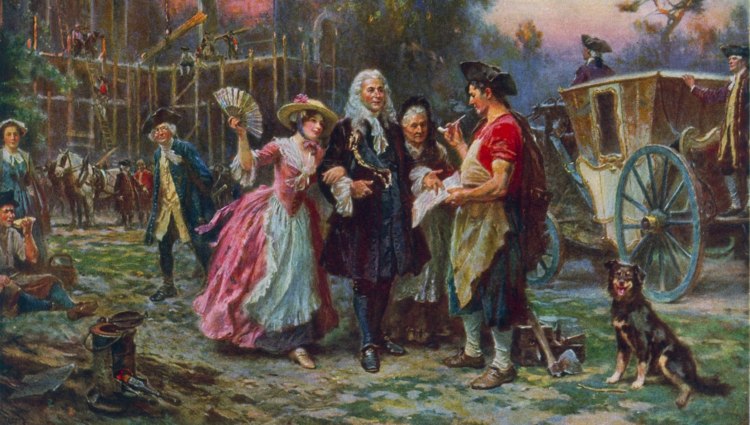
The featured image is “Building the Cradle of Liberty” (1863–1930), by Jean Leon Gerome Ferris, and is in the public domain, courtesy of Wikimedia Commons.