Senate Majority Leader Jack Johnson’s state financial disclosure filed in January shows he owns Tesla stock.
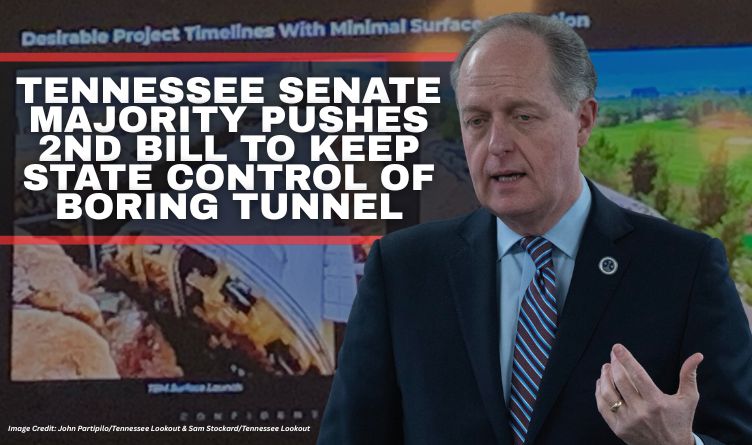
Image: Senate Majority Leader Jack Johnson has proposed his second bill in a week to ensure the State of Tennessee controls oversight of a Nashville tunnel project. Image Credit: John Partipilo/Tennessee Lookout & Sam Stockard/Tennessee Lookout
***Note from The Tennessee Conservative – this article posted here for informational purposes only.
By: Adam Friedman and Sam Stockard [Tennessee Lookout -CC BY-NC-ND 4.0] –
One of Tennessee’s leading lawmakers has proposed a second bill in less than a week to make sure that Nashville’s city government has no oversight of the Boring Company’s underground tunnel through the city.
The legislation, HB1515/SB1673, would make it so that all “subsurface passenger transit” companies report their assets subject to property taxes to the state comptroller instead of a county assessor. The only project that would fit under this new description is the proposed 13-mile Music City Loop, and it would essentially block the Nashville-Davidson County property assessor from determining the value of the Boring Company’s assets in the city.

In Tennessee, utilities and other large-scale infrastructure projects that cross county lines report their assets to the Tennessee Comptroller, but so far, the Boring Company has plans only for Nashville.
It’s the second bill state Senate Majority Leader Jack Johnson, a Franklin Republican, has sponsored to give the state oversight of the Boring Company’s project over fears that Metro Nashville’s government won’t be as friendly to it.
Last week, Johnson proposed a bill to establish the Subterranean Transportation Infrastructure Coordination Authority, an 11-member board and a 20-person staff to issue permits and provide all regulations for subterranean projects. The new board comes with an $5 million annual price tag.
Nashville’s Boring Company tunnel will be completely funded by the company, and is expected to run from the State Capitol building to Nashville’s Convention Center to the Nashville Airport, with another line running down Broadway and West End into Midtown.
The company only uses Tesla vehicles in its tunnel. Billionaire Elon Musk founded and owns the Boring Company and is the largest stockholder in Tesla.
Johnson, whose state financial disclosure filed in January shows he owns Tesla stock, has justified the need for his tunnel bills because company officials have told him the project could eventually cross city and state lines.
Johnson said Tuesday he bought the stock in early 2025, “well before anyone knew that Boring was coming to Tennessee.” He added that he didn’t know in advance about the announcement held at Nashville’s airport.
Asked if he sees any conflict between owning the stock and sponsoring bills related to the Boring project, Johnson said, “It’s a different company. I’m sensitive to that because I don’t want there to be any perception of conflict. But it was bought well in advance. I never knew anything. I haven’t added to the position.”

The common theme among the routes is that they would be built along state-owned roads, avoiding Metro Nashville-regulated roads and allowing the project to fall under the purview of the state’s transportation department, which Boring Company Vice-President David Buss said the company prefers.
“We talked to the city as well as the governor’s office, and we talked to the state, and it made a lot of sense to start this project with the state’s support,” said Buss at a community meeting held Monday in Metro Councilmember Joy Kimbrough’s North Nashville district. “Tennessee has been a wonderful support as we grow, and we want to continue to work with the Metro Council and the people of Nashville on this.”
In Las Vegas, Nevada, where the Boring Company built its first tunnel, the company is alleged to have violated environmental regulations nearly 800 times, for such infractions as releasing untreated water into the city and digging without approval. The company has also contested nearly $112,000 in fines from the Occupational Safety and Health Administration for serious violations, including reports of workers suffering chemical burns after being splashed with toxic sludge.
Last week, in an announcement approving right-away access and permitting, Gov. Bill Lee said the first segment of the tunnel “is expected to be operational by the end of this year.”