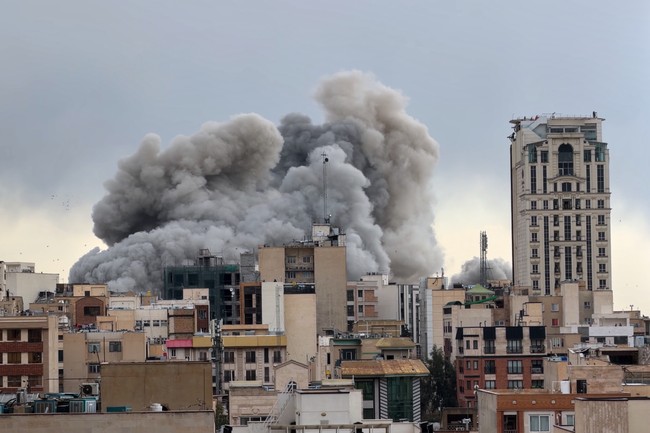
When a country spends two decades lying through its teeth in negotiations, that nation should not feel shocked when no one will help pull its chestnuts out of the fire. The chestnuts its leadership still has, that is.
Since the beginning of joint US-Israeli war operations, the remnants of Iran’s regime have remained publicly defiant. They have declared that the IRGC and other military forces have inflicted massive damage on Americans and Israelis. The USS Abraham Lincoln is thisclose to being sunk!
Privately, however, the regime knows it’s cooked if they can’t get an end to the intensifying barrages of Operations Epic Fury and Roaring Lion. The New York Times reports this morning that the Iranian intelligence service tried to plead for a cease-fire with the CIA, which may have prompted Donald Trump’s “too late!” post on Truth Social yesterday:
In public, Iran’s surviving leaders have defiantly refused to negotiate with President Trump to end the American and Israeli assault on their country. But a day after the attacks began, operatives from Iran’s Ministry of Intelligence reached out indirectly to the C.I.A. with an offer to discuss terms for ending the conflict, according to officials briefed on the outreach.
U.S. officials are skeptical — at least in the short term — that either the Trump administration or Iran is really ready for an offramp, the officials briefed on the outreach said.
Still, the offer, which was made through another country’s spy agency, raises critical questions about whether any Iranian officials could put into place a cease-fire agreement with the Tehran government in chaos as its leaders are methodically picked off by Israeli strikes.
The NYT connects dots to the social media post yesterday morning:
And after saying for days that he was open to discussing a deal with Iran, Mr. Trump posted on social media on Tuesday morning that it was now “too late” for talks.
That may have been a tail-end reaction to the covert outreach. However, the sequence fits better with Trump’s declaration of terms on Sunday afternoon, which would have been directly after the Iranian intel operatives reached out to the CIA. The Iranians promised to restart talks in a more serious manner if the US and Israel halted their attacks. Shortly after that, according to the NYT timeline, Trump made his terms public for a cessation of hostilities:
President Donald Trump said today that members of the Iranian Revolutionary Guard who lay down their arms will be granted “full immunity,” and those who refuse “face certain death.”
“I once again urge the Revolutionary Guard, the Iranian military police, to lay down your arms and receive full immunity or face certain death,” Trump said in a video address Sunday afternoon. “It will be certain death. It won’t be pretty.”
This mostly got overlooked at the time, given that this was Trump’s first public remarks on the war to the American people. A declaration of possible terms for ending the war may not have seemed unusual at the time, but this was a little more specific than one might have expected. Trump probably figured the IRGC wanted to find a way out before the US and Israelis did existential damage to their regime, and wanted to send a specific message that existential damage was the point.
Besides, as the NYT admits later, no one could possibly believe that the Iranian regime offered new talks in good faith:
First, it is not clear that Iran is actually open to a deal, despite the recent outreach from its intelligence arm. Some Iranian leaders may believe they can inflict enough physical, economic and political pain on the United States and Israel to force an end to their assault. Mr. Trump already faces growing political pressure from Republican allies unhappy about the operation.
Actually, it has been very clear for a very long time that the Iranian regime won’t cut a deal that limits their options in any phase of their threats to the region. Iran’s only deal with the West was Barack Obama’s JCPOA, which all but blessed an eventual Iranian nuke while doing nothing about its terror proxies or ballistic missile systems. Trump has spent months trying to get Iran to negotiate on these points, and finally concluded last week that the mullahs are big fans of circle jerks:
Senior US officials said Tuesday that President Donald Trump ordered strikes on Iran after Tehran demonstrated during three rounds of nuclear talks last month that it was not serious about giving up the capacity to produce a nuclear weapon.
“They basically offered us a lot of political wins and some concessions, but they were unwilling to give up the building blocks of what they needed to preserve to get to a bomb,” said one of the two senior US officials who briefed reporters on condition of anonymity.
The mullahs “offered us a lot of political wins.” Does that sound familiar? That’s the trap into which Obama fell with the JCPOA, led down that primrose path by Rob Malley and Ben Rhodes. The Iranians figured they could pull another fast one with Trump, and maybe even more with the author of The Art of the Deal. It turns out that Trump knows when he’s being played.
The Iranians refused to even discuss their support for Hamas, Hezbollah, and the Houthis or their ballistic missile systems, even when the US offered to let the other Gulf states take the lead on those issues:
Laying out Washington’s objectives in the negotiations, the second senior US official said they were for Iran to hand over all of its highly enriched uranium; ensure that the three nuclear facilities hit by the US last year — Natanz, Fordow and Isfahan — would be decommissioned forever; guarantee that Iran would cease its support for proxy militia groups; and dismantle Iran’s ballistic missile program.
The senior US official acknowledged that the latter two issues were not addressed in the three rounds of talks mediated by Oman. However, he said that the US decided those issues would be raised in separate talks that would include Arab allies, who are impacted by Iran’s missile program and support for proxies.
While Trump’s top negotiators Jared Kushner and Steve Witkoff informed their Iranian counterparts during the talks that they expected Tehran to negotiate with its Arab neighbors on its missiles and proxy support, Iran never did so.
“That was one of the first tells — that while we agreed in good faith to allow the region to take on these two issues, the Iranians made no attempt whatsoever to convene the region and talk about them,” the first US official said.
The Iranians wanted a return to the bad-faith status quo ante, not a renewed effort for peace. And now, thanks to the rain of ballistic missiles all over the Middle East, the other nations that tried to push Trump into settling the issue now understand just how lunatic the Iranian mullahs and the IRGC really are. They want these threats permanently neutralized now, not just kept in abeyance at the whim of the mullahs and their apocalyptic military leadership.
In that sense, Trump’s correct in assessing that there’s no one to talk with about a cease-fire now. Most of that clique is dead now, and even the ones left alive can’t be trusted to negotiate anything. It will take a regime change of some sort before Trump and Benjamin Netanyahu have any partner for de-escalation talks. In the meantime, the US and Israel will ensure those threats get neutralized in the most efficient and direct manner possible.
Editor’s Note: For decades, former presidents have been all talk and no action. Now, Donald Trump is eliminating the threat from Iran once and for all.
Help us report the truth about the Trump administration’s decisive actions to keep Americans safe and bring peace to the world. Join Hot Air VIP and use promo code FIGHT to get 60% off your membership!