 It is not often that I find myself quibbling with the great philosopher, Peter Kreeft. On the contrary, it is usually best to do with Dr. Kreeft what T.S. Eliot did with Dante. “I have just finished an article on Dante,” Eliot wrote in 1920, “and I feel that anything I can say about such a subject is trivial. I feel so completely inferior in his presence—there seems really nothing to do but to point to him and be silent.”
Usually I am very happy to point to Dr. Kreeft and be silent. What has caused me to break my silence is his discussion of two questions in the introduction to his recently published book, The Two Greatest Novels Ever Written: The Wisdom of The Lord of the Rings and The Brothers Karamazov (Word On Fire, 2025). “What is a novel? And what makes one great?”
“The first question is easily answered,” he says. He then answers it by quoting the definition of a “novel” in the Merriam-Webster Dictionary as “an invented prose narrative that is usually long and complex”. This really will not do. A biography or an autobiography is “an invented prose narrative”, as is a work of history. The authors of such works might be diligent in trying to tell the truth, or they might choose to be very selective of the parts of the truth that they want to tell, or they might be intent on constructing a carefully concealed lie. None of these manifestations of “invented prose narratives” can be described as novels. The replacement of invented with fictional would help to remove the confusion, even though carefully constructed lies, purporting to be presentations of the facts, are also fictional narratives.
The stipulation that a novel is “usually long and complex” is necessary to distinguish novels from short stories and novellas, the latter of which are too long to be short stories but not long enough to be novels. It’s not clear at what point, in terms of length, a short story becomes a novella, or a novella becomes a novel. This is, however, a tangential question beyond the scope of Dr. Kreeft’s two questions.
Having defined the “novel”, albeit not very satisfactorily, Dr. Kreeft proceeds to a discussion of why novels are important. Such importance is rooted in their power to be “life-changing” or to make a difference to society. Novels have the power to change lives and societies negatively or positively. Those which have a positive effect are those which conform to the truth. Dr. Kreeft quotes Aristotle, who defines truth, or the telling of truth, as “to say of what is that it is, and of what is not that it is not”. In other words, Dr. Kreeft adds, it is “tellin’ it like it is”. Since novels can do this, since they can tell the truth with great power, it is false to say that fiction is untrue. Indeed, to say that fiction is untrue is to tell a lie!
This truth about the truth-telling to be found in fictional narratives is encapsulated by Dr. Kreeft with his customary succinctness and lucidity: “Great novels can give us more psychological wisdom than psychology text books, more sociological wisdom than sociology textbooks, more philosophical wisdom than philosophy textbooks, more historical wisdom than history textbooks, and more theological wisdom than theology textbooks.” The mark of greatness in a novel is its ability to convey life-changing wisdom to the reader. And the reason that novels can do this better than textbooks, Dr. Kreeft explains, is because “life is a narrative, not a textbook”.
The other quibble that I have with Dr. Kreeft is with the title of his book. Although the wisdom to be found in The Lord of the Rings and The Brothers Karamazov makes them two of the greatest fictional narratives ever written, I’m not comfortable with calling The Lord of the Rings a novel, nor was its author. In terms of literary form or genre, The Lord of the Rings has more in common with The Iliad, The Odyssey, The Aeneid, Beowulf, The Divine Comedy, Sir Gawain and the Green Knight and Paradise Lost than it has with The Brothers Karamazov or any other novel. It is not a novel but a prose epic.
Whereas the novel is novel, i.e. relatively new, having its roots in the early modern period, the epic has its roots in classical antiquity. Even though Tolkien chose to break with formal tradition by writing in prose instead of verse, his fictional narrative remains part of the genric tradition of the epic. It is prosaic in form but epic in terms of genre. It is of the genus epic, not the genus novel.
Having quibbled with Dr. Kreeft, I will now resume my customary deferential posture. I will do so by concluding with my brief endorsement of the book that can be found on its back cover: “What would happen if one of the world’s greatest philosophers were to share his wisdom on two of the world’s greatest works of literature? What would happen is this book. Peter Kreeft, surely one of this century’s greatest philosophers, takes us deep into two of the deepest works of the past two hundred years. This is a journey into the heart of wisdom that everybody on the quest for truth will want to take.”
__________
The Imaginative Conservative applies the principle of appreciation to the discussion of culture and politics—we approach dialogue with magnanimity rather than with mere civility. Will you help us remain a refreshing oasis in the increasingly contentious arena of modern discourse? Please consider donating now.
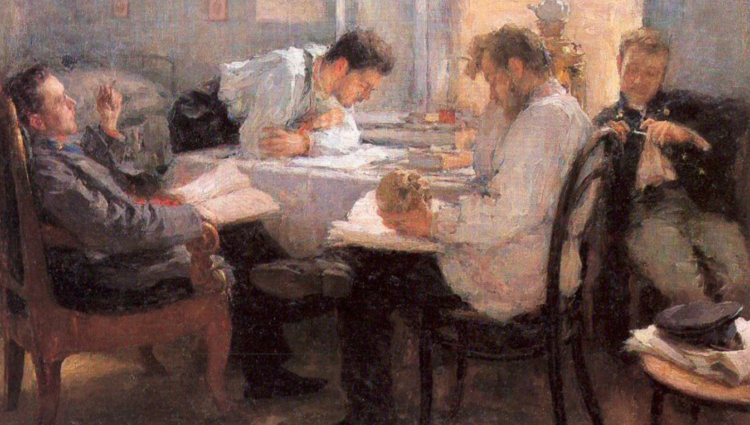
The featured image is “The Night Before Examination” by Leonid Pasternak (1862–1945), and is in the public domain, courtesy of Wikimedia Commons.