Not only do democracies invade every aspect of life and politicize them, they always and everywhere—from Athens to America—serve as an impetus to imperialism. If the will of the majority is to rule at home, why not enforce such rule the world over?

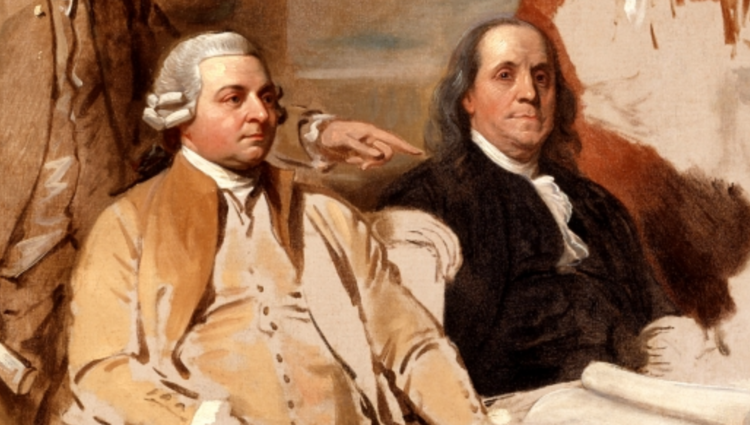
John Adams & Benjamin Franklin
“Remember Democracy never lasts long. It soon wastes exhausts and murders itself. There never was a Democracy Yet, that did not commit suicide,” John Adams wrote in a private letter, dated December 1814. “It is in vain to Say that Democracy is less vain, less proud, less selfish, less ambitious or less avaricious than Aristocracy or Monarchy. It is not true in Fact and no where appears in history.”
One of the most frustrating aspects of modern times is its insane and dangerous sanction of democracy. The word itself has become something sacred or so pervasively employed that it means next to nothing, though it also has become a god-term, meaning everything to everyone. Again, as such, it means nothing and everything.
This is in deep contrast to the vast span of the Western tradition. Essentially from Plato through the American Founding, democracy was associated with conformity, violence, upheaval, instability, and placating the lowest common denominator of society. During the Founding, Adams was by no means alone in challenging democracy. At the very beginning of the Constitutional Convention of 1787, in late May, the opening statements of the delegates witness explicitly the fears of democracy and its growing influence in the post-revolutionary thirteen states. Representative Gerry stated, “The evils we experience flow from the excess of democracy. The people do not want virtue; but are the dupes of pretended patriots [“demagogues” in the original; later corrected].” Later that same day, Representative Randolph agreed. He “observed that the general object was to provide a cure for the evils under which the U.S. laboured; that in tracing these evils to their origin every man had found it in the turbulence and follies of democracy.”
Not surprisingly, the Constitutional Convention created a republic with a small democratic element. That element was that each American citizen (its numbers severely restricted) could vote for one representative of the House of Representatives. The was no popular vote for the Senate, the Supreme Court, or the Presidency. Of course, it must be noted, the functions of the federal government were extremely limited, a most minimal government that barely touched the lives of any Americans.
Echoing and manifesting the traditions of ancient republics, especially the Roman republic, the new government incorporated elements of a monarchy (the executive branch), an aristocracy (the Senate and the Supreme Court), and a democracy (the House of Representatives. This must be put into context, however. From the ancient world to the present, a republic—the most natural, best, but also most fragile government known to man—reflected the human person. The monarchy reflected the head and the intellect, the aristocracy reflected the reasoning of the soul and the hearth, and the democracy reflected the stomach and the procreative regions, the animalistic passions. Certainly, just as the human body needed all three, so does a republic. But, only the insane or depraved man would ever allow his animalist passions in life. They exist to provide for food and sex, but they should serve rather than dominate. The same is true for republics. They must, by necessity, incorporate democracy, but they should never be led by it. That would be the very definition of insanity.
Again, we were created as a republic, not a democracy. To suggest otherwise is not only historically inaccurate but philosophically unwise. The words, republic and democracy, are not interchangeable. At best, a democracy fits into a republic, but a republic never fits into a democracy.
Never one to shy away from controversy, John Adams continued his attacks on democracy during the year of the creation of the Constitution. In 1787, he noted, with Plato, that all democracy ends in tyranny. “Where the people have a voice, and there is no balance, there will be everlasting fluctuations, revolutions and horrors, until a standing army, with a general at its head, commands the peace, or the necessity of an equilibrium is made appear to all, and is adopted by all,” Adams claimed, prophetically anticipating Napoleon. In no way were democracies immune from the abuse of power. “My opinion is, and always has been,” Adams complained, “that absolute power intoxicates alike despots, monarchs, aristocrats, and democrats, and jacobins.”
Frankly, it’s hard to prove the Founders incorrect in their criticisms and paranoia. Beginning with the Second Great Awakening—and its extreme evangelicalism, each evangelical declaring Jesus as his personal Lord and Savior—democracy pervaded nearly every aspect of early nineteenth-century America. After all, if every one had a direct relationship to God with no intermediaries, why would he not have a government of the same kind?
Tragically, though, a simple majority (50.1% of the population) can be every bit as tyrannical as a despot or oligarchy. Indeed, because the majority feels so empowered, it compares itself to God and it reaches into every aspect of life. Indeed, there have been few forms of government so intrusive into civil society as democracy as it grossly politicizes all aspects of society.
But, we have to take the arrogance a step further. Not only do democracies invade every aspect of life and politicize them, they always and everywhere—from Athens to America—serve as an impetus to imperialism. If the will of the majority is to rule at home, why not enforce such rule the world over?
Again, democracies are everywhere and always incredibly arrogant, at home and abroad.
So, yes, it matters deeply that we Americans confuse our republic for a democracy. Ideally, a republic is protective of its people—the common good as opposed to democracy’s brutal zero-sum game of the greater good—and often, perhaps even to a fault, insular. Still, I would take the quiet, virtuous republic any day over the obstreperous arrogance of a democracy.
It it’s always worth remembering Thomas Jefferson’s words of warning and clarification in his brilliant first inaugural: “All, too, will bear in mind this sacred principle, that though the will of the majority is in all cases to prevail, that will to be rightful must be reasonable; that the minority possess their equal rights, which equal law must protect, and to violate would be oppression.”
Too many democrats—especially Americans—have forgotten Jefferson beautiful admonition. If we want a stable society, a functioning republic, we must remember them.
__________
The Imaginative Conservative applies the principle of appreciation to the discussion of culture and politics—we approach dialogue with magnanimity rather than with mere civility. Will you help us remain a refreshing oasis in the increasingly contentious arena of modern discourse? Please consider donating now.
The featured image (detail) is “American Commissioners of the Preliminary Peace Agreement with Great Britain, 1783-1784, London, England. (oil on canvas, unfinished sketch, between 1783 and 1784). Pictured here are John Adams and Benjamin Franklin.” This file is in the public domain, courtesy of Wikimedia Commons.