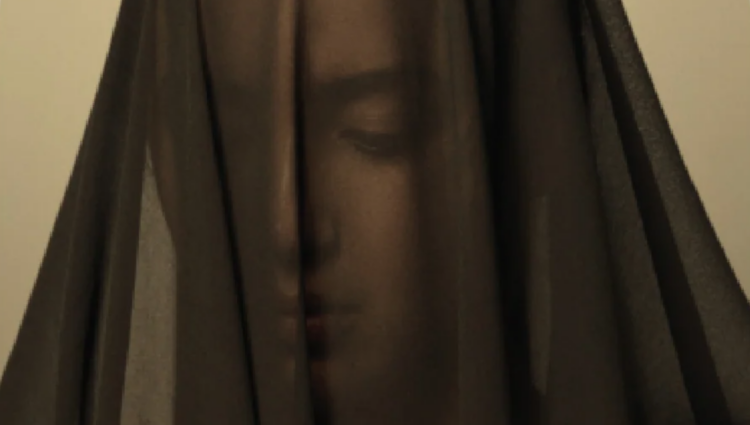
“Till We Have Faces” is filled with profound passages that resonate with the struggles of average Christians living in a post-Christian age. Peter Kreeft is to be thanked for helping lovers of Lewis access that profundity and so find the wisdom and courage to remove the veil and look to the divine Bridegroom who shed His blood that we might be His Bride.
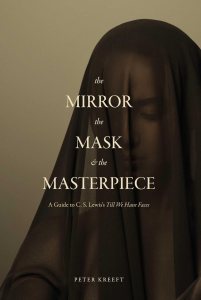
The Mirror, the Mask & the Masterpiece: A Guide to C.S. Lewis’s Till We Have Faces, by Peter Kreeft (140 pages, Word on Fire, 2026)
 C.S. Lewis is one of those rare writers whose unique vision, style, and passion has inspired thousands of readers with a mania to read all his books, even though those books cover a multitude of different genres. There are, however, two works in the Lewis canon that are notorious for stopping eager readers in their tracks: That Hideous Strength and Till We Have Faces. How fortunate, then, that one of the great educators and popular explicators of the last half century has taken the time to mine, for Lewis non-specialists and specialists alike, the literary, philosophical, ethical, psychological, and theological gold of the latter.
Peter Kreeft, professor of philosophy at Boston College, has published over one hundred books, including a series that render accessible the key themes and lessons of central texts in the Western canon (the Psalms, Augustine’s Confessions, Aquinas’s Summa, Pascal’s Pensées, Tolkien’s Lord of the Rings), a second series that sets Socrates in dialogue with influential philosophers ancient and modern, and dozens of other books on prayer, heaven, the problem of pain, the Bible, ethics, apologetics, and Catholic doctrine. As prolific and diverse as Lewis in his oeuvre, Kreeft also shares a vital quirk with the author of Narnia: he puts everything he knows into everything he writes.
This is supremely the case with The Mirror, the Mask & the Masterpiece: A Guide to C.S. Lewis’s Till We Have Faces. Readers of this book will come away with somewhat more than a clearer understanding of Lewis’s haunting novel; they will wrestle with what Kreeft has learned over his nearly ninety years about the true nature of good and evil, identity and self-deception, reason and myth, faith and hope, love and truth. Rather than reduce Till We Have Faces to a simple allegory in which each thing represents one and only one other thing, Kreeft welcomes his readers to explore the rich, varied landscape of what Lewis considered to be his finest novel.
Before taking up the characters, themes and plot, Kreeft meditates briefly on the style and setting of the novel. The style, written in the form of a legal brief, is not, Kreeft reminds us, “Lewis’s style at all, but [the first-person protagonist] Orual’s” (13). Till We Have Faces offers a masterclass in what might be called compassionate objectivity. Through the artistic process, “Lewis succeeded in throwing off his mask, abandoning his public ‘persona’ and style, standing outside himself and entering Orual with empathy and understanding—which is exactly the opposite of the smug and imperial arrogance that his enemies at Oxford accused him of, probably because they thought of Christianity itself as arrogant” (13). For Kreeft, Lewis’s aesthetic surrender mirrors, and was likely made possible by, his surrender to Christ.
The setting is “pre-Christian, Gentile, Greek, and barbarian” (15), but it is mostly so to serve the Cupid and Psyche myth that Lewis retells in his novel. Throughout, Kreeft argues that the real struggle Lewis takes on is not between the many gods of polytheism and the One True God of Christianity, but how the nature of divinity differs from our perception of him/them. “Christians reading TWHF can simply substitute ‘God’ for ‘the gods’ whenever mentioned, and they will find that they as Christians have the same problems and questions that pagan polytheists in the story had” (20). This is a vital insight, for Lewis, like Tolkien, Chesterton, Dante, and Aquinas, was skilled at extracting true truths from the philosophies and myths of the ancient Greeks and Romans. They wrestled then as we wrestle today with the problem of pain and evil, with the caveat that our wrestling is more intense because we believe our God is omniscient, omnipotent, and omnibenevolent.
For those unfamiliar with the plot, Orual is the ugly daughter of the cruel king of Glome, whose only consolations are her tutor, the Fox, a Greek slave and stoic philosopher, and her beautiful step-sister Psyche. When a plague strikes, Psyche is chosen to be the sacrificial scapegoat and is left to be married to/devoured by the divine Beast (Cupid), son of the goddess Ungit (Venus).
After the ritual, Orual seeks out the body of Psyche to bury it; instead, she finds Psyche healthy but dressed in rags. Psyche tells Orual the Beast is a gentle god who, though he has forbidden her to see his face, has taken her as his Queen and housed her in a palace of gold. Orual, who cannot see the palace, thinks Psyche is mad and urges her to leave, but Psyche replies that she must obey her husband rather than Orual. Offended and suspicious of her mysterious “husband,” Orual manipulates Psyche into agreeing to use a lamp to look at his face while he is sleeping.
Psyche reluctantly agrees, but, when a drop of oil falls on Cupid, he rebukes Psyche and sends her into exile. He then appears to Orual, condemns her for the role she has played, and tells her she will suffer alongside Psyche. Although Orual goes on to be a just and good queen of Glome, she increasingly turns inward and begins to wear a veil. To deal with her grief, she writes a journal (Till We Have Faces) in which she articulates her anger against the gods.
After many years pass, Orual learns Psyche is now venerated as a goddess, and that, in the story told across the kingdom, Orual is the villain. In the closing chapters, the still angry Orual gets the chance to present her case before the gods—only to learn the truth. She knew Psyche was happy and destroyed her anyway. After confessing the disordered nature of her love, Orual comes to understand the true nature of love and shares in the beauty of Psyche.
As we read Lewis’s novel, Kreeft explains, “the steps of discovery and education for Orual and the reader follow the order of the story: The plot of the internal drama and the plot of the external drama follow a similar road map” (31). Because we experience Till We Have Faces through Orual’s eyes, we make the same spiritual and psychological realizations she does at the same time. We follow her lead in always taking the side of the rational, logical Fox over that of the “superstitious” priest of Ungit, only to discover that there is truth in bloody pagan rituals.
“There is wisdom latent in the pagan myths, Lewis thinks, however overlaid they may be with lust, cruelty, terror, and fear. Deep truths are hidden there like diamonds in tar pits” (48). But neither Kreeft nor Lewis stops there. “This is also,” Kreeft, correctly explicating Lewis, argues, “how the Old Testament relates to the New. Jewish prophecy, unlike Greek philosophy, was divinely revealed and authoritative; but it, too, was primitive, imperfect, and incomplete—divinely designed to function as an imperfect finger pointing to a perfection to come” (49).
We need, to use Lewis’s terminology, both the “thin” religion of the Fox and the “thick” religion of the priest. As part of her spiritual awakening, Orual is visited by the spirit of the Fox who, having learned the importance of the heart, has realized that the priest was right that the gods “will have sacrifice—will have man. Yes, and the very heart, center, ground, roots of a man; dark and strong and costly as blood” (99). Here is how Kreeft incisively, if shockingly interprets these words from the novel: “What kind of terrible religion is this? It sounds like the worship of Dracula. No, the exact opposite. The true God does indeed work a blood transfusion, but he feeds us his blood instead of consuming ours. God does indeed demand our all: our heart, center, whole self, flesh, and blood, not just our head and hands, not just thoughts and deeds” (99).
In the original myth of Cupid and Psyche told by Apuleius (a synopsis of which Lewis provides in an appendix), Orual sees Psyche’s palace and destroys her out of envy. Lewis alters this detail, but only partly. Orual is given a brief glimpse of the palace but immediately rationalizes it away, refusing to believe what she has seen. The palace cannot be real, and so Psyche must be mad.
It would be easy to interpret this scene as one in which Orual chooses her head (the Fox’s stoicism) over her heart (her love for Psyche), but Kreeft complicates things, shedding light on Lewis’s deep understanding of the psychology of sin and temptation. “[T]he good, honest, unselfish, truth-seeking heart is to be trusted to enlighten the head, but the wicked, dishonest, selfish, rationalizing heart is not. The saint’s heart is receptive to divine inspiration; the sinner’s heart is receptive to demonic temptation” (87). Long before her spiritual awakening, Orual realizes that her heart/soul is as ugly as her face. That, Kreeft suggests, is the real reason she begins to wear a veil, to hide her soul from God.
Though Lewis remained a firm Anglican, many of his books suggest that he believed, at least in a limited sense, in purgatory. Kreeft, a convert to Rome, explains that Catholic theology permits, but does not require, the belief that, at our death, “we will get a momentary foretaste of the beatific vision. We will see the light and face and beauty of God, who is destined to be our infinite and eternal joy, for a heartbreakingly beautiful moment before our time in purgatory, so that we will know what goodness and beauty we have rejected in every one of our sins. What makes purgatory not only endurable but hopeful, and even joyful, is that we will know that this is the light and beauty we are now infallibly destined to know and love forever after our purification is complete, for only the pure of heart can see God” (95).
How similar and yet how different is Orual’s journey. “Orual also sees the light and beauty of the god for a split second, and the rest of her life is her purgatory. The Church Suffering will see this flash as a hope and foretaste of heaven, but Orual sees it in terror and anguish as a foretaste of her potential hell. Her veil is most of all not against men but against the God, against this light” (95). To further block out this light, Orual becomes a workaholic for her people. That is to say, she “tries to disappear into her career, as do so many, both men and women, in our world” (96).
And yet, there is grace at the end. Rather than receive a philosophical or theological answer to her complaints, Orual receives what Job does at the end of his own journey of suffering: a theophany, a revelation of God himself. “Why,” Kreeft asks, “was Job satisfied even though God answered none of his very good and agonizing questions? If God had answered Job in the way he had hoped, he would only have been satisfied until the next minute, when more questions would have risen” (120). Here is how Orual responds to her meeting with the divine: “I know now, Lord, why you utter no answer. You are yourself the answer. Before your face questions die away. What other answer would suffice? Only words, words; to be let out to battle against other words” (106). After quoting this haunting passage, Kreeft identifies it as his “candidate for the most profound passage in the book” (106).
Till We Have Faces is filled with such profound passages that resonate—despite their pre-Christian strangeness and obscurity—with the struggles of average Christians living in a post-Christian age. Kreeft is to be thanked for helping lovers of Lewis access that profundity and so find the wisdom and courage to remove the veil and look to the divine Bridegroom who shed His blood that we might be His Bride.
*
Author’s Note: This essay is dedicated to the memory of Barbara J. Elliott, my friend and colleague at Houston Christian University. Her academic and spiritual mentorship of my daughter Anastasia led, in part, to her decision to, like Barbara and Peter Kreeft before her, cross the Tiber to Rome.
__________
The Imaginative Conservative applies the principle of appreciation to the discussion of culture and politics as we approach dialogue with magnanimity rather than with mere civility. Will you help us remain a refreshing oasis in the increasingly contentious arena of modern discourse? Please consider donating now.