At Easter in the year 432, in the village of Slane, Ireland, Saint Patrick declared: “There is no better day for my task. I will announce my mission by lighting the Paschal Fire at this place on Easter Eve!”
 One day in Lent, a boat sailed up the winding reaches of the Boyne, past the battlefields and the monstrous tumuli on the north bank which are the burial mounds of kings who died when Pharoahs were buried under Pyramids in Egypt, past Slane’s steep, verdant hill, and on by sluggish winding reaches towards An Uaimh, or Navan. When the rough leather sail got no helping wind, the men in the craft would scull.
It was a pleasant trip, between grassy banks where trees were growing faintly green above bushes of golden whin, the glory of the Irish Spring; a trip of twenty miles. The river-voyagers must have camped somewhere on the river banks for a night; for it was early morning when they arrived at the Ford of the Alders, Trim. There, where the river sweeps like silver light round pastures, the little boat came ashore. On a low eminence, not far from the water, was a rampart that surrounded a sunny house, from which the inmates watched with curious eyes.
The chief of the travellers, having landed, read in a holy book. A lad came running from the house to interrupt the traveller’s devotion.
“Who are you, stranger?” the boy asked.
“I am Lommán, a priest, of the company of Patricius the Bishop,” was the answer, spoken in learner’s Gaelic.
“Are you a Briton, holy sir?”
“I am.”
“My mother is a Briton,” the boy said. “She has named me Fortchearn, which the British call Vortigern.”
“And your father, my lad?”
“He is Felim, the son of the High-King. Come, my mother will make you welcome.”
Lommán had found the household that he was seeking. He was welcomed in the language of the Britons, the Celtic speech that had P’s instead of K’s.
Felim’s wife had known the faith in Britain, and doubtless she had prepared her husband and son for it. Glad she was to welcome a priest to that house beside the Boyne. Lommán baptised the household, and the parents committed their boy to him to be reared for the Church. House and land at Trim were made over to the mission.
When these good folk enquired how the Bishop, Patricius, was faring, since he landed with his twenty-four helpers last autumn, Lommán would have surprising news: “He is in Meath already.”
He would tell how Patricius had spent the winter in Ulster, the clerics copying missals and the craftsmen making crosses and vestments; and how, when the Spring came, and all was ready, the Gallic ship had been launched again and steered out through the raging channel of the sea-loch, and had sailed past the mountains of Mourne and along Louth’s low coast to the Boyne’s mouth. Here Patricius had bade the pilot steer up the river mouth to a reedy landing place near Mornington (as the spot is called now), and had come ashore in Royal Meath, the province which was the mensal land of the monarchs of Ireland. One Cianán of Duleek, a Christian, is said to have brought Patrick to this place; and it is suggested that Cianán was an Irish Christian who returned to his native land from the Continent or Britain, with the mission.
“And now,” Lommán would say, “the Bishop waits at the Boyne’s mouth to advance to Tara, that he may preach the faith before the High-King himself, and win permission to establish the Church in Ireland. He has sent me to take counsel with you, whom he knew to be his friends.”
There was a conference of those first Christians of Meath, and the next move of the mission seems to have been made in the light of the counsel taken at Trim; the mission was to move to Slane and to celebrate Easter on that high hill by the Boyne, which looked over the High-King’s territory.
At Slane, the Bishop and his helpers set up their mission station. Mass was said, very likely, under a shieling, and the first Christians of Meath may have come in during Holy Week to receive the sacraments from the Bishop of the Irish himself.
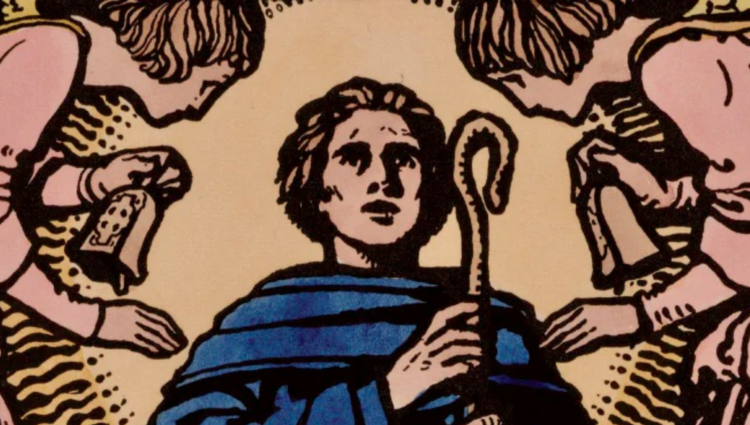
Patrick probably sat in praetorio then, on the hill which commands all the blue distances of Meath, as he conferred with his people and his converts. To our eyes, he would appear to be wearing ecclesiastical vestments; for the vestments of today are much what the habitual dress of Roman citizens of good position was in his time. He was clean shaven in the Roman manner, unlike the moustached and bearded Irish; his crown was tonsured, and he wore the soft, dented cap, which developed into the mitre. He bore a staff which was altogether remarkable. For centuries afterwards it was revered as the Bachall Iosa, the Baculum of Jesus, and the place in which it was preserved is named Ballyboghil, the Town of the Baculum, to this day. This staff was believed to have been carried once by our Blessed Lord Himself, who was crucified and rose again just 400 years before that Easter at Slane. It was borne by Patrick as a relic of the utmost sanctity. Whether the story of its origin was true or only legendary, the fact that Patrick used it in his missionary travels would suffice, surely, to make it venerable in later times. Conceive, then, the meaning of its end. In the sixteenth century, when an English prelate was sent to Dublin as King Henry the Eighth’s archbishop, the relic venerated since Patrick’s day in Ireland was taken from the place of its custody and burnt in the street by that alien prelate, in hatred for all that it signified, whether legendary or authentic.
Another relic of Patrick’s mission escaped the reforming destroyers. That was his Mass bell, which we still possess. It is made of hammered iron, roughly, as if by a village blacksmith, riveted, and coated with bronze. Including the handle, it is less than eight inches high. There is no clapper. It is sounded, as the many other old Irish bells were, by being struck. In the eleventh century, the high age of Irish culture, the coarse, old bell was enshrined reverently in a case of bronze, silver, and gold, with precious stones and magnificent interlacing ornament in the style called Celtic. “The beauty, richness, and intricacy of the workmanship of the shrine,’’ writes a Scottish antiquary, “discloses to us the taste and skill prevailing at the time, and indicate the degree of veneration for the rude object of hammered iron to which so magnificent a work of art was given as a covering.” Our generation heard that bell ring, fifteen hundred years after the coming of Patrick; for it was struck at the Mass in Phoenix Park in 1932, when a million worshippers attended the Eucharistic Congress; and, a few hours later, at Benediction in the heart of the Irish capital.
The Bishop, we have said, took counsel with the Christians of Meath, there on Slane hill. They would counsel him not to venture to Tara for the present. “There is danger, Lord Bishop, at this season.”
“How so?” Patricius would ask, but he was resolved to go.
“Go not,” the native advisers would say, “for this is the time of the fiery festival of the Spring, which the Magi of the heathen hold on the royal hill.”
Perhaps it was the newly baptised prince, Felim, whose garment bore in its edges the Seven Colours of Nobility to denote his royal rank—perhaps it was he who gave reasons for not advancing on Tara.
On the day that we count March 25, the High-King’s people would keep the birthday of the year, the fiery feast of Spring. On the eve, no fire must be seen in all the country, until the ceremonial fire of Spring was lighted, in the High-King’s presence, on Tara hill. Then there would be a heathen festival, with hymns chanted to the morrow’s sun—the sun, that fire in the sky which is the father of all fires; “and fire, the Druids say,” the prince would explain, “is that by which all things live.”
“The day you name,” the Bishop would answer, “will be that day which we call the Lord’s day, Dominica, which in Irish is Dia Domhnaigh.”
The Irish would repeat the words, Dia Domhnaigh.
“Moreover,” the Bishop would continue, “the coming Lord’s Day will be Paschal Sunday, Domhnach Cásca.”
Mark how the Latin Pasch, by the P-into-K rule, became Cáisc, Cásca, when it was made Gaelic. In the year 432, Easter Sunday fell on March 25, a coincidence of the Christian festival with the pagan day of observance which was truly dramatic: for from that coincidence sprang the conflict and the challenge.
“There is no better day for my task,” Patrick must have said. “I will announce my mission by lighting the Paschal Fire at this place on Easter Eve!”
That is what he did.
__________
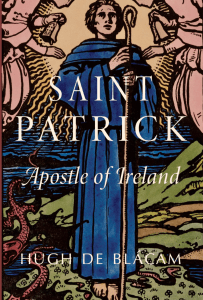
This essay is taken from Saint Patrick: Apostle of Ireland. Republished with gracious permission from Cluny Media.
Imaginative Conservative readers may use the code IMCON15 to receive 15% off any order of not-already discounted books from Cluny Media.
The Imaginative Conservative applies the principle of appreciation to the discussion of culture and politics—we approach dialogue with magnanimity rather than with mere civility. Will you help us remain a refreshing oasis in the increasingly contentious arena of modern discourse? Please consider donating now.