The Letter of Clement provides our first glimpse of the Gospel fused with ‘Romanitas’—a vision of Rome not so much as a symbol of strength and power as of unity and peace. Whereas the old ‘Pax Romana’ was achieved through conquest and force, the new order would be built on the love of Jesus.
 The writings of the early Church Fathers bear witness to the amazing confluence of Israel, Greece, and Rome that marks the emergence of our Western, Christian civilization. The Letter to the Corinthians attributed to St. Clement of Rome is one of the earliest Christian writings outside of the New Testament. Clement is known as the third successor to St. Peter as bishop (episkopos, overseer) of Rome, and hence is honored by Catholics as the fourth pope. He is believed to have lived in the mid-to-late 1st century. To put this in perspective, Clement would have been at roughly the same historical remove from Jesus as we are from Martin Luther King, Jr., and possibly even less. A century later, Tertullian writes that Clement was ordained by St. Peter himself, and Irenaeus also declares that Clement knew and conferred with the apostles.
Other than that, little certain is known about Clement, including his place of origin. The letter was written in Greek to the Greek-speaking Christians of Corinth. It was translated into Latin and Syriac early on. Scholars disagree on the dates of Clement’s reign as bishop or when this, his only authenticated writing (there is also a second, spurious letter ascribed to Clement), was composed. Some have argued for a date as early as the 60s AD, and others for a date as late as 96. The letter itself does not name the author, being addressed simply “The Church of God that dwells as a pilgrim in Rome to the church of God in pilgrimage at Corinth.” It has been suggested that Clement wrote the letter in concert with a staff of theological experts. It is rich in biblical references—mostly to the Old Testament, and some to Paul’s letters, to which Clement’s letter is very close in style. The Letter of Clement was in fact treated as scripture early on, read in churches along with the writings of Paul; it just narrowly missed being included in the New Testament canon.
To start with, Clement is writing authoritatively as bishop of Rome to the church in Corinth. This argues for Rome’s early self-understanding as being in a position of primacy to other local churches. What comes through from Clement’s writing is that Rome’s identity translates not so much as an imposition of power but rather a source of unity and concord, a consistent leitmotif the letter.
The letter was occasioned by a controversy in the Corinthian church. Christians there had deposed several of their presbyters (elders, priests); Clement reproves them for this action because the presbyters were duly appointed ministers, ordained by the Apostles who in turn were ordained by Christ. Ousting duly ordained priests is therefore tantamount to contravening God’s will. Clement’s argument here is the first testimony to the foundational belief in apostolic succession, the chain that connects members of the church to Jesus through history. Clement decries jealousy, pride, and factitiousness and offers a call to humility and peace, citing examples of both from scripture. He walks a fine line between rebuking the Corinthians for their behavior and shining a positive, guiding light on the situation.
The dominant tone is uplifting and edifying, preaching a very Roman sense of order. We must obey our duly appointed authorities because the order of the church reflects God’s harmonious governing of the universe. We must submit our will to God’s: “Let us, brothers, each in his own order, strive to please God with a good conscience and with reverence, not transgressing the fixed rule of each one’s own ministry.” The letter bears witness to a church with a clear order and structure from a very early date.
Reading the Letter of Clement, you strain to get a mental image of the world behind the words. The world of Clement, the secret world of early Christian Rome, is a largely undocumented one, lost in the mists of time. Today we might see the work in retrospective terms, as a writing of “the fourth pope.” But what did it mean to be bishop of Rome in Clement’s lifetime? He was not yet the “papa” in common language. There was no apostolic palace, nor probably much in the way of pomp or ceremony. Clement would have presided, not over a great basilica, but over furtive meetings in private homes. Being the Roman bishop would have been more like being the head of an underground movement. In the Letter of Clement we sense the precariousness, danger, and fresh adventure of primitive Christianity, qualities that come out in other writings of the early (Apostolic) Church Fathers.
And the letter survives as literature, transcending its immediate purpose. Clement combines practical solicitude with philosophic serenity. The letter contains lyrical passages about the harmony and order of creation, God’s providence, and hints of the reality of Christ’s resurrection in the rhythms of nature. This is all presented under an umbrella of Judaic piety and deep scriptural wisdom. Patristic scholar Mike Aquilina points to the letter’s integration and craft, as well as its impressive length, contrasting these qualities with St. Paul’s epistolary style which often bears witness to the haste and urgency of a missionary on the move.
For Peter and Paul, Rome represented the ultimate portal to the Gentile world, and in crossing it they met their fate as martyrs to the faith. Their martyrdoms are fresh events in Clement’s memory, duly memorialized in the letter. But Clement, although writing from the seat of empire, is not himself an emperor, not a “big man,” but on the contrary a “little man”—the subversive leader undermining the institution from within. Christians in Rome at this time may have amounted to a few hundred people—the first ones probably Jews from Jersualem, then joined by Gentile converts. And it is part of the Christian message that the little man, or the little group, turns out to be the authority, the real ruler. Clement’s little group was the mustard seed planted in the midst of the mighty empire.
I mentioned the problems of identity and dating surrounding Clement’s letter. The Latin name Clēmēns (meaning mild, gentle, or calm) was a common one in ancient Rome, making absolute identification difficult beyond the testimony that he was Clement, bishop of Rome. He has been equated variously with the Clement mentioned by Paul in the Letter to the Philippians, with a freed slave of the consul Titus Flavius Clemens, and with a Roman nobleman who at one time served the emperor.
And when it comes to assigning a date, the letter’s internal details have given scholars plenty to chew on. There is Clement’s allusion at the start to “sudden misfortunes and calamities that have fallen upon us.” Could this refer to persecutions of Christians under one of the Roman emperors, to the eruption of Mount Vesuvius in 79 AD, or to the Roman civil war in AD 69?
Then there is the fact that Clement talks of Temple sacrifices in Jerusalem as still ongoing, which would not have been the case after the year 70 when the Roman forces destroyed the city and the temple. Was the letter then written in the 60s? Or is Clement speaking of Temple sacrifice in some idealized sense rather than as a literal present-day reality?
Attention has also been paid to the names of the two couriers who Clement says are carrying the letter to Corinth: Claudius Ephebus and Valerius Vito. Were they freed slaves of Emperor Claudius and his wife, Valeria Messalina? If so, they would have been too old in AD 96 to be acting as diplomatic legates…but just the right age around AD 70 or 80.
Tantalizing clues, but no definitive answer.
After wide popularity in the first five centuries of the church, the Letter of Clement seems to have gone underground. Not until the 1600s did it recapture scholars’ attention, when the patriarch of Constantinople gifted a copy to King Charles I of England, sparking a revival of interest in the Apostolic Fathers, who were now increasingly recognized as a specific group of early Christian witnesses. I can’t help wondering if the Protestant Reformers might have rethought some of their views if they had known this letter and what it so clearly implies (or so it seems to me) about Rome’s role. This is not to deny that the letter raises questions about the precise structure of the nascent Roman church. Historians, archeologists, and other scholars certainly have many mysteries to follow up from the clues left in this and other ancient Christian literature.
What is certain is that the Letter of Clement provides our first glimpse of the Gospel fused with Romanitas—a vision of Rome not so much as a symbol of strength and power as of unity and peace. Whereas the old Pax Romana was achieved through conquest and force, the new order would be built on the love of Jesus. Reading the letter today, we can marvel anew at the multicultural harmony that Christianity brought about in the ancient world and the continuity that binds the church together from age to age.
Sources:
Early Church Fathers Collection (ed. David Augustine, Word on Fire Classics, 2024)
The Faith of the Early Fathers, Volume 1 (ed. William A. Jurgens, The Liturgical Press, 1970)
The Apostolic Fathers, Volume I (ed. Bart D. Ehrman, Loeb Classical Library, 2003)
__________
The Imaginative Conservative applies the principle of appreciation to the discussion of culture and politics—we approach dialogue with magnanimity rather than with mere civility. Will you help us remain a refreshing oasis in the increasingly contentious arena of modern discourse? Please consider donating now.
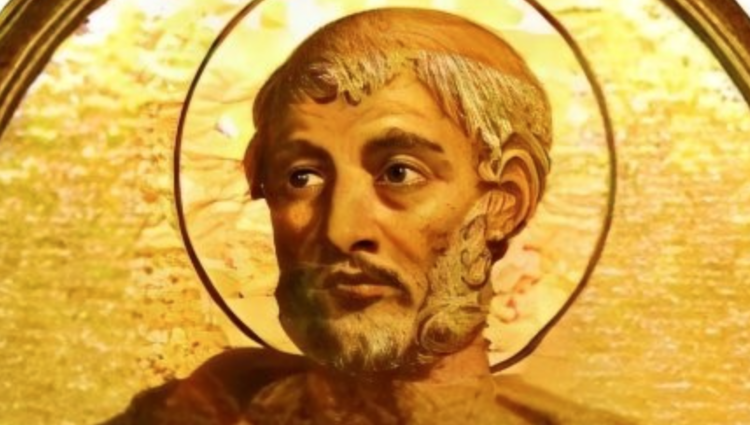
The featured image is a portrait (c. 1840) of Pope Clement by an anonymous artist. This file is in the public domain, courtesy of Wikimedia Commons.