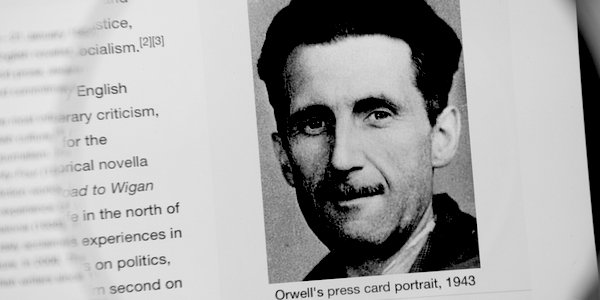
GEORGE Orwell’s 1941 essay England Your England, written at the height of the Blitz and at a moment in English history when it was not unreasonable to think that the nation and its distinctive culture might not survive, contains the following sentence:
‘The Stock Exchange will be pulled down, the horse plough will give way to the tractor, the country houses will be turned into children’s holiday camps, the Eton and Harrow match will be forgotten, but England will still be England, an everlasting animal stretching into the future and the past and, like all living things, having the power to change out of recognition and yet remain the same.’
When I read those words as an impressionable teenager the sentiment appealed immediately to my sense of patriotism. I was further to the left at the time than I am now, and reading Orwell helped me reconcile my love of country with what remained of my adolescent radicalism.
Likening England to ‘an everlasting animal stretching into the future and the past’ must have been terribly inspiring to those Britons who read it during the darkest hours of the Second World War, at a time when, as Churchill put it, Britain was in danger of sinking ‘into the abyss of a new Dark Age made more sinister, and perhaps more protracted, by the lights of perverted science’.
As I’ve grown older and, I like to think, wiser and moved quite far to the political right, I now read Orwell a little less uncritically than I did as a passionate youth. Hence, my flinching at the idea of ‘country houses’ being ‘turned into children’s holiday camps’, and ‘the Stock Market being pulled down’, the latter suggesting the author’s revolutionary impulses but also his economic illiteracy. Had either of those things taken place, the freedoms Orwell championed would have disappeared overnight.
To be clear, I continue to love Orwell. Indeed, I feel I owe him a great debt. Reading him as a young man — I read almost the entire oeuvre while travelling across America on a Greyhound bus in 1976 — helped to form my moral compass and belief in the integrity and dignity of individual men and women. No other writer of whom I’m aware wrote so eloquently in favour of human decency and better explained those dark impulses that enable totalitarian states to use terroristic violence and the perverse corruption of language to erase the freedom and autonomy of the individual. But he was not at his best when discussing economics, which one can also say about his near-contemporary and political opposite, the great Catholic convert and apologist G K Chesterton, another writer to whom I owe a considerable debt.
Writing England Your England at a time when Britain and her empire stood alone against the forces of National Socialism, Italian Fascism and the Stalinist variety of Bolshevism, when British cities were being bombed incessantly, and the nation was facing the imminent threat of a German invasion, Orwell saw the war as a means to effect a democratic Socialist revolution and bring about the fairer society he desired.
By linking the social transformation of England to waging war successfully against Nazi Germany, Orwell is appealing to a form of patriotism that links love of country with his vision of democratic Socialism, an oxymoron some would say, but something achievable in the mind of the author of Animal Farm.
Orwell believed that England could become Socialist and yet remain essentially English. He puts it thus: ‘An English Socialist government will transform the nation from top to bottom, but it will still bear all over it the unmistakable marks of our own civilisation, the peculiar civilisation which I discussed earlier in this book . . . It will not be doctrinaire, nor even logical. It will abolish the House of Lords, but quite probably will not abolish the Monarchy. It will leave anachronisms and loose ends everywhere, the judge in his ridiculous horsehair wig and the lion and the unicorn on the soldier’s cap-buttons.’
Marvellous prose, to be sure; but there is also something slightly ridiculous about it, even a bit quaint. Orwell is beginning to sound like one of those ‘utopian Socialists’ derided by Marx and Engels in their Communist Manifesto. While Orwell remained optimistic about the future, believing that his vision of a Socialist Britain could be realised once she had won the war against Germany and, as we have seen, remains committed to the idea that England possesses ‘the power to change out of recognition and yet remain the same’, he is prepared to concede that national cultures can be eradicated under extraordinary circumstances, by which he meant ‘some very great disaster, such as a prolonged subjugation by a foreign enemy’.
This raises the question: Was Orwell correct in describing England as an everlasting animal that could change dramatically yet somehow stay the same? Based on recent visits to England, conversations with people who live there and extensive reading, I would have to say that the ‘very great disaster’ of which Orwell wrote has already occurred and nothing short of civil strife can undo it.
As thousands upon thousands of unvetted military-age men continue pouring into the country across the English Channel, and as millions of migrants legally have come to the United Kingdom over the last few decades, many of whom hate the country and want to change it beyond recognition, and as churches are turned into mosques and Sharia threatens to replace the common law in some parts of the country, can it still be said that the nation I left in the late winter of 1983 to move to America remains the same place in the late winter of 2026? Having visited England as recently as 2019, I would have to say it is hugely different from the nation I left in the early 1980s, so different, in fact, that I find it difficult to know where to start.
While my father and mother were alive, I visited England quite frequently, less so after their deaths in 1987 and 1991 respectively. My last visit was in 2019 to attend my sister’s 80th birthday celebration in the village in Devon where my mother was born. Before travelling to Devon by train, I spent a few days in London, staying in a renowned hotel on the border between Holland Park and Shepherd’s Bush. After going to confession in Westminster Cathedral, I took the tube to the East End, specifically Whitechapel, where my brother and I used to drink at the Blind Beggar, the pub where in 1966 Ronnie Kray murdered George Cornell, a member of a rival gang.
The streets of Whitechapel looked nothing like I remembered them. The buildings were the same and the layout of the streets hadn’t changed much in 40 years, but the people who walked those streets were very different from those who had walked them when I would join my brother for a pint or two, invariably more, on a Saturday evening.
In fact, Whitechapel looked like a city somewhere in South Asia or in the Middle East. White people were conspicuous by their absence. Many of the women wore burqas or variations thereof. I wasn’t sure what I was seeing but knew it wasn’t England, or at least the England I knew and loved, and it wasn’t the England eulogised by George Orwell.
That evening I visited Kensington Gardens, where my mother and I would eat sandwiches sitting on a bench by the Round Pond after a busy day visiting museums and other sites of interest, near to where Barrie became acquainted with Arthur and Sylvia Llewelyn Davies who lived nearby and whose third son, Peter, was the inspiration for Peter Pan. I remember exactly where that bench was located and was hoping to spend a few moments sitting there, remembering those halcyon evenings with my mother and older sister, but was unable to do so due to the three burqa-garbed young women who occupied the bench. Perhaps recklessly, I took their photograph. Their response to raise two fingers in my direction, though whether it was meant as a gesture of peace, or profanity, or victory will be for ever unknown.
But my biggest shock came the next day when I visited my brother in Leytonstone. When I was a boy, my mother would tell me stories about how people would let her cut in line during the Second World War because she was often pregnant and always accompanied by small children. I grew up thinking queueing was somehow sacrosanct, one of those foundation stones of civilised life, little noticed but essential in preventing the physically strong lording it over the weak. To get to my brother’s house from Leytonstone tube station, I needed to take a short bus trip. It was rush hour and very crowded outside the station. As the bus I needed to take arrived, what seemed like a multitude of people, representing almost all races and ethnicities on Planet Earth, except those people curiously dubbed ‘Caucasians’, surged aggressively forward as if they were scrambling to get a seat on the last helicopter leaving Saigon. I was so glad my mother wasn’t there to witness this ugly stampede, the antithesis of the deference and English manners that shaped the wonderfully civilised and Christian Edwardian lady she was and remains so in the memory of her lastborn.
I was also reminded of my late brother, who voted Labour for most of his life but was drawn away later on, and was the least racist person I have ever known, describing himself as a ‘culturalist’.
Yes, indeed, culture matters. Forbidden words, I know, but some cultures are better than others.
My walk through Whitechapel and Kensington Gardens and what I witnessed in Leytonstone brought home to me what is surely an unassailable fact: England is not the timeless and ‘everlasting animal’ of which Orwell wrote.
Loving England is deeply embedded in my DNA, and I pray to God I am wrong about its coming demise and that Orwell was right.