Paul Kingsnorth believes that the Machine Age has replaced the four P’s of traditional culture (the past, the people, place, and prayer) with four S’s: science, self, sex, and the screen.
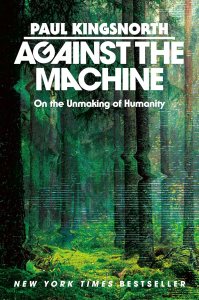
Against the Machine: On the Unmaking of Humanity, by Paul Kingsnorth. (348 pages, Random House, 2025)
 Paul Kingsnorth is right about much, and he is blunt about pretty much everything that he is right about. But will his rightness and his bluntness make a difference? In other words, is he right to believe that our world can be righted? Only time will tell, and time may not be, OK is not, on his side. For that matter, it’s not on our side, meaning humanity’s side, either.
The race is on, and it’s a contest between Kingsnorth’s four P’s and the four S’s of the “Machine Age.” That translates to the Kingsnorth quartet of the “Past” (where a culture comes from), the “People” (who a culture is), Place (where a culture is), and Prayer (where a culture is going in terms of its relationship to “God or the gods”) versus his opposing quartet of the “anticulture of the Machine,” a quartet which is composed of science, the self, sex, and the screen.
Kingsnorth might not have needed to define each of his S’s, but he does: Science gives us a “non-mythic” story of our origins; “the highest good is to serve the self”; sex is an “affirmation of individual identity”; and the screen is “both our main source of distraction from reality and the interface by which we are directed into the coming post-human reality of the machine.”
If the Machine Age has an ideology, Kingsnorth regards the “S” foursome as a “fair summary” of it. On the other hand, he continues, “it is less an ideology than a theology,” which essentially and “effectively functions as a replacement for and simulacrum of religion.” There you have it. Which is putting matters fairly bluntly.
To be sure, Kingsnorth could have been blunter about it—and he often is. For example, a chapter simply titled “The Universal” begins with this simple sentence: “The internet and its consequences have been a disaster for the human race.” As a result, “everything has changed.” And yet, “the real changes are only just beginning.” Does that mean that Kingsnorth thinks that there is still time to right the world—or that there really isn’t?
He must think, or at least hope, that there is. Otherwise why write this book? And why not? After all, as G.K. Chesterton once put it, what is hope if not hoping when everything seems hopeless?
An Englishman himself, but an Englishman who has left England for rural Ireland, Kingsnorth is of a mind to think that things in England have been going wrong for a very long time. He chooses 1850, to be precise, for it was then that the economic powerhouse of the world (became) “a primarily urban nation.” And today? Today his former homeland is “one of the most urbanized, most centralized and least agrarian nations on earth.” And if that doesn’t state matters bluntly enough, Kingsnorth’s former homeland is also one of the world’s most “decultured” and “rootless” nations to boot.
Pessimistic demographer that he also is, Kingsnorth adds that, while it’s now been 175 years since England became primarily a place for city dwellers, it’s only been since 2007 that a majority of those living on earth have come to live in cities. How large an urban place had to be to qualify as a Kingsnorthian-sized city remained undefined by Kingsnorth. But what happens to people living urban lives does not escape a Kingsnorthian description. There we can and do live “ignorant of our neighbors, of the seasons, or anything but our own direction and ambition.” The result is a “kind of turning in on ourselves: a radical parochialism.”
Kingsnorth doesn’t say so precisely, but he seems to be more than suggesting that such a parochialism leads those currently living comfortable, cosmopolitan urban lives are all too quick to conclude that those who live elsewhere are, well, living among the “deplorables.”
If a “London progressive” by the name of Karl Marx didn’t spring immediately to mind here, he should. At least he did for Kingsnorth in the context of something about what urban dweller Marx regarded as the “idiocy of rural life.” That, of course, would be an understanding of idiocy, with which a transplanted Englishman and current Irish farmer by the name of Paul Kingsnorth is in sharp, not to mention blunt, disagreement.
To be sure, the Paul Kingsnorth, who does have his difficulties with progressives of all sorts, does not necessarily find everything objectionable about all sorts of radicalisms. By his own self-definition he is a “reactionary radical.” Here he is one with G.K. Chesterton, who is one of many authors whom Kingsnorth has read and readily borrows from in this book. Jacques Ellul, Christopher Dawson, Simone Weil, Christopher Lasch, E. F. Schumacher, James C. Scott, and Carl Trueman are his favored few among more than a few others.
Chesterton thought of himself as a reactionary, and no doubt a radical one at that. Here Kingsnorth borrows not just from Chesterton, but from one Craig Calhoun and his 1982 book titled The Question of Class Struggle. The title aside, the book was actually not a Marxist tome, but an attack on Marxist-inspired history, especially that of E. P. Thompson and his The Making of the English Working Class.
Rather than impose a Marxist framework on the early stages of the Industrial Revolution, Calhoun returned to the artisans, farmers, small businessmen and families “who resisted the rise of that system in the first place.” And who would those resisters be but those much-maligned and much-ridiculed, machine busting Luddites. In sum, they were the original reactionary radicals.
Kingsnorth does not tell us when he first read Calhoun‘s book, but he does tell us that only then did he fully and finally realize what he had been doing as a writer and a reporter for many, many years. (Full disclosure: This mainly American historian and one-time Chesterton performer only became aware of Calhoun and his book by reading this Kingsnorth book.)
As a younger man, Kingsnorth reported on and sympathized with leftist protests and movements directed at modern capitalism as practiced on both the international stage and on various national stages. Here Chesterton could have been helpful to Kingsnorth as well. After all, Chesterton had his own issues with both cosmopolitan capitalism and state-sponsored, state-run, and/or state-owned enterprises.
To my knowledge, Chesterton never referred to the “machine age,” but he saw large-scale capitalism, socialism, communism and fascism as all products of the age that Kingsnorth defines as the “machine age.” And all were targets of his ire well before they would become the targets of Kingsnorth’s ire. To be sure, each in its own way has been destructive of Kingnorth’s four P’s. And each in its own way has been responsible for promoting various versions of his four S’s.
But let’s stay with Calhoun, because Kingsnorth dwells on Calhoun, whose work “explained my own work—and my own politics—to me in two simple words.” Those two words, not surprisingly, would be “reactionary radicalism.”
Those two words strike Kingsnorth as just right for two reasons. In the first place, they do not fit neatly into any left versus right categories, which is just fine for an ex-leftist who has found a home somewhere on the right and who is looking for anti-machine age allies wherever he can find them.
And in the second place? Here trouble looms. The politics of reactionary radicalism is, by Kingsnorth’s own admission, a “politics from an older world.” If so, and especially if only so, what are the possibilities for reactionary radicals today? After all, things did not end well for the Luddites then. And the Luddites have not been well-treated in the history books since then. None of this augers well for an anti-machine campaign on the part of any remaining–or potential–Luddites in our heavily machine-driven, urban age.
In searching for reasons to be hopeful, Kingsnorth sees reactionary radicalism as a defense of the “moral economy,” which he then defines as a “system built around community bonds, local economies, and human-scale systems.” This might be well and good, for that matter it is well and good. But Kingsnorth also knows that this cannot be the end of his story.
We know that because he adds this proviso to the end of that same sentence: “in the face of colonization by the machine.” Yes, the machine is a colonizer–both at home and abroad. As such, “it will always replace people with technology, and it will always make consumers of us all.” Always?
Kingsnorth also knows that he then must ask himself and his readers two questions: “Can we cleave to reactionary radicalism… in a society in the advanced stages of conquest by the Machine? Is it not too late?”
Cleave? Don’t we need to do more than cleave? First we must return to, then rebuild and restore a reactionary radicalism. Kingsnorth must think so. Nay, he must believe so. Otherwise, to be repetitively blunt, there is no point in bothering to write this book.
In any case, he surely must also believe that it is not too late. For that matter, he also wants to believe that reactionary radicalism can still be found, “if we look in the right places.” Such places, he believes remain “especially prevalent outside the West.” And in the West? Here things are much more dicey, not to mention downright, perhaps even impossibly, difficult. After all, in the west what Kingsworth calls the “moral economy” has already been “destroyed” (not weakened, mind you, but destroyed). What then? Then, Kingsworth declares, we have no choice but to “start rebuilding it.”
Once again, Kingsnorth refuses to avoid being blunt. Good for him. Such bluntness is needed. In fact, it likely is required. The hour is late indeed. And if that isn’t blunt enough, how about this: It may well have been too late before he so much as started to write this book.
Now permit me to be even blunter: Any modern-day Luddite crusade “against the machine” will fail just as the original Luddites failed before being subjected to ridicule and repression, not to mention irrelevance.
Kingsworth must know this; hence his emphasis on rebuilding rather than destroying. He must also know, or at least hope, that such a painstaking process must begin with thoughtfulness and reading. And if Chesterton is always worth reading, this Chesterton-inspired book is very much worth reading as well. In fact, it ought to be required reading even for those who have only the mildest of second thoughts about the age in which we live today, let alone anyone and everyone who might be ready to start the rebuilding process here and now.
__________
The Imaginative Conservative applies the principle of appreciation to the discussion of culture and politics—we approach dialogue with magnanimity rather than with mere civility. Will you help us remain a refreshing oasis in the increasingly contentious arena of modern discourse? Please consider donating now.