The offering of ourselves that we make is a “true” and therefore acceptable offering when it is made with a “pure and humble heart”. When we learn to thank, praise, adore and glorify him for who he is and for what his love has done for us, then we are learning the meaning of true selfless loving.
 In a Jewish world it was easy enough for the daily timetable of the people to revolve around the religious practices of Judaism. But after the siege and fall of Jerusalem and the destruction of the Temple in AD 70 the Jewish people, as well as Christians, became a minority in a much bigger pagan world whose daily timetable did not revolve around religious practices. The early Christians followed the example of Jesus, praying three times a day in the Synagogue, dedicating their day to God, until they were no longer welcome there, or because it became dangerous to go there. It became all too easy for their persecutors, like Saul of Tarsus, to find them there at the third, the sixth and the ninth hour of the day. St Paul confesses, “Lord, I used to go from synagogue to synagogue, imprisoning and flogging those who believed in you” (Acts 22:19–20). The Morning Offering used by the first Christians could not so easily be repeated in the Synagogue several times a day, according to the Jewish custom, so it came to be said early in the morning to consecrate the whole day to God before work began.
It was then that in the new Temple, “not made by human hands”, which was Christ’s Mystical body, they would offer themselves to God, offering him their love “with all their heart, with all their soul, with all their mind and with all their strength” (Mark 12:30). The first Christians may not have been able to visit the Synagogue to renew and reinforce this Morning Offering as Christ did, during their busy days at work, but they could and did pause to do this at the third, the sixth, and the ninth hour as before, as the early sources make quite clear. In many towns it would often be the sound of a drum, a horn or a trumpet used to mark off the main sections of the day that Christians would use to remind themselves to renew their Morning Offering.
In the old Temple it was a physical offering of something precious that was made to God, but in the new Temple it was something even more precious that was offered. Just as Jesus, the New High Priest had offered himself from the moment he was born in a wooden crib to the day he died on a wooden cross, his followers wished to do likewise. Jesus called this a new worship in “spirit and in truth” as it would no longer consist in offering a physical offering to God to represent ourselves, but it would be a spiritual or mystical offering of ourselves, our love and our entire being. We often sign letters, emails, birthday or Christmas cards to friends and even acquaintances using the word “love” with which to sign off. But in doing this we are all too often devaluing a sacred word. To love someone means to go out to them with your whole heart and soul and with your whole being. It means that you would not only be prepared to live for them but to die for them too. Repeating the words of the first commandment again, it means to offer yourself to someone “with all your heart, with all your soul, with all your mind and with all your strength”. As only we ourselves can make this offering, we become priests, because nobody else can make it for us. That is why St Peter called the first Christians a royal priesthood (1Peter 2:9), because although they made their offerings themselves, they made it in Christ the King, the only true High Priest through whom alone human offerings could be effectively offered to God like never before.
The offering of ourselves that we make is a “true” and therefore acceptable offering when it is made with a “pure and humble heart”. When we learn to thank, praise, adore and glorify him for who he is and for what his love has done for us, then we are learning the meaning of true selfless loving. It is for this reason that God leads us into the Dark Night of the Soul. It is here we are asked to keep giving over and over again until our impure motives, our cupboard loving and our desire to obtain spiritual “goodies” to satisfy our desire for self-satisfaction are purified out of us. This alone is where the same Holy Spirit who conceived Christ in Mary’s womb conceives a “humble heart” within us. Now it can be seen how important contemplative prayer is as it is practised in the Dark Night. This is the crèche where Christians born of the Holy Spirit are nurtured by him to become the saints and mystics without which no authentic reform or renewal of the Church can take place. This is why I have tried to develop a brief history of Christian mystical spirituality to show how and why the mystical spirituality that took place within the Mystical Body of Christ in the early Church has been taken away from us in the last few hundred years. It must be resurrected amongst us once more, and without delay.
After making our Morning Offering we must spend the rest of our day transposing what we have expressed in words into actions in the real world in which we live. This real world means doing a hundred and one little things such as dressing the children, making their breakfast and taking them to school. It means doing an honest day’s work, often amongst and for dishonest people who hate you for your honesty. It means doing the washing, the shopping, the cooking and working in the garden. It means facing up to big things too, like the loss of your job or the curse of cancer, or some other malicious malady that has been diagnosed, if not in oneself then in others who are dear to you and coping with the consequences. It means standing up for the truth, not just in a pagan world but in the Church too when it loses its way, and even being prepared to die for it, as were the early martyrs. Multiply these examples from your own daily life to see the reality of daily living in a world that is becoming more and more self-centred.
The Morning Offering, together with a brief review of the day ahead, will help you make what might appear to be a series of spiritual stumbling blocks into stepping stones, that with God’s help can enable you to surmount the tide of evil that might otherwise engulf you. This sadly is the truth in the world we have been called to transform. This transformation, as St Catherine of Siena insisted, begins with us. The sincere way we make our Morning Offering and the sincere way we try to put it into practice in the day ahead is a perfect beginning. It gradually enables us to learn and practise what came to be called the “prayer without ceasing”, as everything we say and do becomes a prayer. It will involve the daily dying to self that we will experience as we try to take up our daily cross and follow Christ. Just as selfishness is porous to evil, the selflessness learned in the Night, becomes porous to the goodness that brings the same joy to us that Christ said he experienced and wanted to share with us.
Instead of a few brief moments at the beginning of the day praying for those we love, whether alive or dead, our prayer for them should correspond with the “prayer without ceasing” as every moment of our day is taken up with turning to God in formal prayer and turning to him in the neighbour in need. We can do the same for those who ask us to pray for them. Instead of just giving them a moment of our time, we give them every moment of our day. In this way they not only benefit from our selfless giving, but from what we receive in return from the God who can use us as a prism to direct his love through us to others. Practising this daily offering to God and dying to self in the Dark Night is so very much harder than before. But no matter what stage you are passing through in your spiritual journey, you must never fail to say your Morning Offering, and if possible short prayers of the heart throughout the day. This will help you to transform your day into the Mass, making it into the place where you continually offer all you say and do to God, in, with and through Jesus Christ Our Lord.
The good news is that those who persevere will travel more swiftly towards the selflessness that leads to union, thanks to the Holy Spirit who guides and supports us. While you are still travelling in darkness, he teaches you how to seek God alone and nothing for yourself, while in moments of light he begins to give you the sublime fruits of contemplation that will enable you to become a Christ-like human being.
___________
This essay is chapter forty-five of The Primacy of Loving and is published here by gracious permission of the author.
The Imaginative Conservative applies the principle of appreciation to the discussion of culture and politics—we approach dialogue with magnanimity rather than with mere civility. Will you help us remain a refreshing oasis in the increasingly contentious arena of modern discourse? Please consider donating now.
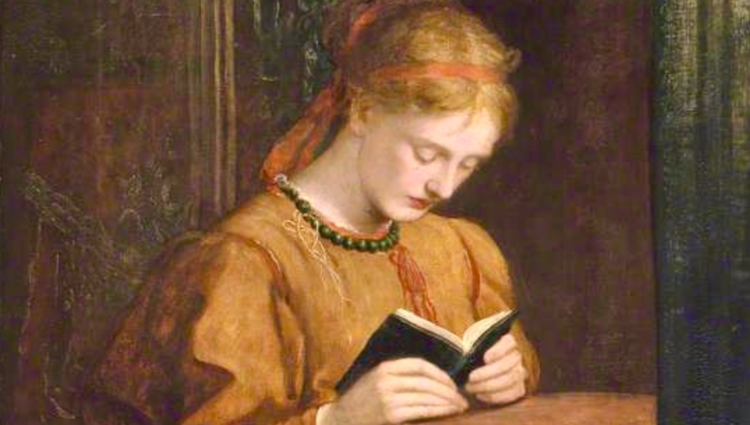
The featured image is “Prayer” (between 1867 and 1887), by George Frederic Watts, and is in the public domain, courtesy of Wikimedia Commons.