In a world of spoiled children, indigent adults, victim complainers, and entitled brats of all ages, the one who accepts responsibility for himself will have the tools for high self-esteem, achievement, and success in every area of life.
 I was five years old when I “got saved”. We had been to the Sunday evening service at our independent, fundamentalist Bible church, and the preacher must have hit home the need to choose Heaven instead of Hell, to repent of our sins and “accept the Lord Jesus Christ into our hearts.”
I still remember at bedtime saying tearfully to my mother that I wanted to accept Jesus. She knelt with me and led me in a simple prayer, saying I was sorry for my sins and that I wanted to accept Jesus and be saved. We wept together, and she gave me a hug, and that was it. I was saved. I was going to Heaven with the rest of my family and not going to Hell alone.
The critic of Christianity will likely be horrified by such a tale. They will see a vulnerable child brainwashed by religious fanatics—an innocent boy scared by visions of eternal torment, of being separated from his family and left alone in the dark. I have no doubt that some of their critique applies in some religious families and communities. Guilt, shame, and fear have been the tools of unscrupulous manipulative religious people of all stripes. I have always defended the experience, saying it is better to be scared into Heaven than soothed into Hell.
I defend my early encounter with the faith because my family and church community were loving, kind and authentic. They had plenty of human frailties and faults, but their faith was genuine and their love and concern for me was real. That early step of repentance and faith grounded my life in the right priorities, and now, some sixty five years later I still regard that boyhood decision to be formative and foundational.
At the core of Christianity—whether Catholic or Protestant—is this practical personal penitence. This is the bottom line and the first step. It is the Jesus prayer of the Russian staretz: “Lord Jesus Christ, Son of the Living God, have mercy on me a sinner.” It is the prayer of St Dismas the good thief: “Lord, remember me when you come into your kingdom.” It is the prayer of every person who, in one way or another, is brought to the foot of the cross and kneels to confess his sin and profess his faith in Christ Jesus the Lord. It is there in the Evangelical Christian who goes forward at the “altar call,” and the Catholic who goes to confession.
Now, as a Catholic it is my privilege and duty to make my confession on a regular basis and, as a Catholic priest, to hear the confessions of my people. As a result I have become increasingly aware of the practicality of penitence. In other words, confession is not only a religious obligation, it is an extremely powerful and practical solution to individual problems and humanity’s ills. It is so for the obvious practicality of having an outlet for guilt, shame, and stress. It is also a simple and practical solution for a range of psychological and relational problems.
However, more profoundly than these obvious practical benefits, there are three important and fundamental reasons for the practicality of penitence.
First, the individual penitent comes to the encounter with a fundamental belief in God. It may not yet be a specific, well- articulated and catechized faith, but belief in God is enough because that belief immediately shifts the person’s center of existence. He is not alone in the cosmos, and therefore he is not the center of the universe. While this assumption may seem like common sense to all deists, it is worth considering that if one is an atheist, the conclusion must be egocentrism. In other words, if there is no God, I am the center of the universe. To be sure, the atheist admits the existence of other individuals, but without God each one of the other individuals must also be operating on a foundation of egocentrism. They have no essential and necessary interdependence.
This foundational deism is practical because it is realistic. The individual penitent accepts the fundamental truth not only that he is not alone, but also that he is, by definition in a relationship with the deity. The relationship may be conscious and grateful and blessed. It may be rebellious and defiant and cursed. It may be relatively unconscious and unaware, but it is still a relationship. This underlying acceptance of the reality of God and one’s dependence on him establishes a natural and healthy self understanding and understanding of reality.
The second practical aspect of penitence is that the individual accepts that he is at fault. The human instinct, when something is wrong, is to blame others. The penitent, by virtue of coming to confession, accepts the blame. It is not someone else’s fault. It is his. He owns it. The power of this paradigm shift is enormous. Conflict of all kinds, from family spats to world wars are rooted in blaming others. Penitence rejects the blame game and accepts one’s own part in the problem. When this change of direction (metanoia) becomes part of one’s mentality a third extremely practical principle results.
The third practical result of penitence follows. If the penitent accepts the blame for the problem, then he also accepts the responsibility to do something about it. The power of this truth impresses me when I hear the first confessions of the children in my parish. These sweet second graders have not committed heinous mortal sins. Nevertheless, as part of their spiritual formation at the age of reason (just above my own when at five years old I “got saved”), they come to make their confession, and as they do I am aware that they are learning a lesson that will change their lives. They are learning to take responsibility for themselves. No one else is to blame, and no one else is ultimately responsible for them and their destiny.
In a world of spoiled children, indigent adults, victim complainers, and entitled brats of all ages, the one who accepts responsibility for himself will have the tools for high self-esteem, achievement, and success in every area of life.
I am convinced that this practical aspect of penitence—the core of Christianity—is what changed the world. All non-Christian religions, apart perhaps from Judaism) are, in one way or another, fatalistic. The pagans trust fate or the whims of their gods and goddesses. The Eastern religions trust in karma. The Muslims, in the inscrutable providence of Allah. The animists in the cycle of life. In every case the individual is at the mercy of powers beyond his control.
The Christian penitent, however, takes personal responsibility. He believes in God: a God who gave him free will, and he is able to say to God, “forgive us our sins” and “thy will be done” This action of repentance and faith therefore empowers him to take responsibility, and when he melds his will with God’s “all things are possible” He therefore has the mindset and power to make a change in his life, and if he can change his life, then he can change his destiny and he can change the world.
This paradigm shift from fatalism to self-determination enabled Christianity to conquer the ancient world and to go on to create Christendom and all the benefits that have accrued to the modern world, thanks to Western Christian culture. The advances of knowledge, development of technologies, medical science, art, architecture, music, and literature are all rooted in the underlying understanding that the individual is not bound by unknown, inscrutable forces, but has power to accept blame, and therefore to accept responsibility to change himself, his future, and his world.
__________
The Imaginative Conservative applies the principle of appreciation to the discussion of culture and politics—we approach dialogue with magnanimity rather than with mere civility. Will you help us remain a refreshing oasis in the increasingly contentious arena of modern discourse? Please consider donating now.
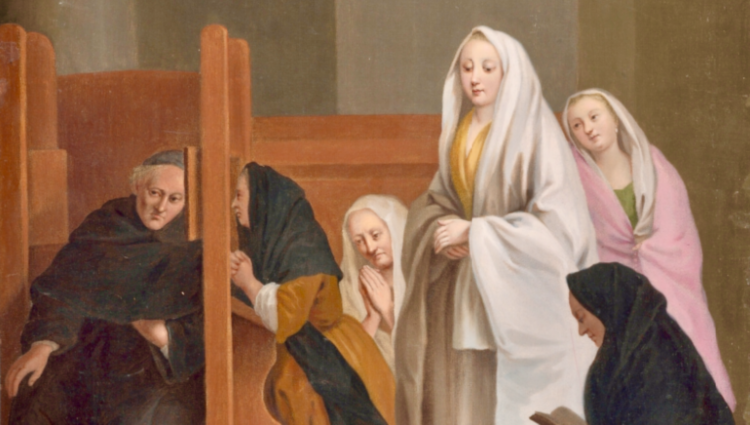
The featured image is “Poenitentiae Sacramentum” (after 1757), by Pietro Longhi, and is in the public domain, courtesy of Wikimedia Commons.