“The Roots of Ordered Liberty: America at 250”
The Academy of Philosophy and Letters is proud to announce a lineup for our annual conference featuring talks by such conservative luminaries as Nathan Pinkoski, D. C. Schindler, and Kody W. Cooper. We will host a debate over whether the Federalists or the Anti-Federalists were ultimately right, a panel on “America: From Republic to Empire,” another on “The Thinkers Conservatism, Inc. Ignores: Meyer, Röpke, Nisbet, Kendall,” and much more.
More information about the conference program—including how to register—can be found here.
On the theme of the conference
The year 2026 marks an important milestone for the American republic: 250 years since the Declaration of Independence. By most conventional accounts, this event served to found the American republic as a separate political entity, rooted in, but distinct from, its European—and specifically English—origin. According to the Declaration, liberty is among the “self-evident” rights of human beings, along with its prerequisite—life—and its telos—happiness.
This structure situates liberty within a distinctive order of things, suggesting that liberty is not for its own sake, but instead ordered toward something higher. In order fulfill its telos, liberty must exist within structures (familial, social, political, cultural, ecclesial) that direct it toward its proper end. The American founders understood this and—drawing on the Western philosophical, theological, and political tradition—established a political order that aimed to provide and enable these structures, seeking to preserve life and liberty while making the pursuit of happiness possible.
Yet, 250 years on, these structures seem to be endangered from numerous quarters.
On the side of ideas, common (mis)construals of the Declaration and the American founding either depict them as arising ex nihilo and dedicated simply to abstract ‘propositions,’ or as the contingent—and self-interested—work of morally dubious characters.
And these ideas have consequences: in concrete terms, our fractious political discourse seethes with division, discontent, and rage; every faction predicts catastrophe and doom while high-profile acts of political violence punctuate the news. Our educational system is failing at all levels, with students being fed ideological propaganda even as they prove unable to meet the most basic standards. Our cultural output reflects decadence and vulgarity, catering to the base rather than elevating the public square. And, our imperious foreign policy risks American lives for obscure causes with tenuous connections to our national interest, while exporting our decadence by force.
Has the contemporary American political order been irrevocably severed from its roots? Can the American experiment in liberty be sustained?
This conference, which will take place June 4-6 in College Park, MD, and is sponsored by the Academy of Philosophy and Letters, will consider questions that include, but are not limited to:
- How should liberty be properly understood? Can it be distinguished from tyranny, on one hand, and license on the other?
- What is human happiness and how should it best be pursued? What is the relationship of politics and morality to happiness?
- As the Declaration of Independence suggests, the American claim to liberty rests both on universal appeals, and on assertions that are rooted in particular, historically conditioned circumstances. How should we think about the relationship between the universal and the particular—the philosophical and the historical—in the American political tradition?
- What were the moral-cultural assumptions of the Framers that informed the constitutional order that emerged? How does this relationship bear on our current social order, legal and jurisprudential order, and our culture?
- Has the republic of 1776 become an empire? Where does American foreign policy stand in relation to the concerns of those such as George Washington regarding the need to avoid foreign entanglements? What are the implications for domestic liberty and tranquility?
- How have the scientific and technological developments over the last two and a half centuries changed the character of the people and the institutions of the American republic? Where lies the balance of ordered liberty in this regard?
- What is the relationship between education and liberty? How should education be reformed and employed to reinvigorate the American order and promote political discourse among citizens?
- Can returning to the classical and Christian roots of American political order aid in an American renaissance? In what ways can this recovery be accomplished?
Register for the conference here.
An opportunity for younger scholars
What is more, in accordance with the commitments listed above, we are pleased to announce the return of the Edmund Burke Fellowship for graduate students, advanced undergraduates of exceptional caliber, and young professionals. All students of the humanities, broadly conceived, are welcome to apply.
The Fellowship will be awarded to up to 40 students. It covers the full cost of attendance at our annual conference in College Park, MD (June 4-6, 2026). It also covers all meals, plus a two-night stay at a nearby hotel. Recipients will be responsible only for the cost of travel to / from the conference.
Fellows will enjoy intellectual exchange with like-minded academics, policymakers, and teachers at panels, in discussions, and over meals. The two-and-a-half day conference also provides an opportunity to make the kinds of connections that may be especially useful to early-career academics.
In order to apply for the Fellowship, please email:
- Your resume or CV
- A one-paragraph statement of interest in the topics of the conference and APL’s mission.
to apl@philosophyandletters.org.
Applications are open until May 30, 2026, but will be distributed on a rolling basis, so interested students should apply as soon as possible.
For more information on the Academy of Philosophy and Letters generally, please visit our website: philosophyandletters.org.
Who are we?
The Academy of Philosophy and Letters was founded in recognition that the direction of society is set by its most deeply held beliefs and aspirations. These are molded by culture in the broad sense, as represented by universities, the arts, churches, publishing, museums, and entertainment. Acting on the minds, imaginations, and moral-spiritual sensibilities of a society’s members, the culture shapes their general perception of reality and their likes and dislikes—for good or ill. Politics does not operate independently of the culture but reflects it. Though politics can also shape culture, being able to exert educational and other cultural influence is ultimately more important than winning elections. Major and long-range change presupposes a transformation of the culture.
The Academy pursues a deeper understanding of the meaning, origins and development of civilized life, especially in the Western world, and of how a humane society can best counteract threats to its own survival. The Academy seeks explanations for acute problems in America and the rest of the world and addresses how they might be overcome. To this end, the Academy promotes exploration of moral, religious, epistemological, literary, artistic, and scientific issues, including their relation to politics and economics. The Academy recognizes the importance of the historical dimension of civilized life and acknowledges the profound responsibility of those who live now to preserve the best of the cultural inheritance and to transmit it, improved if possible, to future generations. Just as the Academy recognizes the indispensability of national sovereignty and the need for civilizations and societies to cultivate the best in their particular traditions, so does it explore and foster values that constitute a common human ground.
The Academy eschews ideological and political partisanship in favor of the pursuit of truth for its own sake. It cherishes intellectual integrity and humility.
The Academy sponsors conferences, seminars, symposia, and lectures, encouraging an open and vigorous but always civil exchange of views. It circulates its findings using suitable media.
Membership is by election, but guests are always welcome. Both members and guests share a deep interest in the aforementioned issues and an ability to contribute to their elucidation.
__________
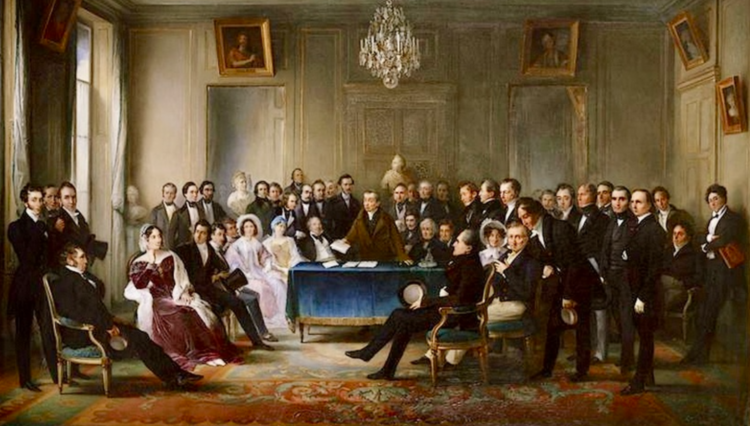
The featured image is “Andrieux faisant une lecture dans le foyer à la Comédie Française” (1847), by François-Joseph Heim, and is in the public domain, courtesy of Wikimedia Commons.