FOR years the climate change establishment has been desperately trying to convince the rest of us that global warming is making our weather worse. One by one, the scares have fallen by the wayside as the real world refused to co-operate – melting ice caps, famines, rising seas and so on. The only scare left now is the weather.
But the zealots faced one big obstacle. The historical data available provides no evidence of weather becoming more extreme. Hurricanes, floods, droughts, storms, wildfires – you name it, they are no worse now than in the past. Even the Intergovernmental Panel on Climate Change (IPCC), whose sole function is to find such evidence, has been forced to admit as much.
So the scientists who work for the climate change establishment decided simply to ignore the data and concoct their own. They called it ‘weather attribution’. They built a set of computer models based on present conditions and alongside this fabricated another model of an imaginary, counterfactual world, which tried to portray what the world’s climate would have looked like in pre-industrial times.
We know the saying ‘garbage in, garbage out’. Program the counterfactual model to assume that, for example, hurricanes were not as powerful in pre-industrial times, and Bob’s your uncle, you get the result you wanted.
Weather attribution has been slammed by independent scientists, such as Roger Pielke Jr, one of the world’s leading experts on extreme weather trends. He calls it ‘research performed explicitly to serve legal and political ends’, adding that the findings are not subject to peer review and are rushed out to garner news headlines.
One of the leading figures in the weather attribution industry, Friederike Otto, has even admitted it was set up to create a ‘defensible scientific basis in support of lawsuits against fossil fuel companies’.
Thus it is that every time there is a bit of bad weather somewhere in the world, within hours the media is full of headlines ‘proving’ that global warming is to blame.
Take the recent heatwave in California. A day later the BBC reported that ‘rapid analysis by scientists at the World Weather Attribution group on Friday found that intensity of heat would have been “virtually impossible” without human-caused climate change’.
Note the BBC present these claims as factual, not based on computer modelling.
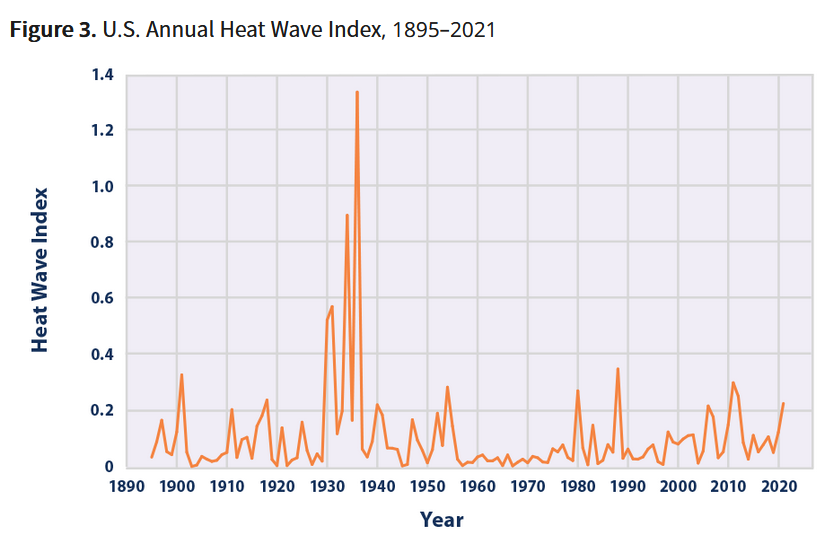
The BBC did not mention the fact that California has had similar March heatwaves in the past (the hottest was in 1879). Nor did they mention that the fact that official US agencies say that heatwaves in the country used to be far more severe:
The speed with which attribution claims hit the media proves that this is all a highly organised propaganda exercise, not science.
The idea that our weather is worse because of a tiny increase in temperatures is in any event absurd. What, I wonder, do these supposed experts reckon would be the perfect temperature of the earth? Their logic would suggest the Ice Age must have had perfect weather.
Now, for what I believe is the first time, a new scientific study has exposed the deceit and flaws lying behind the weather attribution industry, which is heavily funded by the Green Blob, including the Grantham Foundation and the European Climate Fund.
The Global Warming Policy Foundation, which has published this study, has issued a press release which reads:
***
London, 24 March: Extreme weather attribution studies are based on flawed logic and generate misleading headlines, according to a new briefing paper from The Global Warming Policy Foundation (GWPF).
In Contorted Science: The Flawed Logic of Extreme Event Attribution, Dr Ralph B Alexander argues that studies attempting to link specific heatwaves, hurricanes and floods to human-caused climate change are fundamentally misleading and have been created for legal and political, rather than scientific reasons.
The paper scrutinises recent high-profile studies by World Weather Attribution and the Grantham Institute. In 2025 alone, World Weather Attribution claimed that 24 of 29 extreme events examined were made more severe or more likely by climate change.
Alexander shows how such conclusions depend heavily on climate models that struggle to reproduce historical climate patterns and assume scientists can accurately simulate a ‘natural’ climate without human emissions.
Some key recurring weaknesses are identified within attribution studies:
· Flawed logic: attribution claims involve ‘begging the question’, the act of simply assuming the conclusion you are trying to investigate.
· Statistical practices that inflate headline probability claims while downplaying uncertainty.
· The neglect of historical records showing comparable extreme events long before modern emissions levels.
The report traces the growth of rapid event attribution to political frustration with the cautious conclusions of the Intergovernmental Panel on Climate Change (IPCC), which has expressed low confidence in long-term global trends for most types of extreme weather. It recognises the role of a 2012 meeting convened by the Union of Concerned Scientists. The meeting was aimed at strengthening the perceived link between extreme weather and climate change in order to pursue litigation against fossil fuel companies.
The report’s author, Ralph Alexander, said: ‘Extreme event attribution studies are a blot on science, the hallmarks of which are empirical evidence and logic. Neither feature is central to attribution studies, which were created for legal and political not scientific reasons.’
Harry Wilkinson, head of policy at The Global Warming Policy Foundation, said: ‘It is disturbing that event attribution studies have got so much traction in the international media, despite their underlying flaws. This is a major scientific scandal.
***
The study can be downloaded here.
One thing is certain, though – none of this will be reported by the BBC.