Irenaeus’s doctrine of divine pedagogy has definite application to the intellectual and spiritual life: it sets the tone for a lifestyle of quiet, patient growth in knowledge, through prayer and learning at the feet of the Lord.
“Behold, I make all things new.” (Revelation 21:5)
 St. Irenaeus of Lyons is one of the major Christian theologians from the second century after Christ. One commentator has gone as far as to call him the first great Christian theologian (not counting St. Paul, of course). He is often compared with his older contemporary St. Justin Martyr, sometimes known as “the first Christian philosopher.” But Justin and Irenaeus have a different approach. Whereas Justin—somewhat like Augustine and Thomas Aquinas in later eras—strove to reconcile Christianity with dominant philosophical models, Irenaeus is much more interested in expounding Christianity in terms of the biblical worldview. As such, Irenaeus is the perfect guide for people today who are seeking a faith that is evangelical, Christocentric, and catholic.
Irenaeus led the intellectual assault against Gnosticism, a powerful destabilizing force in early Christianity. His works did much to destroy Gnosticism’s credibility. So effective were Irenaeus’s polemics that most Gnostic literature disappeared (although the residue of Gnostic ideas unfortunately did not). In the 1940s, when a Gnostic library was uncovered in Egypt, scholars had the opportunity to see how fair Irenaeus’s characterizations were; Gnostic doctrine really was as extreme as he depicted. The path of the early church was anything but smooth, facing enemies without in the form of persecution and also enemies within in the form of heresy. Irenaeus was one of those who fought the good fight, enabling the authentic Christian faith to be passed down through the ages.
Further, Irenaeus led the way to establishing the canon of scripture and the idea of apostolic succession as a mark of the church’s authenticity. The fact that we recite “I believe in God, the Father Almighty, Creator of Heaven and Earth” in the Creed every Sunday is due in large part to Irenaeus’s conflicts with the Gnostics, who denied that the God of the New Testament was the same as God the Creator.
It wasn’t until the 17th century that the “Apostolic Church Fathers” were widely recognized as a distinct group, revered for their antiquity and closeness in time to Jesus and the apostles. Even St. Thomas More, when he wrote of the “early church fathers,” had in mind St. Jerome and St. Augustine, writers from a much later generation, not St. Irenaeus and his predecessors. Interest in and knowledge of the early Church Fathers has increased throughout the modern era, and Irenaeus has occupied a central place in that revival.
Irenaeus’s full stature was in fact only recognized in the 20th century. The second of his two major writings, Demonstration of Apostolic Preaching, was discovered as recently as 1904. Irenaeus’s stock has steadily risen since then, helped by boosts from contemporary voices like Bishop Robert Barron. Things came to a climax in 2022 when Irenaeus was finally declared a Doctor of the Church, by Pope Francis, with the additional title “Doctor of Unity” (in this light, it might not be coincidental that the Irenaeus’s name means “peaceful one”). Irenaeus currently stands as the only Doctor of the Church before St. Augustine. There could be no better time to begin immersing ourselves in this rich and profound early Christian thinker.
First, a bit of scene setting: Irenaeus was born roughly a century after Jesus’ death and resurrection. As he tells us in his memoirs, he was a student of St. Polycarp, who in turn was a student of St. John the Apostle. Thus, as Encyclopedia Britannica declares, “there were three generations between Jesus of Nazareth and Irenaeus of southern France.” That Irenaeus had this direct pedagogical lineage from the Lord gives immense credibility to the message he imparts, as we shall see. Irenaeus was not just an ivory-tower theologian, but a pastor actively engaged in the care of souls. He was also engaged with the thought and intellectual and spiritual conflicts of his day. According to tradition, he gave his life for the faith.
Irenaeus’s principal work is Against Heresies (Adversus Haerēsēs in the Latin version, translating a Greek original now mostly lost). Although the work was intended as an attack against Gnosticism, it transcends being merely a diatribe or, indeed, a work of apologetics. Irenaeus truly deserves his title of Doctor of the Church because he gives us a positive articulation of the faith that speaks to all times. His work is relevant, and not at all dated, because the intellectual trends he combated have remained with us. Nowhere is this truer than in the fifth and final book of the treatise, devoted to the themes of resurrection and redemption.
Irenaeus has been credited with bringing a more Eastern style of thought to the West. This shows in his more positive conception of human nature, sin, and the Fall than we might be used to from our Augustinian heritage. Irenaeus’s whole theological perspective is transformative: starting from the goodness of creation, he emphasizes God’s redemptive action on creation. Irenaeus distinguishes between humans’ being made in God’s image and being formed into his likeness—the latter being a gradual, soul-making process throughout life and throughout history. For Irenaeus, creation is not a finished product but an ongoing project. God is bringing his creation, including humanity, to perfection in his Son. That perfection will consist in a full sharing in the divine life in the midst of creation.
Creation is at the center of Irenaeus’ thought, and for Irenaeus creation was ordered for the sake of humankind. “Creation is tailored to meet human needs,” he declares; “the world was constructed for man, not man for the world” (5.29.1). All things are ordered to eschatology, the final goal for which God created the cosmos. St. Paul announces that at the end of time all things will be subjected to Christ, so that God will be “all in all” (or “everything to every one”) (1 Corinthians 15:28). For Irenaeus, this signals that all of creation will be restored and redeemed to be what God meant for it to be at the beginning. Irenaeus’s God is not the angry deity who condemns, but the loving creator who repairs what is broken and raises what is already good to greater heights.
For Irenaeus, God created in order to share his being and life. God created Adam not because he somehow needed company, but rather “to create a recipient for His generosity” (Against Heresies, 4:14:1). God’s completeness in himself means that he is not a competitor with human beings, a fact with enormous consequences. It leads, in fact, to Irenaeus’s most famous insight: “the glory of God is a living man” (or “a human being fully alive”). God’s glory is manifested in human flourishing. God’s glory does not diminish us; it makes us greater in turn.
God is known to us through his creation, not merely in the abstract. There is in St. Augustine’s thought a strongly Platonic notion that we must ascend through created things to a pure, unmediated vision of God, which is conceived as the final goal of life (the Beatific Vision). This idea of an ascent in which we leave material and created things behind is not found in Irenaeus. Rather, Irenaeus stresses that creation (including material creation) is itself raised up and perfected, and this is an ongoing process. Our traditional prayers and spirituality often reflect a suspicion of the senses as powers that can obscure our vision of God. For Irenaeus, everything has the capacity to reveal God, but the fulfillment of this reality is yet in the future. As the Irenaean scholar Gerald Hiestand comments: “a day is coming when the Son of God will be revealed, and then all of creation, man especially, will not only not obscure the glory of God, but will fully reveal it.”
Hiestand continues, contrasting the Irenaean view with the Platonic ascent that was so important to Augustine: “Creation is not a ladder to be climbed and then kicked away once one has reached the beatific top. Rather, the logic of the incarnation compels us to understand that creation itself is the eternal and necessary means by which God reveals the fullness of Himself to His creatures.”
Some theologians see a tension between the idea of creation’s renewal in eternity and the doctrine of the beatific vision. There is a fear of “instrumentalizing God,” as if God were merely a means to enjoy his creation. First, it’s worth pointing out that the Thomistic tradition makes allowance for the enjoyment of creation in the future age. It teaches that the joys of the future age will consist “essentially in the immediate vision and love of God, and secondarily in the knowledge, love, and enjoyment of creatures” (John A. Hardon, Catholic Dictionary). If creation is going to be preserved for eternity, then we will certainly be interacting with it. Yes, as Irenaeus affirms, “the life of man consists in beholding God.” But the life of the future kingdom cannot consist entirely of an absolute, unmediated vision of God. Rather, God will continue to refract his love and grace through the created world.
It’s worth bearing in mind that worship, biblically speaking, does not denote simply an unending liturgy but includes man’s vocation to reflect God’s image in creation. There is no reason to suppose that this is going to stop in the future age. Quite to the contrary, it will begin all over again, as humanity finally fulfils the commission it received in Eden, and concerning which it so badly missed the mark through the ages. The redemption will consist not in a rejection of creation, but its ultimate fulfillment.
Irenaeus thus resolves the tension between a “beatific vision” account of the future life and one that emphasizes creation. Creation itself will be made to reveal God to the highest degree! Irenaeus argues that “seeing God” (the beatific vision) is not static but active and effective: “Just as those in the light share its brilliance, those who see God are in God and share His splendor, which gives life […] Humans will see God to live, becoming immortal through that vision” (4.20.5–6).
Irenaeus’s thought is organic, holistic, integrated. For him, ends are closely connected with beginnings, and the Old Testament with the New. For Irenaeus the concepts of creation and redemption are closely intertwined with the incarnation, by which the Son took on human flesh. The Son assumed human nature so as to raise humanity to God. Divinity and humanity were conjoined in him, foreshadowing the eventual conjunction of heaven and earth in the future age. In that glorious age, learning will come to a climax as we go straight to the Source to learn all truth, “engaging in fresh and unending dialogue with God” (5.36.1).
The idea that God is bringing his creation to gradual perfection through time has a bearing on salvation history and our knowledge of truth. This is known as Irenaeus’s theory of divine pedagogy. God is a teacher who is bringing us, his students, to more perfect knowledge at the pace that is right for us. As Irenaeus eloquently puts it, “He designed time and temporal existence so that humanity could grow into spiritual maturity and eventually yield the harvest of immortality” (4.5.1). And Irenaeus ties God’s pedagogy to creation and new creation: “Since you are His work of art, you must patiently await the hand of the Artist who makes all things in their proper season—specifically, the season of your own development” (4.39.2).
Accordingly, the Fall of Man is not quite the dire catastrophe for Irenaeus that it is for other theologians. Adam and Eve’s discovery of the difference between good and evil was, instead, a sort of necessary growing pain that went along with becoming responsible and mature human beings. Irenaeus, let me emphasize, had a direct historical connection with Jesus and lived a century and a half before St. Augustine.
In Irenaeus’s system, the ideas of gradual divine pedagogy and cosmic redemption connect up with another key idea, that the Messiah Jesus sums up all of human history and experience. This is Irenaeus’s signal idea, his concept of recapitulation (in romanized Greek, anakephalaiosis; in Latin, recapitulātiō).
Irenaeus took a cue from the Letter to the Ephesians, where St. Paul speaks of God’s plan to “unite all things in [Christ], things on heaven and things on earth” (Eph 1:10). Anakephalaiosis literally means “to give a new head.” Jesus became the new head of humanity, the one who gives us a new identity as children of God. Jesus undid the sin of Adam, just as his mother Mary undid the sin of Eve. These classic theological ideas find their origin Irenaeus, the man who knew the man who knew the man who rested his head against Jesus’ breast.
In the fifth and final book of Against Heresies, Irenaeus puts paid to the Platonic eschatology, still very much with us, which dreams of “going to heaven” as the final goal of the good life. The bishop of Lyons was perfectly familiar with such philosophical visions of escape from the earthly realm, and he will have none of it. He gives us instead a robust treatment of the future world from the perspective of the resurrection of the body. The blessed dead are in safekeeping with God, in anticipation of the final day when they will be raised up with new and glorified bodies, now fully matured into God’s likeness.
Irenaeus’s insistence that the body is included in salvation is also rooted in his anthropology. For Irenaeus, a human being consists of three components: body, soul, and spirit. A human being is not merely a body, not merely a soul, not merely a spirit. It is all three, and therefore all three must be saved. This relates to his larger point that God does not leave any aspect of his creation unredeemed.
True, at present created things can become the occasion for idolatrous attachment; that is part of humanity’s fallen nature. But we have an altogether too limited view of God’s power. We often forget that he can transform material reality (just look at the Eucharist, which for St. Irenaeus is nothing less than a presage of the resurrection). And he can transform our minds and attitudes, so that we no longer treat created things as idols but as the truly are, reflections of God’s glory and wisdom and power.
As someone engaged in the creative life on a daily basis, I find Irenaeus’s view of creational redemption immensely satisfying. But I also find it more plausible and consonant with revealed truth. Irenaeus’s theology has great vocational relevance, inviting us to live our lives in fulfillment of God’s plan to make his image manifest in all creation. Sin is nothing other than hamartia, missing the mark of our vocation to reflect the divine image. God’s purifying forgiveness sets us on the right path again so that we may resume our project of divinization, or being remade into God’s likeness.
Irenaeus’s doctrine of divine pedagogy has definite application to the intellectual and spiritual life: it sets the tone for a lifestyle of quiet, patient growth in knowledge, through prayer and learning at the feet of the Lord. All too often our popular theology has tended to make salvation all about postmortem fate (where I go after I die). When this happens, we lose sight of the idea of God as an active and transformative force in the present, steadily building his kingdom in our midst with our participation. Irenaeus’s thought is deeply biblical, and to my taste less “mechanistic” and more humane than many other accounts of salvation, the Fall, and the atonement found in the theological tradition.
Yet Irenaeus’s theology of cosmic redemption does not seem to have found a permanent home in mainstream Christian consciousness in the West, where visions of God’s future are dominated either (on a popular level) by Victorian sentimentality about floating around on heavenly clouds, or (at a higher level) by a pure, unmediated beatific vision taking place in an immaterial void. The biblical vision of new creation is all too often missing from our minds. On the contrary, the idea that God will destroy the world is often assumed, even among orthodox believers.
But could it be that these ideas are nothing but remote echoes of the Gnosticism that Irenaeus fought against? And, on the other hand, could it be that Irenaeus’s life-affirming ideas about cosmic redemption are buried deep within the stream of Christian thought, waiting to surface at a good time?
In some cases, the early Fathers give us access to traditions about Jesus not recorded in the scriptural canon. Toward the end of Against Heresies, to enhance the credibility of his theory of a redeemed creation, Irenaeus relays a tradition purportedly from Jesus himself, predicting the prodigious size of grapevines in the new kingdom. Here is what Irenaeus says:
In that era, the righteous will reign, and a liberated creation will produce food with supernatural abundance. The elders who knew John, the Lord’s disciple, relayed that Jesus taught about those days, describing vines with ten thousand branches, each branch with ten thousand twigs, and so on, down to grapes that yield massive quantities of wine […] Papias, a listener of John and associate of Polycarp, recorded these traditions in the fourth book of his five-volume work, testifying to their credibility among believers. He noted that the traitor Judas’ skepticism regarding such productivity was met with the Lord’s reply: “Those who come to that age will see it.” (5.33.3–4)
Bear in mind that this man, Irenaeus, stands in a direct line of pedagogical descent from Jesus Christ. You cannot get much more authentic than that. Should we assume that Irenaeus knows whereof he speaks? I leave this question to you.
__________
The Imaginative Conservative applies the principle of appreciation to the discussion of culture and politics—we approach dialogue with magnanimity rather than with mere civility. Will you help us remain a refreshing oasis in the increasingly contentious arena of modern discourse? Please consider donating now.
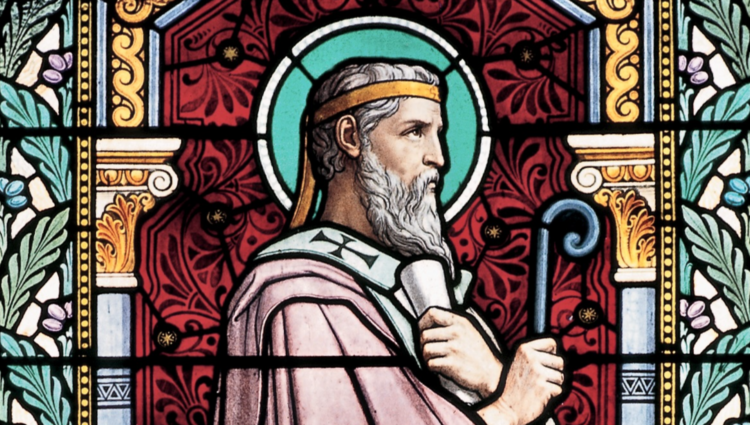
The featured image is Irenaus, in Church of St Irenaeus, Lyon, Francecourtesy of Wikimedia Commons.