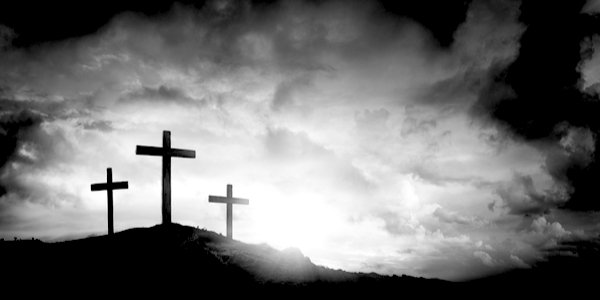
IT ALL happens in one week. On Palm Sunday Jesus enters Jerusalem on a donkey. He throws the crooks and wheeler-dealers out of the temple. He has his Last Supper with his followers and institutes the Holy Communion. He is betrayed, arrested, given a show trial, tortured and put to death. On the following Sunday, he rises from the dead.
And so the Sunday after these momentous events we settle into the routine of the Christian year. Is it a bit of a let-down? Today, as every Sunday, the Prayer Book calls me to repentance. Assuming that I answer this call to penitence – albeit in a weak and inadequate way – what happens next? Usually nothing much. Nothing spectacular, anyway. But I keep telling myself that I must not be always going in search of excitements and emotional shocks.
Samuel Johnson used to confess after attending church every Good Friday: ‘O God, since last year I have made no amendment, no improvement.’
My Christianity doesn’t make me into a good person. Those who think of themselves in that way are the people Jesus condemned as whited sepulchres and hypocrites, and told us to take no notice of them. I don’t suddenly, or even slowly, start to feel good, but I do begin to feel the necessity of trying to listen to God. A friend once said to Evelyn Waugh: ‘You know, Evelyn, you’re an utter bastard!’ And he replied, ‘Yes, but think how much bigger a bastard I’d be if I were not a Christian.’
Attendance at the Holy Communion is of the nature of a duty and an obligation. Christ commanded: ‘Do this in remembrance of me.’
We don’t have to be commanded to do that which we enjoy doing.
The life of faith is not about my feelings.
I keep returning to what C H Sisson said when he began regular attendance at church: ‘It was like giving myself up to the police.’
Very like it. For a man gives himself up to the police when he knows he has done something wrong. God’s revelation to us that we are in the wrong is a blessing and a gift, for by it we are taught the truth about ourselves.
Regular attendance is necessary. Repetition is the soul of devotion.
You won’t automatically be given a spiritual high. Church is routine. As the French writer Georges Bernanos said: ‘You have to get used to being mildly bored.’
In our routine attendance at the Holy Communion, we receive the Blessed Sacrament. This event is not a moral lecture. It is not theoretical. It is practical. It goes far beyond thought and ideas. It is a medicine and it can be trusted to do its work.
That is the work of making us habituated to faith. You will start to be sanctified, but the essence of your sanctification is that you won’t notice it.
You certainly won’t start to become a better person. If I’m good already, I don’t need Christ to save me from my sins. For, as William Blake said, ‘If moral virtue was Christianity, Christ’s pretensions were all vanity.’
The life of faith is the gradual reversal of the Cartesian principle. I think, therefore I am. The being of God must become more certain to me than my own existence.
Since the Enlightenment, what passes for theology is only foolish speculation in which we construct arguments for the existence of God. At times we find these quite convincing, but at other times not.
As a philosopher and a pretentious swine, I’m particularly susceptible to this sort of arrogance. I must, as my mother would say, Stop it off!
God does not change. In him there is no variableness or shadow of turning. It is my faith that is intermittent and weak.
The foolishness of speculative theology: what would it mean if my existence were more certain than God’s!
This does not mean that faith is anti-intellectual, only that the crucial work of the intellect is to recognise the primacy of God’s existence. All theology flows from this admission, this submission.
Kierkegaard told us what this would cost us: ‘It is one thing to stand on one leg and prove the existence of God, and quite another thing to go down on one’s knees and thank him.’
What it chiefly costs you is your pride and that poisonous thing we’re all supposed to have by the bucketful, self-esteem. Myself is the last person I should esteem.
As you try to persist in the life of faith, you are not likely to start to feel closer to God. In fact you are very likely to feel that God is further away or even absent altogether. It doesn’t matter what you feel. You have, by your act of repentance, reversed the Cartesian principle. It is not a case of ‘I think, therefore I am’ but of ‘I am because God is.’
When Jesus, in his great sacrifice, was closest to God, he cried out: ‘My God, My God, why hast thou forsaken me?’
The speculative theologian is like a fish that swims around and all the while doubts the existence of the water.
Whereas God is our element. God is the one in whom we live, move and have our being.
To acknowledge the primacy of the existence of God is also to begin to understand what manner of person I am, my true nature and character.
Our love for God – such as it is – is not some soppy thing, funny feelings in the tummy. It is trying to do as God says: ‘If a man love me, he will keep my commandments.’
Though of course we don’t keep ’em! But it doesn’t matter. God is what matters. As Tom Eliot said: ‘Ours is only the trying; the rest is not our business.’
Just stick at it then. That is the life of faith: sticking at it on this so-called Low Sunday and for the rest of the year.
You can’t do this all by yourself like a solitary sage. You need to be among others who are also sticking at it, same as you. That is what the church is for. Ezra Pound said: ‘I am homesick after mine own kind.’
However unlikely it looks from here, these other stickers-at-it are my own kind.
The church is the Body of Christ – that is to say, the church is what makes God visible.
Stick around . . .