Image Credit: TN General Assembly
The Tennessee Conservative [By Olivia Lupia] –
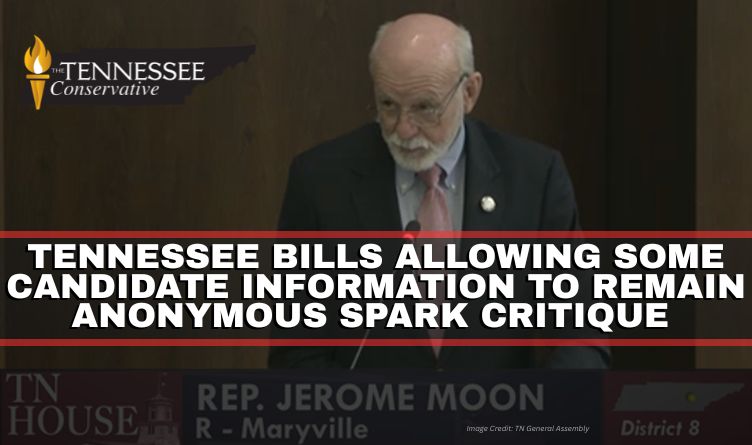
Two bills making their way through the Tennessee legislature would allow applicants for director-level positions in city and county governments to remain anonymous during the hiring process and permit the addresses of certain candidates seeking election to be confidential, drawing criticism from advocates for transparency and openness in government.

The first bill, HB2616 by Rep. Jerome Moon (R-Maryville-District 8), would allow a governing body to conduct an executive session “for the purpose of interviewing applicants for employment as director-level staff of the body,” which would encompass positions which are filled by a mayor or vote of the governing body and has authority over the operation and employees of a department, agency, or division of a governmental agency.
Per the legislation, the body does not have to notify the public of the executive session, though deliberation or the actual hiring decision cannot be made in the session. Any discussion amongst members and the official vote “must be done in an open, publicly noticed meeting.” But should an applicant request, the body must treat their application materials as confidential, therefore making them not open to public inspection.
The records of the individual ultimately selected for the position would become publicly available through a records request, but all other candidates’ information would remain confidential at their request, a provision which has brought pushback from open government advocacy groups, including the Tennessee Coalition for Open Government (TCOG), who say the bill will take away transparency from these positions.
“We think that there should be a fair and transparent process in the selection of those very highly influential positions,” TGOC Executive Director Deborah Fisher said. “Let’s say they’ve interviewed two candidates even, and they come out into a public meeting, and then they’re supposed to debate and discuss who to select and say, this person’s really good and this person is really good and they have this experience, but they won’t even be able to say their names in the public meeting until after they vote.”
The bill was reportedly initially brought by the City of Nashville which claimed candidates for certain positions were afraid of applying due to worry over losing their current jobs, but Fisher believes the bill would be less impactful in Nashville than in communities outside the city.
“I don’t know for sure, but I do agree that, in smaller communities, they do tend to be, you know, more interested because these are major positions in their community. I’ll put it this way, when I get calls from people about, ‘oh, was there an open meetings violation’ or they want to know something about their superintendent or whatever it usually is from somewhere other than Nashville” she said.
After passing the House State & Local Government Committee 9-6 with several Republicans voting against or marking themselves “Present Not Voting”, HB2626 is set for a floor vote on Tuesday, April 14. The Senate companion, SB2162 carried by Sen. Richard Briggs, passed the Senate State and Local Government 6-2 with two Republicans voting “No” and is awaiting a calendar date for a full floor vote.
Another bill, HB1659 also by Rep. Moon, would keep addresses on a nominating petition confidential and not open to public inspection for candidates to the office of judge, chancellor, district attorney general, and public defender.
The only exception to the confidentiality would be if another candidate or law enforcement authority requests the address to verify the candidate lives in the district of the position for which they are running or “in anticipation of or as part of a contest of candidacy or contest of election.”
This second piece of legislation appears to be far less controversial, likely as it only pertains to some personal addresses no longer becoming public knowledge on election petitions.
HB1659 passed the House State & Local Government Committee 15-2 with bipartisan support and is scheduled for a full floor vote on Tuesday, April 14. Companion bill SB1720 has already passed the Senate 32-0, with only Sen. Joey Hensley marking himself “Present Not Voting”.
If you have thoughts on either piece of legislation mentioned above, use this tool to find contact information for your Representative or Senator.
HB2616/SB2162- allows director-level candidates to remain anonymous- will receive full House vote April 14 & Senate vote soon
HB1659- keeps addresses for certain candidates confidential- will receive full House vote on April 14.


About the Author: Olivia Lupia is a political refugee from Colorado who now calls Tennessee home. A proud follower of Christ, she views all political happenings through a Biblical lens and aims to utilize her knowledge and experience to educate and equip others. Olivia is an outspoken conservative who has run for local office, managed campaigns, and been highly involved with state & local GOPs, state legislatures, and other grassroots organizations and movements. Olivia can be reached at olivia@tennesseeconservativenews.com.