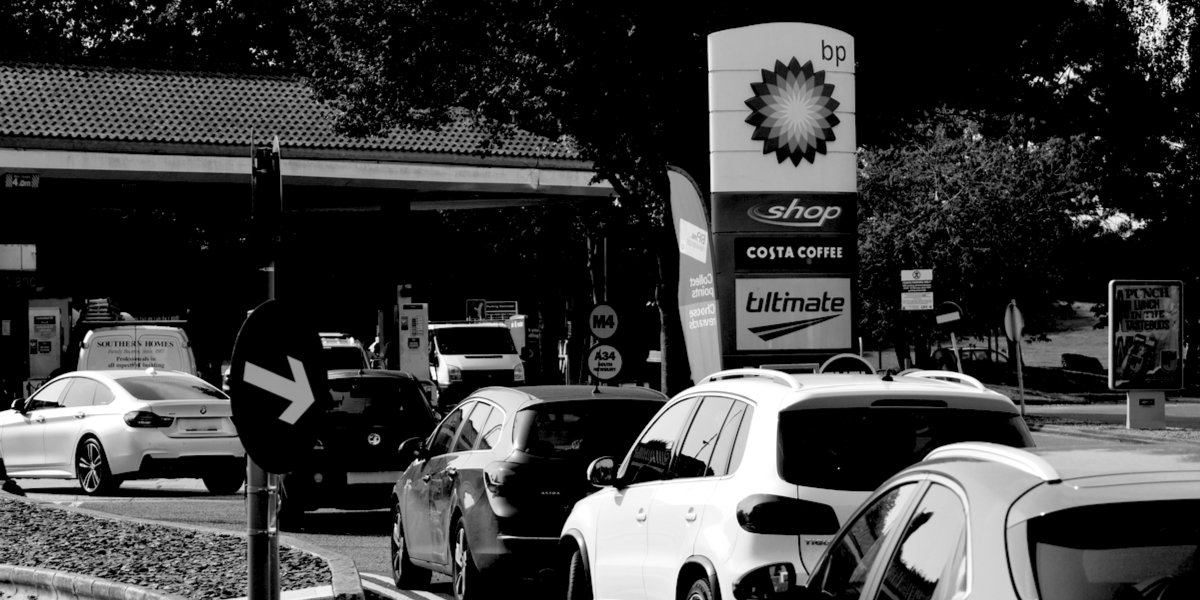
I WAS waiting in a queue at my local supermarket petrol station when a question suddenly came into my head: what is the Government making out of the people in the queue like me and the sudden dramatic inflation of fuel prices we are all facing?
As soon as I had filled up, I parked in the supermarket car park and started a quick search on the internet to establish some facts. In general I don’t trust Google 100 per cent but for this purpose, I thought, it would do.
I asked it a few simple questions:
How many litres of road fuel are sold in the UK each day (split into petrol and diesel)?
How much has the price per litre increased over the last two months (again split into petrol and diesel)?
What percentage of the fuel price is tax?
Here’s what I found — and this is just for the UK, focusing only on the recent price increases (feel free to check the maths).
According to Google and sources (TaxPayers’ Alliance, RAC and government-published figures) about 120million litres of road fuel are sold daily in the UK. That breaks down to 46million litres of petrol and 74million litres of diesel.
Annual consumption exceeds 45billion litres, with diesel making up the larger share (though petrol usage has recently risen).
As of this April (give or take a penny or two), fuel tax (fuel duty plus VAT) makes up roughly 54-57 per cent of the pump price.
Take into account the recent price changes (since late February 2026). Petrol is up 25p per litre (19 per cent increase, now 158p) and diesel is up 47–49p per litre (34 per cent increase, now 191p).
The calculation:
Petrol:
46,000,000 litres × £0.25 increase = £11,500,000 per day
× 7 days = £80,500,000 per week
Diesel:
74,000,000 litres × £0.48 increase (taking mid range) = £35,520,000 per day
× 7 days = £248,640,000 per week
Combined impact:
Total additional weekly revenue from price increases: £329,140,000
Estimated tax portion (57 per cent): £187,609,800 per week
Conclusion:
That’s roughly £190million per week in additional tax revenue, purely from recent fuel price increases — on top of existing fuel tax already being collected.
All of this comes directly from UK motorists.
A significant upward transfer of wealth to the government . . . a zero opportunity cost for them, you could say. Not bad, eh?
Never miss an opportunity!
It’s been hard to write this without resorting to profanity.
A version of this article appeared in Johnny Dollar’s substack on April 13, 2026, and is republished by kind permission.
Editor’s note: In a separate communication with Howard Cox, founder of Fair Fuel UK, he told me:
‘Over 60 countries are already helping drivers. These nations have reduced or suspended fuel taxes, excise duties, VAT, or equivalent levies in response to oil price spikes. Reeves is wallowing in an extra £200m windfall of VAT since the Middle East Crisis erupted seven weeks ago. The crisis has cost drivers an extra £1.3 billion to fill up. She must now show some fiscal backbone; she must cut fuel duty now, remove the dishonest double taxation from fuel duty itself, and reassure business, consumers and markets that this regressive tax will be frozen for the lifetime of this parliament.’