Bill gives attorney general authority to investigate and request a replacement for elected district attorney general.
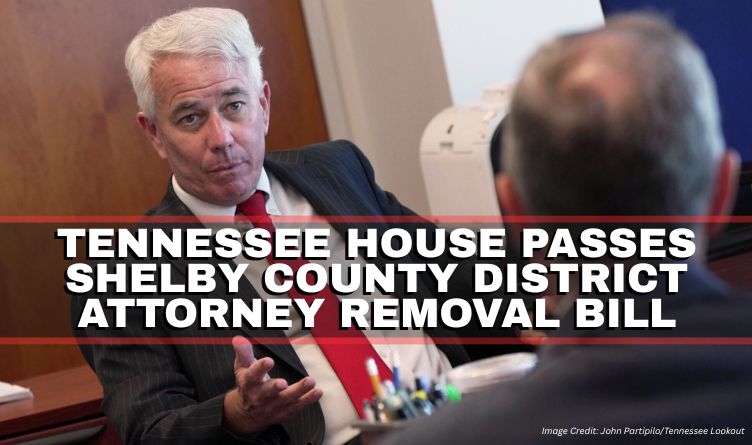
Image: Democrat Shelby County District Attorney Stephen Mulroy Image Credit: John Partipilo/Tennessee Lookout
***Note from The Tennessee Conservative – this article posted here for informational purposes only.
By Sam Stockard [Tennessee Lookout -CC BY-NC-ND 4.0] –
The Tennessee House passed legislation Wednesday giving the state attorney general power to audit and seek removal of the Shelby County district attorney for refusing to prosecute crimes.
The Republican-controlled House voted 71-23, along party lines, to target the district attorney general in the 30th Judicial District, in this case DA Steve Mulroy, with House Bill 483.
Under the amended measure, the attorney general would be able to ask the Tennessee Supreme Court to appoint a replacement if an audit finds “clear evidence” the district attorney declined to prosecute criminal offenses “based on an unjustifiable and unconstitutional standard, without regard to facts or circumstances, or taken other action that constitutes a failure or refusal to prosecute.”
The Senate is set Thursday to take up its version of the bill, sponsored by Republican Sen. Brent Taylor, a vocal critic of Mulroy, a Democrat.

Democrat Rep. Torrey Harris of Memphis questioned the constitutionality of the bill during debate, leading Republican Rep. Andrew Farmer (the bill’s House sponsor) to say he would meet with him later to discuss the matter.
“He knew saying it on the record that it is not a constitutional piece of legislation probably would have hurt them in court later on,” Harris said.
During Wednesday’s debate, Harris read the state law limiting the legislature’s ability to pass laws affecting only one county, without its approval.
Farmer said he believes the bill is constitutional and defended the measure Wednesday by using figures showing that out of 514 felony cases, the Shelby County district attorney dismissed 144, gave suspended sentences on 178 and got convictions and jail time on only 84. He had no details on the types of offenses involved in those statistics.
“You can’t just turn a blind eye to the law,” Farmer said after the vote.
The legislation gives the state attorney general authority to review the way the district attorney handles every case, including plea agreements, convictions, sentences, dismissals and another decision not to prosecute.
Lawmakers also are pushing legislation that requires the Shelby County District Attorney’s Office to report the disposition of every case involving arrests made by the Memphis Safe Task Force. Mulroy has called that an unnecessary bureaucratic move that will force him to shift resources to deal with the report instead of criminal prosecutions and working with victims.
The state already has a method for removing district attorneys from office for misconduct, either through ouster lawsuits or by the legislature. The state Board of Professional Responsibility also can investigate a district attorney and seek disbarment or a suspension of their license.
This measure, though, would specifically target the Shelby County district attorney, possibly violating the state’s Home Rule Amendment, which prohibits the legislature from passing laws that affect one county without its approval.
Farmer, though, said the legislature wants Memphis to continue to see a lower crime rate stemming from the task force’s arrests.
“I see this as an encouragement bill, encouraging the 30th Judicial District district attorney to do the right thing,” Farmer said.
Mulroy issued a statement this week criticizing the measure: “The bill targets Shelby County only for unprecedented, intrusive oversight of a locally elected DA by an unelected attorney general, without providing any basis for treating Shelby County differently. It singles out federal task force cases for special treatment, even though Tennessee law provides no basis for treating those cases any differently than the many cases brought independently by local law enforcement. The provision allowing the attorney general to seek a temporary replacement of a DA largely repeats language already in Tennessee law and is therefore unnecessary; to the extent it goes further, it is likely unconstitutional.”
Mulroy added, “Other than that, it’s great.”
The bill’s financial analysis says the cost would be “insignificant.” Harris questioned that report, since staff in the district attorney’s office would have to deal with a state audit.