As a theory of history, progressivism always believes in conflict and violence and antagonism. Progressivism, then, not surprisingly, is wrapped up in bigotry, racism, and violence.
 “Progress! Did you ever reflect that that word is almost a new one?” asked an enraptured Woodrow Wilson in 1913. “No words come more often or more naturally to the lips of modern man, as if the thing it stands for were almost synonymous with life itself, and yet men through many thousand years never talked or thought of progress.” Instead, Wilson claims, they thought only of the past as a golden era, a time in which morality and technology were superior. “Now all that has altered,” Wilson believes. “We think of the future, not the past, as the more glorious time in comparison with which the present is nothing.”
To be certain, the idea of progress and progressivism had been visited upon American civilization repeatedly, first in the time period, 1890-1920, and then again in the more recent Bush-Obama era. To even begin our discussion of progressivism, though, we must note—rather critically—that progressivism is a theory of history, not a political statement. Many today who claim the mantle of progressive are, to be sure, on the political left. But, being a Leftist and being a Progressive is not an absolute. Karl Marx was a progressive, but so was Frederick Jackson Turner. Barack Obama is a progressive, but so is George W. Bush.
Again, progressivism is, first and foremost, a theory of history. Originating in the Germanic thought of Fichte and Hegel, progressivism posits two forces in intense conflict in history. First, there is the Thesis, what a high school debater might call the “status quo.” It encompasses much of existence, the culture, the economy, the state, the educational system, the religious institutions, etc. But, it is always opposed by the Antithesis which resents the control of the status quo and the powers that be. In its struggle, though, with the Thesis, neither can dominate over the other. Instead, when the two forces—the Thesis and the Antithesis fight—they inevitably form a third thing, the Synthesis. Yet, this Synthesis very quickly becomes the new Thesis, only to find itself in opposition again to an Antithesis. This, simply put, for the progressive, is the sum of history. ThesisAntithesis=>Synthesis. And, start all over again. Repeat and repeat and repeat. For some progressives, there is an end to this cycle. Again, it can be a Karl Marx on the Left or a Francis Fukiyama on the Right, but each believes in an end to history. This does not mean that time actually stops. Time keeps going, but history itself ends. For Marx, it ends in a communist utopia. For Fukiyama, it ends in a world of democracies.
In the American experience, the most important progressives were Teddy Roosevelt, Woodrow Wilson, E.A. Ross, John Wesley Powell, and Albert Beveridge. Critically, Roosevelt claimed there could be no real progress in government until democracy found its voice in the executive power, the presidency. This of course, is in complete opposition to James Madison who said in a republic, it is the legislature which is to predominate.
Let’s quickly return to Woodrow Wilson and his New Freedom of 1913. He offers the very best definition and analysis of progressivism possible and is worth quoting at some length.
The makers of our Federal Constitution read Montesquieu with true scientific enthusiasm. They were scientists in their way,—the best way of their age,—those fathers of the nation. Jefferson wrote of “the laws of Nature,”—and then by way of afterthought,—“and of Nature’s God.” And they constructed a government as they would have constructed an orrery,—to display the laws of nature. Politics in their thought was a variety of mechanics. The Constitution was founded on the law of gravitation. The government was to exist and move by virtue of the efficacy of “checks and balances.”
The trouble with the theory is that government is not a machine, but a living thing. It falls, not under the theory of the universe, but under the theory of organic life. It is accountable to Darwin, not to Newton. It is modified by its environment, necessitated by its tasks, shaped to its functions by the sheer pressure of life. No living thing can have its organs offset against each other, as checks, and live. On the contrary, its life is dependent upon their quick co-operation, their ready response to the commands of instinct or intelligence, their amicable community of purpose. Government is not a body of blind forces; it is a body of men, with highly differentiated functions, no doubt, in our modern day, of specialization, with a common task and purpose. Their co-operation is indispensable, their warfare fatal. There can be no successful government without the intimate, instinctive co-ordination of the organs of life and action. This is not theory, but fact, and displays its force as fact, whatever theories may be thrown across its track. Living political constitutions must be Darwinian in structure and in practice. Society is a living organism and must obey the laws of life, not of mechanics; it must develop.
All that progressives ask or desire is permission—in an era when “development,” “evolution,” is the scientific word—to interpret the Constitution according to the Darwinian principle; all they ask is recognition of the fact that a nation is a living thing and not a machine….
There are several serious problems with Wilson’s claims. First, the founders were historians and political theorists, not scientists. Second, the founders rarely acknowledged a Newtonian universe and only once—by John Dickinson, the most conservative member of the founding—compared the proposed Constitution with the Solar System. Third, the founders never thought of the founding or the constitution or the government as a machine. As with the Romans, they believed the republic to be a reflection of the organic and, specifically, the three parts of man (his mind—the executive; his soul and heart—the aristocracy; and his stomach and pro-creative regions—the democracy). Their organic, though, was ancient, not Darwinian and evolutionary. Fourth, most importantly, if we actually interpret the Founding according to Darwinian principles, we can dismiss the past as something through which we had to overcome and evolve.
Compare this with the truly right and righteous understanding of Calvin Coolidge, arguably the most anti-progressive president in American history:
About the Declaration there is a finality that is exceedingly restful. It is often asserted that the world has made a great deal of progress since 1776, that we have had new thoughts and new experiences which have given us a great advance over the people of that day, and that we may therefore very well discard their conclusions for something more modern. But that reasoning can not be applied to this great charter. If all men are created equal, that is final. If they are endowed with inalienable rights, that is final. If governments derive their just powers from the consent of the governed, that is final. No advance, no progress can be made beyond these propositions. If anyone wishes to deny their truth or their soundness, the only direction in which he can proceed historically is not forward, but backward toward the time when there was no equality, no rights of the individual, no rule of the people. Those who wish to proceed in that direction can not lay claim to progress. They are reactionary. Their ideas are not more modern, but more ancient, than those of the Revolutionary fathers.
On this, Wilson is dead wrong, and Coolidge is absolutely right.
As a theory of history, progressivism always believes in conflict and violence and antagonism. Progressivism, then, not surprisingly, is wrapped up in bigotry, racism, and violence.
This is contrary to a republican or Christian believe of history which sees history not only as the vehicle (but not manifestation) of God’s providence and the human working out of charity and love. History is not made by sweeping forces, but rather by individual and familial and societal acts of self-sacrifice. Most of history, as such, remains hidden as it is done quietly and without artifice or pretense. Yes, Napoleon makes history, but so does every kind deed ever performed by every mother who ever lived.
_________
The Imaginative Conservative applies the principle of appreciation to the discussion of culture and politics—we approach dialogue with magnanimity rather than with mere civility. Will you help us remain a refreshing oasis in the increasingly contentious arena of modern discourse? Please consider donating now.
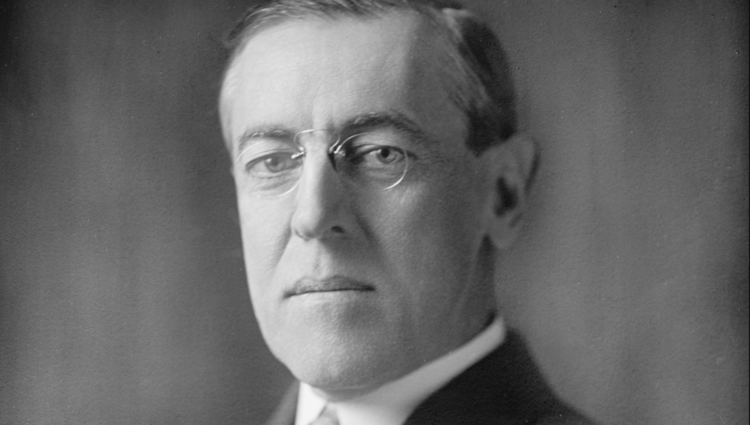
The featured image is 1914 portrait photograph of Woodrow Wilson by Harris & Ewing, and is in the public domain, courtesy of Wikimedia Commons.